Categories
Old

Things 53: Sita Sings the Blues, FFFFound Quotes

(Originally sent July 2009)

A slightly different format for Things this week, as I have two things to heavily recommend and also realised I had gathered a nice set of quotes from ffffound.

Event
The Hide&Seek pervasive games festival takes place from Friday 31st July to Sunday 2nd August [2009] in and around the Royal Festival Hall, and is free. See the games they plan to run across the three days here.

I definitely plan to attend, so let me know if you are interested. It’s like a more polished version of the Sandpit event that I went to a few weeks ago. To get an idea of what it’s like, see my blog post.

[Do note that this is a re-posted blog version of an old email. At the time of posting, the next Hide&Seek Sandpit event will happen on Thursday 4th August 2011 – T.M. 24/07/11]

Films
I saw Evil Dead 2, which like Evil Dead is less like a horror film and more like a nightmare you have after watching a horror film.

I saw Coraline, which was very beautifully made, but somehow not quite as neat and satisfying as the novel.

I saw Tokyo, which was a collection of 3 very strange short films about Tokyo, and is the kind of thing I would like to see a lot more of even though I only really liked two of them.

But more importantly, I saw Sita Sings the Blues, a feature-length animation by Nina Paley, which is a) good and b) free to download.

It covers a certain episode from the Hindu epic Ramayana, uses a range of animation styles, some songs from the 1920s, and includes debate between storytellers about different versions of the story, which I particularly liked. You can see some of this in the trailer:

Different ways to watch it can be found here, including just watching it on YouTube:

The story of how the film interacts with copyright law is also interesting.

Quotes
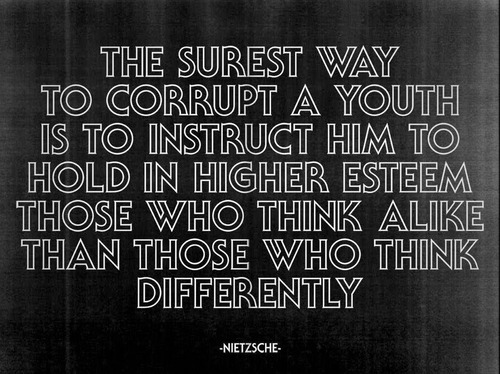
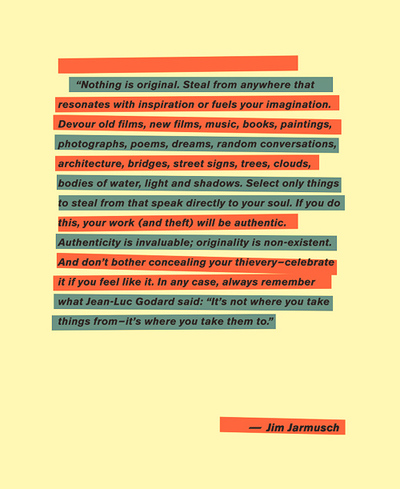
FFFFound!” is an invitation-only site where select graphic design types post up images they like (warning: NSFW about 5% of the time). Sometimes the images simply depict a quote. Here’s some of my favourites, alongside some other quotes:

1) “If you can’t explain it simply, you don’t understand it well enough.” – Einstein

2)
3)

I think the fact that the source of this quote is unknown strengthens it. As soon as you attach a name to it, the question of that person’s own mortality suddenly clouds the quote’s otherwise clear, zen-like nature.

4) (Actually this one is not from ffffound, or particularly a quote). In a discussion about the technological singularity (advances in technology accelerate, we invent self-improving AI which improves itself at an accelerated rate, until a day comes in which so many advances are made it is impossible to predict what might happen after), Vernor Vinge suggested that the super AI would not consider humans to be worthless and wipe us out, since it should see us as a useful backup.

When Steward Brand of the Long Now asked how long a dangerous intermediary period might be during which AI’s would be “smart enough to exterminate us but not yet wise enough to keep us around”, Vinge answered:

About 4 hours.

So watch out for that.

5)
6) Georges Perec:
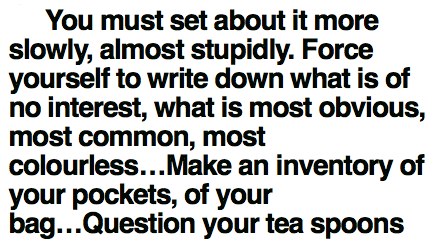

For the full quote go here. [You may notice that many questions/puzzles that appear on Things are in this spirit. – T.M. 24/7/11]

Last week’s puzzle – CC list issues
Given the lack of response on this issue and no fully satisfactory solution being evident, I’m going to go with the least bad solution as I see it: one CC list for people at RAPP, one for everyone else. We’ll see how that goes.
Categories
Old

Things 52: Pug Baroo, Location Based Services, Argument Visualisation

(Originally sent June 2009)

Last week, Things was once again postponed due to time pressures burning my midnight oil candles at both ends. However, now that both my IDM evening course and my PhD are over, I theoretically have more time, and I’ve also made progress with my answer to the puzzle from Things 46 on how to get things done at sub-weekly intervals (see puzzles section below), so future updates may return to regularity.

Films
I finally caught Synecdoche, New York. Imagine Charlie Kaufman (Being John Malkovich, Eternal Sunshine of the Spotless Mind) doing a ‘Memento Mori‘ piece. It’s like that. I think it’s the best film I’ve seen since Speed Racer, which is a statement almost entirely devoid of utility or cogency.


Video

It’s been quite a while since I featured a ‘cute animal’ video. Here’s three pug puppies demonstrating the comedic value of turning your head on one side when confused, an action which, as I understand it, is referred to as ‘baroo’ in cute animal watching circles.

Link
Location based services – most commonly applications on your mobile that help you do things by knowing where you are through GPS or mobile phone mast signal interpolation – are on their way. (In terms of the hype cycle I think they are currently falling from the ‘peak of inflated expectation’ to the ‘trough of disillusionment’ before finding genuine utility). Mathew Honan tested a bunch of these services and wrote about it in Wired, in a long but important article.

My personal take is that most of the services he tries are like MySpace in that they work okay when the only other people on there are People Like You, but in order to scale they will need Facebook-like privacy control. (Specifically more like the new controls Facebook are adding to the publisher, and I also suspect a time window would be added – e.g. Share my live location with these people, for the next 8 hours only).


Quote

I like to think the years I spent in higher education were successful by this rubric:

“Nothing you learn in the course of your studies will be of the slightest possible use to you in later life – save only this: that if you work hard and intelligently, you should be able to detect when a man is talking rot. And that, in my view, is the main, if not the sole purpose of education.”  – John Alexander Smith


Picture

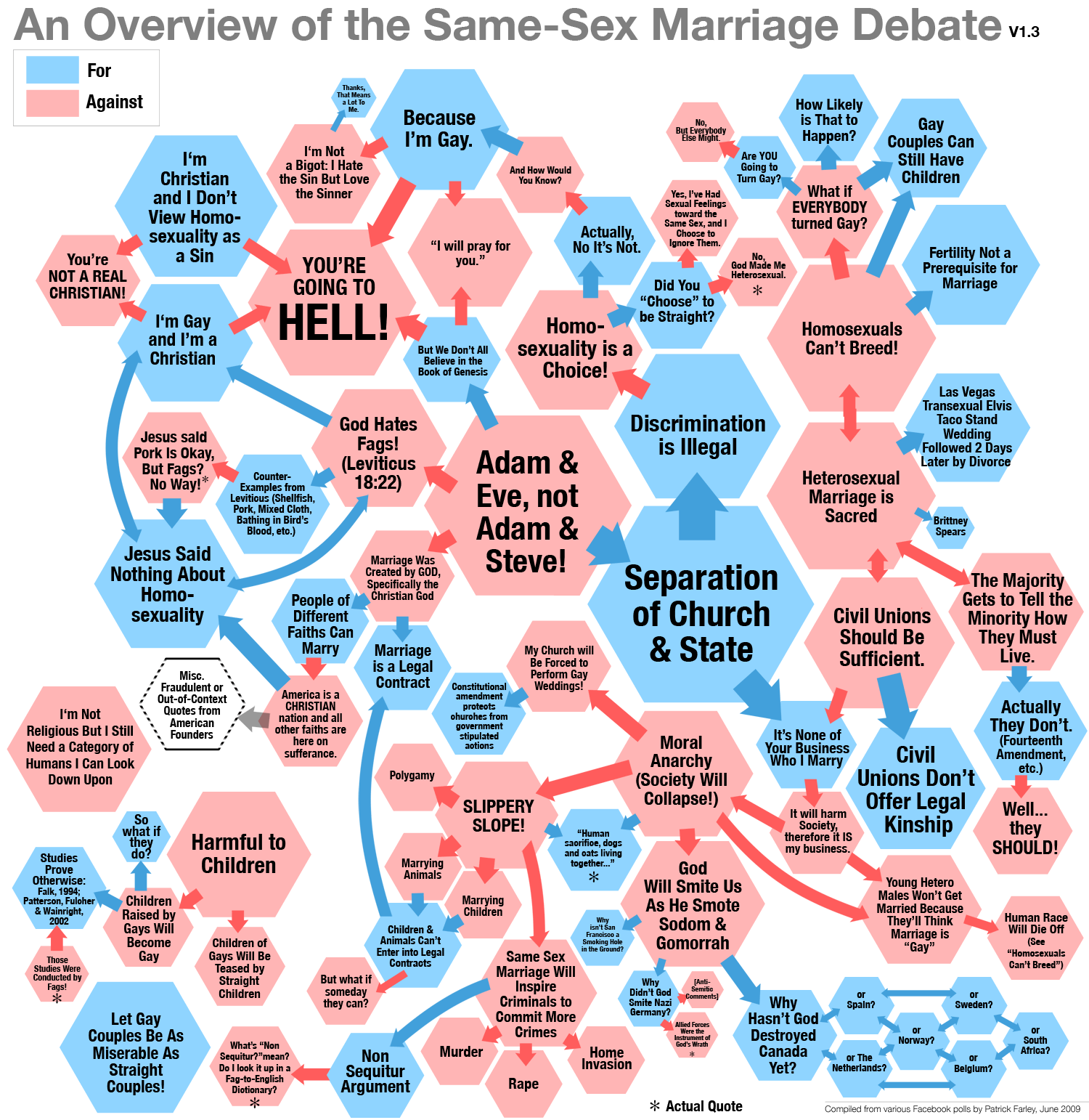
I’m interested in creating useful visual representations of arguments, as I feel sure there is a good way to do it, but I haven’t seen one yet. (I’m currently working on an idea for one which will appear in Things when I have a first draft).

Here’s a version for the same-sex marriage debate by Patrick Farley, based on observed debates on Facebook, which is pretty good (click for big):


This week’s puzzle
As the number of people on the CC list for Things has grown, the amount of reply-to-all discussion seems to have decreased. Currently there are 11 people on it, including me.

It seems clear that some threshold has been passed and a CC list discussion really works best with around 5 people.

The puzzle is, how should this be resolved? For example, I could create one CC list for the first 5 people that were on it, and another for the rest. Or I could create one CC list for people from RAPP, and another for everyone else.

Both of these solutions have disadvantages. What do you think?

On a related note, how do you think I should credit people’s answers to each Week’s puzzles? (In the example below, I summarise the answers people gave that matched my own thinking, and cite by first name the answer I hadn’t considered).

Puzzle from Things 46
I asked for good ways to develop routines with time periods somewhere between daily and weekly. My answer was a spreadsheet programmed with the intended goals and frequencies and set to load up when I switch on my PC.

After trying this out for a few weeks it seems to be successful, and I’ve uploaded a demo version. For a given task, a given ‘davelength’ (a portmanteau of ‘day’ and ‘wavelength’, setting the intended number of days I want to elapse between instances of the task), and a weighting factor, the spreadsheet highlights if I am due to do any tasks today, and if so, which one to prioritise. Upon completing the task I just have to enter the current date in the ‘Date last done’ field.

It would probably work well as an iPhone app, which means someone has probably done it already.

Last week’s puzzle
Reasons people prefer reading writing on paper than a screen seem to breakdown in to 3 main categories:

1) Visual. Resolution and emissivity of screens are issues. In principle technology should be able to overcome these concerns.
2) Convenience. A piece of paper can be folded and put in a pocket, annotated, pinned to a wall, doesn’t need electricity, and is easily carried around to read in many situations. But once again, technology could theoretically match this in most regards, and exceed it in others – think adjustable font size, editing rather than crossing out, digital annotations (including a social aspect), searchable text, and backed up data, for a start.
3) Cultural Inertia. Even if technology addresses other concerns, people that have grown up reading from paper will be resistant to change. The added convenience factors mentioned above will have to be significant before a real transition can take place. (Thanks to Laurence for pointing out this one).

Categories
Old

Things 51: Beatles Rock Band, Google Squared, Ingenious Comics

(Originally sent June 2009)

Things now returns after a brief hiatus during which I revised for and took my IDM Diploma exams. They seemed to go okay.

Movies
I saw Terminator Salvation, which I can’t particularly recommend, and Blue Velvet (on DVD), which I can.

Video
The intro to the Beatles specific Rock Band game is a wonderfully conceived and animated potted history of the band.

High quality video on the dedicated site:

http://www.thebeatlesrockband.com/cinematic.php

YouTube quality if your PC isn’t up to it:

Link Google Squared is like Google’s approach to what Wolfram Alpha does. For example, if you search for planets, it tries to understand what you are looking for and what useful things you might like to know about instances of that thing, using Google algorithmic magic.

When Wolfram Alpha has an answer, it’s right – when it doesn’t have an answer, it has nothing. Google Squared lives in the fuzzy space in between.

As a side effect, this means you can use Google Squared as a kind of I-Ching / astrology / random fortune generator.

Try the following:

1) Go here http://www.google.com/squared/
2) Put in your surname
3) If you get results, use ‘add items’ at the bottom to add the first names of your family – if you don’t get any results you will be given some blank fields in which you can enter the first names directly
4) In the top right you can add additional columns. Type in ‘awards’ and press ‘add’
5) Find out how much your family members have won according to the Google Squared lottery!

Personally I was found to have won HK$0.00, whereas my mum got $517,115.00.

You can see what it thinks about you in other ways – for example, add a column titled ‘orbital period’. Turns out my sister has an orbital period of 1,975.4045670 days!

Quote
‘Newsarse’ [Now NewsThump – T.M. 1/7/11] is like a less polished, UK version of The Onion, providing a satirical take on current events from a UK perspective.

I quite liked their take on YouTube comments:

YouTube’s spokesman states “we are pleased to offer not only graphic images of canine dismemberment, but also a platform for viewers’ irrelevant comments and violent outbursts of racism.”

Pictures
In the past couple of weeks I saw two fascinating ways of doing something different with comics.

Choose-your-own-adventure comic based on reading speed:

http://www.qwantz.com/index.php?comic=1486

One character going left to right, one top to bottom:

http://eruditebaboon.livejournal.com/17849.html

This week’s puzzle – paper
Why do people generally prefer to read writing on paper than on a screen?

Last puzzle – buttons
The puzzle regarding why buttons do up the way they do (one way for male and the other for female) is a difficult one, since answers cannot be proved, and as such it is all too easy to come up with one theory and feel the matter to have been resolved.

Here’s how I broke it down in reply to some suggestions on the CC list:

There are actually two questions bundled up – why is buttoning consistent, and why is it the way it is for the two genders.

Assumptions:
– Buttoning requires both hands to perform a fairly dextrous action and has no particular handedness bias
– Being familiar with buttoning one way will tend to make clothes that button the other way less desirable
– People will tend to wear clothing items for their gender, not so often clothing of the opposite gender

Under these assumptions, we can expect consistency of buttoning to emerge for each sex (but not necessarily opposite to one another) from random starting conditions, and a slight bias one way or the other at the start is likely to have a strong effect on the final outcome.

Arguments could be made in each direction, as it would only take a small effect to tip things one way or the other.

I found an interesting viewpoint on why it should be the opposite way for males vs females in a seemingly well-informed article on a period costume site.

From the last paragraph:

“Since female clothing took on more and more features of male clothing in order to express emancipation […], it became necessary to establish a feature that signalled that an item of clothing was, despite its male appearance, nevertheless female.”

Categories
Old

Things 50: Portal, Legalising Street Racing, Supply and Demand

(Originally sent June 2009)

An unusually long multi-lunch-break-requiring Things in unintentional celebration of hitting 50…

Things blog update
My attempts at setting up two WordPress blogs from a single database failed. I will see if I can set up a second database instead for a Things blog, in between revising for my IDM exams.
[Ultimately, that’s exactly what I did. – T.M. 28/5/11]

Film
Yesterday I saw Sam Raimi’s Drag Me To Hell. It was an extraordinary experience that is difficult to describe – imagine the kind of inventive unpleasantness that happens to Wile E. Coyote applied to supernatural horror, maintaining some of the comedy aspect, and you begin to get some idea. The trailer sets out the premise very clearly but dramatically underplays the scares:

IMDb rating: 8.2
Rotten Tomatoes aggregate: 95%

Videos
This week I finally got around to playing Portal, a short but brilliant game which, for me, achieved the astounding feat of living up to its own considerable hype. Even if you’re not a gamer, the trailer is worth checking out just to see how nifty it is:

If that doesn’t float your boat, here’s a video of a cat that jumps into and out of a tall box. 1’19” is where the best jumping starts happening:

Link
In a fascinating case study for debates on the merits of legalising/criminalising things, police in Florida have been running legal street races in which, for $25, people can attempt to “Beat the Heat”. They claim that given this controlled and safer outlet, they have seen a drastic reduction in illegal street racing.

[Original link is broken, the story is repeated here though – metatim 28/5/11]

[Okay, that link broke too, try this one – metatim 03/08/15]

Quotes
Gavin Potter, a leading entrant for the NetFlix Prize (see this wired article) said:

“The 20th century was about sorting out supply. The 21st is going to be about sorting out demand.”

In other words, by solving problems of supply (think of all the information/products/services available to you via the web), we create a new problem related to demand – how do we sort through all this stuff?

I saw this articulated in the supermarket last week. A child had clearly been sent to pick up some juice, but was just staring at the shelving three times his height stocked with perhaps a 100 variations on fruit juice. His father turned up and asked what was wrong, to which the child replied with palpable desperation: “I can’t find any fruit juice!”

Picture
Here is a lovely graph demonstrating the relationship between Star Trek‘s warp speeds and energy requirements:

On a side note, in Star Trek the ships generate a bubble of distorted space around the ship, which to an outside observer means the ship appears to elongate as it sets off at warp speed. In Star Wars the ships instead enter hyperspace (warning: no basis in science), a kind of parallel universe in which distances are shorter / the speed of light is faster, so no elongation occurs.

Criminally, warp elongation was added to ships entering hyperspace in the Star Wars special editions.

This Week’s Puzzle: Buttons
Why are buttons on clothes for males placed on the opposite side to buttons on clothes for females?

Last Week’s Puzzle: Newspaper Eyeball Value
Last week I asked (roughly speaking) why newspapers are complaining about the internet when many have successful online sites with ads alongside articles just as in the print versions. I received some detailed responses and there’s clearly a lot more research that could be done, but here’s some of the main points:

1) Actually the main newspapers in the UK seem to be perfectly fine, with stable or even growing circulation figures. As JB put it: “I think alarm bells are being rung by consumers that don’t like the net and shareholders with unreasonable expectations!”

A corollary – in a blog post that could desperately use some editing, an argument is made that the important part of a newspaper is not the news (a commodity) but the package and the curation, somewhat consistent with the Gavin Potter quote above.

2) Newspapers cost money to make and to buy. The website version costs a certain amount of money to make but scales much more cheaply, and is free to the consumer. Depending on the scale and margin of each branch, this will give very different results for any given newspaper.

3) Demographics. With TGI I can see that the median age of the most regular newspaper readers (top 2 quintiles) is about 17 years older than the median age of those that regularly visit newspaper websites. The rule of thumb is that who sees your ad has the strongest effect on how well it does (over and above the offer or creative itself). Still one would expect that better targetting leads to better results, and if anything the splitting up of the audience should make targetting easier and hence more profitable.

4) Visibility. Since people get web content for free, they have less invested in it, so are unlikely to read it as attentively (A study suggests people typically read 20% of the text on a web page). Online ads can be blocked, newspaper ads can sit around the house for some time, paper is still easier on the eye than screen, people are more likely to be multi-tasking online… and many other factors similar to this exist.

There are many other arguments and deeper points to be considered about the above, but I would want to be more sure of the data before claiming to have an answer. I may revisit this topic with a more detailed investigation at some point on my blog.