Podcasts
I’ve circled around podcasts without diving in for a long time, unsure of how to navigate the medium. With movies or video games, I’m already looking at places that tell me about new and interesting releases, and I know how to find out if something I’m considering might be good; with movies especially I’m aware of directors, writers or actors I like that will form part of the draw. With podcasts, I have none of that!
Despite that, I’ve found a few podcasts over the years that I liked, so it seemed a good time to round them up.
Blank Cheque
Blank Cheque is a podcast about films (apparently a very popular one but I’d never heard of it, I guess because of my distance from podcasts) specifically about the careers of directors who got ‘blank cheques’, i.e. enough power that they were able to make exactly the films they wanted. It takes the (apparently classic) form of two friends chatting about the subject matter, usually with a guest, but if there was ever a conversation I wanted to overhear about film, this is it. The friends are David Sims, a film critic who is often very funny, and Griffin Newman, an actor/comedian who is also incredibly insightful about films.
They came to my attention through their ‘stunt’ podcast that kicked the whole thing off: “The Phantom Podcast”, a long podcast series diving into Star Wars: Episode I – The Phantom Menace in forensic detail, under the conceit that this was the only Star Wars movie ever made and they are trying to make sense of it. They then ‘discover’ later Star Wars episodes one at a time and continue to analyse them as if nothing else existed. It’s quite incredibly niche and nerdy and there’s only one Things reader I would recommend it to, and I already have, so maybe don’t start with that. (I will say the full ~36 hours (!!) of material covering the prequel trilogy does go out on a pretty audacious high with a George Lucas impersonator defending the films against all criticism in front of a live audience).
I recommend picking a well-known director or film you like and searching the wiki to see if they have covered it (they have covered quite a lot of the big ones by now), then give that episode a listen. My favourite part is that they are often fantastic at drawing out ways in which the film’s meta-text resonates with the text. My least favourite part is that they will often talk over and interrupt their guests, especially women. That’s a pretty sharp down-side, so hopefully the fact I recommend them despite that shows how much I appreciate the good parts.
Designer Notes
Ok, I got into this one a while ago but didn’t mention it until now. A little like ‘Blank Cheque’, Designer Notes sees Soren Johnson interview game leads that have produced especially interesting games over their career. As an interviewer, he’s fantastic at drawing out the most interesting stories, with a knack for spotting when a fascinating nugget got skipped and asking the guest to dig into it.
Like Blank Cheque, if there’s a game series or game-maker you like, search (maybe like this) to see if they have been covered and start there.
Link to Designer Notes podcast
Gamecraft
Much shorter than any others mentioned here; if you have any interest in video games as a medium, a business, and in how it has adapted and grown over the past four decades, this is a fantastic listen. Mitch Lasky covers most of the material and is incredibly insightful since, through a lot of luck and some good judgement, he was somehow very close to the action at almost every major evolution the business has been through since the early 90’s. Blake Robins plays the ‘straight man’ role, standing in for the audience by asking the questions you’d naturally want to ask or pointing out context Mitch is sometimes too modest to state.
Mindscape with Sean Carroll
Sean Carroll is a theoretical physicist with an interest in many different scientific fields, and in this podcast he interviews scientists of all kinds to get a better understanding of their area. He’s a great communicator, and by studying the published materials of his guests in advance he’s able to coax them into explaining it clearly even when they themselves are not quite as eloquent. (Okay, sometimes it doesn’t quite work and he ends up doing most of the explanatory lifting).
Here I recommend scrolling through his list of guests and topics and diving into whichever one you find interesting.
(Random bonus note: I like the way the little intro song has a melody that kind of matches Carroll’s intonation.)
Finally, as an aside, Sean Carroll appeared in Piers Morgan Uncensored to debate Eric Weinstein on the topic of theoretical physics. I’ve seen this characterised as “Jerry Springer for nerds”, notably including the following exchange (only missing a little context):
Eric: If Sean had actually read my paper…
Sean: I actually have read your paper! I have it right here!
Eric: Well first of all, Sean, how dare you…
Someone like Eric is able to get the attention of ‘alternative media’ by sounding very smart and espousing a theory that ‘the establishment’ doesn’t agree with. You need to be incredibly knowledgeable and calm to reasonably debate with someone like this, and Sean pulls it off. I found it fascinating for that reason alone. I even give Piers a little bit of credit for attempting to end the discussion with some grace, given how little he understands the topic (by his own admission).
Useful memorisations
I’m sure a few of you have already done this, but here’s two simple things worth memorising.
First, the numeric position of each letter of the alphabet (a = 1, b = 2, c = 3 etc). In the summer of 2001 I once needed to walk a couple of miles alone and spontaneously decided to memorise this while I walked; I’m amazed how much this has paid off over the years. Admittedly I do move in circles where this sort of thing comes up more often than perhaps is normal.
Second, the ‘major system’ is a simple correspondence between the digits 0-9 and consonants (0 = s, 1 = t/d, 2 = n etc). Once you have memorised this, you can turn any number into a set of letters (e.g. 20251231 = N S N L T/D N M T/D), you then insert whichever vowels you need to make a word or words, which in turn are usually easier to memorise than the numbers because they are a bit weird. This does take a bit of skill, and I’m not very good at it but get by (e.g. NSNL.TN.MT = No SNaiL-eaTeN MuT). Great for PINs or a surprising number of other things. Admittedly sometimes the effort of translating the thing into words and then back again often means I end up memorising the numbers directly, but that’s still a win.
If you have similarly useful memorisations to recommend, let me know!
AI coding trough of disillusionment
In a fast-moving world, this article by Mike Judge, “Where’s the Shovelware? Why AI Coding Claims Don’t Add Up” is now a bit old (article date 3rd Sep 2025), but it was a pretty thorough look for signs of AI coding being transformative in terms of software / websites / apps / games and not finding any evidence:
- The METR study found developers thought AI made them 20% faster but it actually made them 19% slower
- Mike’s own mini-trial found nowhere near the powerful effect he had subjectively thought was happening
- There is no evidence of increased releases of apps on iOS, Android or Steam
- No increase in domain name registrations
- No increase in new public Github repositories
Mike also then directly addresses the most obvious counterpoints that could be raised.
https://substack.com/inbox/post/172538377?=&aid=recKGiRdTrn0tC0OH
Now, to avoid oversimplifying, we should also consider the following:
- Generating code is just one part of shipping a product, all the other parts can be quite difficult and annoying, so maybe that functions as a barrier
- This doesn’t mean nobody sees any benefit from AI in any coding situation. People can be coding for personal use, or improving existing workflows
- Even if there’s no effect on publishing rates, there could be other effects, such as different levels of quality or hiring patterns
There are also, of course, other ways in which generative AI has an impact – there’s dramatically more to this topic than I’m covering here. For example, it’s a great way to make social media spam, presentations everywhere are getting bespoke illustrations that would have otherwise been just text, and some have seen a decline in job roles for junior positions (for example), so there’s still lots to watch out for.
Films where they actually had to Do The Thing
With editing and special effects, movies can weave a lot of magic. However, sometimes the plot will require the film-makers to actually depict something incredibly impressive without any tricks.
I first encountered this as a theoretical example in the book (recommended to me by Will W), “Adventures in the screen trade” by William Goldman, screenwriter of All the President’s Men and The Princess Bride. In one chapter he writes a short story and then has experts in different aspects of film-making give him feedback on how the story might need to change to be realised on film. Of particular note was that the story hinged on a boy getting a transcendently incredible haircut of unknowable beauty; it is firmly pointed out to him that this is essentially impossible to portray on screen.
What I’m getting at here is skills specifically outside of those you expect for film-makers. An example of what I’m not counting: sometimes a character gives an inspiring speech to rouse people to action and it’s literally inspiring – difficult to write, but movies have professional writers. Or sometimes a film requires stunt work, especially a Jackie Chan film in which part of the appeal is he is performing difficult and dangerous stunts himself – but this is still a fairly normal part of film-making, with Jackie Chan being an apex example.
Where it can get harder is music.

Inside Llewyn Davis (2013) is a film about a folk singer on the edge of musical success and (more often) disaster. They found Oscar Isaac for the lead, who is not only perfect for it but also a legitimately talented musician. At one point he is brought in to record a novelty song, “Please Mr Kennedy” (with Justin Timberlake as the song’s on-screen and off-screen writer; also with Adam Driver doing a silly voice), and Isaac’s character opts to take the session fee rather than any cut of the song’s profits. As an audience you should read this as a mistake, as the song will probably perform well. As a novelty song, and to the point of this section, it is legitimately good enough that you believe that’s a possibility. (It’s partly based on the original Please Mr Kennedy by Mickey Woods, and as @mooviedude141 notes in the comments on the film’s version, a different Kennedy did pretty much go on to send two of the performers into outer space).
There are plenty of other films in which a song needs to do a lot of lifting and they pull it off (“Remember Me” in Coco (2017); the Cloud Atlas Sextet in Cloud Atlas (2012); a central performance in Sinners (2025)), all of which are impressive, but I know of two examples that go the full distance.
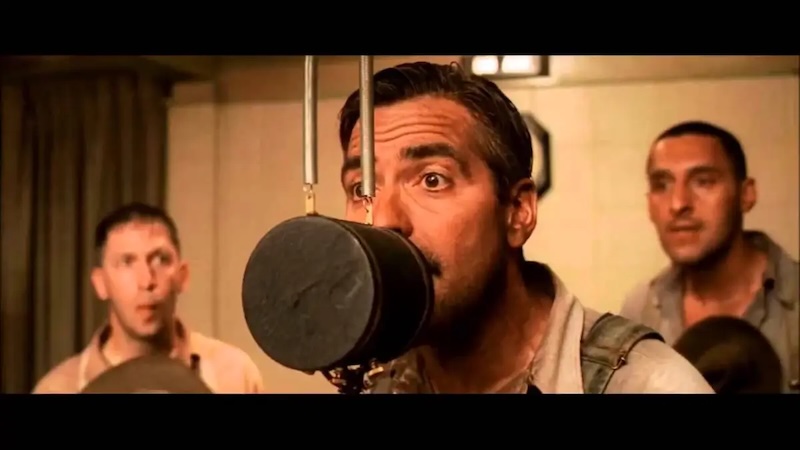
In O Brother, Where Art Thou? (2000), a surprising through-line is that the escaped convict protagonists end up recording “Man of Constant Sorrow”, and while their hijinks continue the song is becoming popular in the background, to pay off beautifully near the end. Meanwhile in real life, that song (and the film’s soundtrack) legitimately became extremely and surprisingly popular.

More recently Kpop Demon Hunters (2025) features several songs by the in-movie group HUNTR/X (performed mostly by genuine K-pop group Twice among other expert contributors), who are supposed to be extremely popular – and in real life, to quote from the Wikipedia summary, “it became the first film soundtrack on the Billboard Hot 100 to have four of its songs in the top ten, was certified double Platinum by the Recording Industry Association of America (RIAA) in October 2025, and received five Grammy Award nominations”.
What about non-music?
In The Ring (1998), a particular video will ‘curse’ anyone who watches it. Perhaps making such a video is arguably within the wheelhouse of a horror film director, but the execution of it really stands out. The video is semi-abstract but nonetheless legitimately creates a deeply cursed feeling, which is why I won’t embed it here and also is part of why that film haunted my nightmares for years, only resolving when I dressed as the main spook Sadako one Hallowe’en.
Very long titles of manga and anime that explain the whole premise
This trend has been running for some years in Japanese anime and manga. Some Examples:
- The World’s Finest Assassin Gets Reincarnated In Another World as an Aristocrat
- Banished from the Hero’s Party, I Decided to Live a Quiet Life in the Countryside
- I Got a Cheat Skill in Another World and Became Unrivaled in the Real World, Too
- The Magical Revolution of the Reincarnated Princess and the Genius Young Lady
- The Guy She Was Interested in Wasn’t Really a Guy at All
I wonder if this becoming acceptable (or even appealing) makes some stories more marketable than they would have been in a short-title paradigm. Perhaps this is partly why the Isekai genre (protagonist goes to ‘another world’, a genre lately overrepresented in general and also in my above examples) has had such a boom in popularity.
We could consider how this might play for major Hollywood films. There have been a few examples with titles changing mid-marketing-push to get longer/shorter and more/less explicit about the premise:
- “Birds of Prey (and the Fantabulous Emancipation of One Harley Quinn)” did not seem to work as a title and had a late pivot to “Birds of Prey”. I can’t help but feel just “Harley Quinn” would have worked better, but that’s a topic for another Things.
- John Carter was previously to be titled John Carter of Mars, but seemingly Disney thought the ‘Mars’ bit would put people off, so hoped to just… sneak it in there?
- Edge of Tomorrow sounds cool but tells you very little, so had a late pivot to the much clearer (but equally terse) Live. Die. Repeat.
Perhaps there’s something fundamentally different going on in the marketing strategy though – Hollywood films that aspire to be blockbusters will often signify their intended mass appeal with a very short title such as ‘Titanic’, ‘Frozen’, or ‘Sinners’. Meanwhile, a lot of anime and manga are trying to carve out a niche, and they can best do that by setting out the full premise up front so the people looking for that exact sort of thing will find it.
So, if there’s anywhere we might expect this trend to show up in Western media, perhaps it’s books?
Recursive Knowledge
Laurence once pointed out to me that “you have a vested interest in anyone that has a vested interest in someone you have a vested interest in”, and he remains correct.
In the second book of Cixin Liu’s Three Body Problem trilogy, the author dramatises the problem of insufficiently recursive trust. Two groups, who we can label Alice and Bob, have a problem: each of them has the capacity to annihilate the other before there is a chance to retaliate.
- Alice trusts that Bob will not attack, and Bob trusts that Alice will not attack
- But, Alice does not know that Bob trusts that will Alice not attack, and vice versa
- If there’s a chance Bob does not trust Alice will not attack, probably he will attack
- So to be safe they each should launch a pre-emptive strike
Unfortunately this keeps going even if you can add another level of trust. Consider just Alice’s side in the next level up (using close synonyms for trust/know to try to keep it manageable):
- Alice trusts that Bob will not attack
- Alice is also confident that Bob, in turn, trusts that Alice will not attack. Hooray!
- But… Alice does not know if that meta-confidence is reciprocal. As far as she knows, even though Bob trusts that Alice will not attack, he might not know that she knows that
- So Alice must consider the possibility that Bob does not know that Alice knows Bob trusts that Alice will not attack.
- If that’s the case, Bob might be concerned that Alice is unaware that Bob trusts that Alice will not attack. Bob will consider the possibility that Alice does not believe Bob trusts Alice will not attack.
- If Bob is considering that, it means he worries Alice thinks Bob does not trust that Alice will not attack – and if that was the case Alice, assuming Bob does not trust her, would launch a pre-emptive attack.
- In this scenario that Alice is imagining, Bob would therefore launch a pre-emptive attack… so Alice had better launch her attack first.
You can see how this keeps going even if you layer on more meta levels of trust. The problem presumably caps out at our ability to compute much further. Unfortunately, if both sides entrust such decisions to AI then this will either become undecideable in the halting problem sense, or they will pre-emptively attack each other while trying to get to the bottom of the recursion just to be on the safe side.
How far can humans really think this sort of thing through? In the previous section I noted there is a manga titled “The Guy She Was Interested in Wasn’t Really a Guy at All”. As you would expect from the title, the drama hinges on the fact that Aya has a crush on Koga who she assumes is a boy, but Koga is in fact a girl in her class who dresses in a very male-presenting way outside of high school.

I don’t think it’s really a spoiler to say that eventually the secret comes out, because it’s very much about the journey rather than the destination (and at the time of writing the series is unfinished). That knowledge recursion is dramatized over a series of stages – Aya finds out about Koga, then Koga learns that Aya has found out but Aya doesn’t know that, and at a certain point Aya overhears that Koga has realised that Aya knows about Koga’s identity – but Koga does not know she knows that! That sounds pretty abstract, but in the moment of reading, the meaning and emotional significance of this highly meta revelation feels incredibly clear. I suppose as social animals, it makes sense that humans can grasp this stuff pretty well when it’s in the context of a story.
While I was thinking about all this I found out that Steven Pinker now has a book out called “When everyone knows that everyone knows”, which deals with ‘common knowledge’; when recursive knowledge operates at a population level.
I should note a slightly distant and dark irony there: we’re going through a kind of ‘common knowledge’ moment right now with the release of the Epstein files. In 2006 Pinker wrote a letter to his friend Alan Dershowitz, who was Epstein’s defence attorney at the time, on the the wording of the “internet luring statute”, and this apparently contributed to federal sex trafficking charges against Epstein being dropped. Pinker says he was unaware this was how it would be used and regrets sending it.
- Transmission ends somewhat uncomfortably