Categories
New

Things 102: Bionic Cat Ears, Brilliant Journalism, Drawable Monsters

This Week’s Puzzle
I have a Tumblr on which I post daily things to draw, called Now Draw This. I really want to make sure I credit the relevant artist when I post a piece of artwork. (I should do that with the photos too, but for various reasons that’s not as important to me).

TinEye is an awesome reverse image search engine, which in the past has helped me track down artwork even when the version I had turned out to have had the colour palette significantly edited. Pretty clever.

The problem is, this site posted the above image (of Ico and Yorda from the game Ico), and neither TinEye nor wily Googling is helping me track down the original artist.

Can you find out who created the above image originally?

Video
Technology expands the range of things we can do. As a society we try to keep up by generating some kind of idea of what we should do. For example, mobile phones enabled us to use ostentatious ringtones. For a while they were everywhere. Now, it seems we’ve collectively decided that’s not such a good idea.

So here’s something I hadn’t even considered: what if you could collect some kind of real-time usually-invisible data about yourself, and then manifest it with a clear physical signal? Would that ever be a good idea?

http://www.youtube.com/watch?v=w06zvM2x_lw

Link
Michael Lewis writes long articles on complex but important topics, that are nonetheless incredibly engaging, thus creating pretty much optimal long-form journalistic pieces. I highly recommend that you make time for his article Beware of Greeks Bearing Bonds (which I thought I’d linked to before but can’t find in my records), and if you like that then you should also read When Irish Eyes Are Crying.

Quote
Joe Cornish, director of Attack the Block, interviewed by Little White Lies:

If you look at a lot of the digital creatures in Harry Potter, you couldn’t go home and sketch them – you’d need a draughtsman’s degree. […] The charm is to go home and feel that it’s possible to figure out how they did it. When I was a kid, I’d go and see Ghostbusters and spend the next day trying to draw the Stay Puft Marshmallow Man, or trying to get the logo right. They had a graphic simplicity that was much more infectious and warm and authored than a lot of the stuff now.”

I had the same childhood experience, and I think it’s a really fun rubric. Attack the Block‘s creature design succeeded in exactly that way.

Last Week’s Puzzle
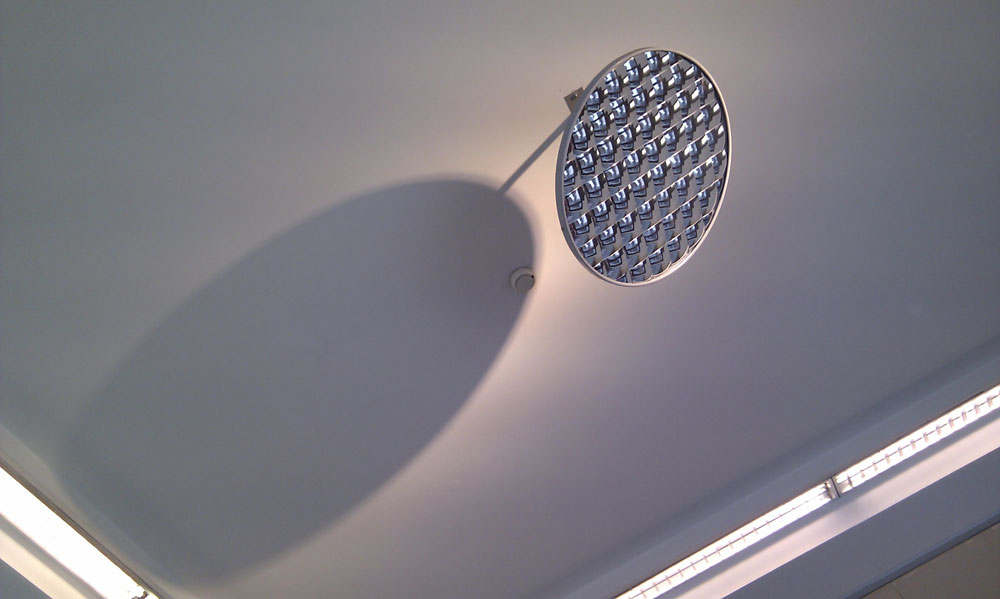
Last week I asked what the purpose was of this insect-eye mirror I saw on the ceiling in a bank in Vienna, but nobody hazarded a guess.

You can tell from the shadow that there’s a bright spotlight pointed at the mirror, so my hypothesis was that it was some kind of way to generate a bright, ambient light throughout the room. But it seems like overkill / overdesign if that’s the goal. And why would you want to have a diffuse, shadowless light that badly anyway? I like to imagine, completely baselessly, that there’s a local superstition about some kind of money-stealing creature that inhabits shadows. But if you can think of something more plausible, do let me know.

Categories
Old

Things 48: Bike Parkour, Limits of Men, Wolfram Alpha

(Originally sent May 2009)

I’m considering switching to a blog format for Things in time for Things 50. Let me know if you have any strong feelings on the subject. [You’re now looking at it! – T.M. 28/5/11]

Video
Danny MacAskill does parkour/free-running but on a bike. Having seen these kind of videos before, I know a lot of them are clearly a collection of flukes edited together – but in this case the man has a staggering raw skill and most of the things he does (with the exception of the first) you get the feeling he could pull off 10 times in a row.

A slow build up, but worth it:

Quotes
Two quotes capturing a similar idea – decide for yourself just how gender-neutral ‘man/men’ is in each case:

“Every man takes the limits of his own field of vision for the limits of the world.”
– Arthur Schopenhauer

“Men perceive the world from their own point of view, which they confuse with absolute truth.”
– Simone de Beauvoir

Link
With no regard to downplaying expectations, Wolfram|Alpha is going to attempt to launch within the next 24 hours. In some sense a web front-end for Mathematica, it will essentially curate public knowledge (population demographics, poker probabilities, mathematical algorithms, and who knows what else) and make it queryable with natural(ish?) language.

The hype:
“Wolfram|Alpha is in a sense the “killer app” for Mathematica. It is a chance for Mathematica to show off the astonishing range of things it is capable of doing when it is deployed, not against a specific problem, but against all problems.”

A lovely little .pdf summarising the ‘quest for computable knowledge’ in 2 sides of A4, where Wolfram|Alpha is naturally the next great step.

A bit of geekish chest-thumping as they assert how mighty their works are.

Showing off the maths bit.

The Reality:
From Douglas Lenat:

“[it] covers a large portion of the space of queries that the average person might genuinely want to ask. […] It handles a much wider range of queries than Cyc, but much narrower than Google; it understands some of what it is displaying as an answer, but only some of it […] The bottom line is that there is a large range of queries it can’t parse, and a large range of parsable queries it can’t answer.”

Assuming they can withstand demand, you will be able to try it for yourself very shortly – they will commence launch preparations at 1am tonight / tomorrow morning.

[Of course, it’s now live, and Lenat’s observation remains accurate – T.M. 28/5/11]

Picture
Dresden Codak
‘s Aaron Diaz, sporadically brilliant webcomicer, illustrates 7 types of plot twist and how they manifest across six genres, from the Reverse Macguffin in a Thriller to Double Shyamalan Mystery.

Puzzle answer: The Space Stick
Can information travel faster than light if you poke an incredibly rigid stick one light-year long? The answer is no. As many of you observed, ‘pushing’ a solid object does not magically transfer force instantaneously through it, but rather creates a compression wave as atoms or molecules push up against one another, and this is bounded by the speed of light. (There’s also the issues of the necessary rigidity being impossible, the huge amount of inertia you would be working against, needing something to push against, and gravitational complications if you’re anywhere near a planet or other large celestial body).

Many of you chose to focus instead on the general problem of faster-than-light communication. In summary, quantum entanglement does involve ‘spooky action at a distance’, but fascinatingly stops just short of being spooky enough to transfer information. Wormholes, on the other hand, are seemingly permitted by General Relativity, which would seem to lead to paradoxes, and remains a mystery.

This week’s puzzle: Wired’s “Color Scheme”
The US issue of Wired this month is guest-edited by J. J. Abrams and features a lot of interesting puzzles as well as a meta-puzzle (I think). I highly recommend ‘Color Scheme’, which you can try here [link broke, try here – metatim 03/08/15], although you’ll have to resist just clicking for the answer on the link bizarrely placed immediately below the puzzle.

Categories
New

Things 101: Mystery Mirror, Cutaway Lens, Scientific Method Madness

Puzzle
I saw this strange insect-eye mirror on the ceiling inside a bank in Vienna. What is its purpose?

Quote
This puts into words something I’ve been feeling strongly over the past few years:

“Excellence is an art won by training and habituation. We do not act rightly because we have virtue or excellence, but we rather have those because we have acted rightly. We are what we repeatedly do. Excellence, then, is not an act but a habit.” – Aristotle

Link
Lifehacker brings together different pieces of research to look at the Cognitive Cost of Doing Things. For me the most important one is Activation Energy (emphasis mine):

[S]tarting an activity seems to take a larger [amount] of willpower and other resources than keeping going with it. Required activation energy can be adjusted over time – making something into a routine lowers the activation energy to do it. Things like having poorly defined next steps increases activation energy required to get started.

The idea in the Aristotelian quote above is the reason I’ve built routines around all the things I want to do; the above sounds like the reason it’s been working.

Picture
Physical cutaway of a Leica lens, one of a few different angles you can see here.

Last Week’s Puzzle
Last week I linked to a New Yorker article that implicitly asked “What is Going Wrong with the Scientific Method?”

The article brings together an interesting collection of anecdotes, observations and studies that suggest in different ways that across many fields, after an effect is observed (e.g. effectiveness of a drug to treat a disease, ability of an individual to telepathically identify Zener cards) subsequent measurements of the same thing will see progressively weaker versions of that effect. This seems to undermine the scientific method, which uses replicability to sort chance results from real ones.

Unfortunately, the article is constructed in a way that tends to disguise how the different pieces of the puzzle relate to one another. I think the apparent effect can be adequately explained by the following:

1) Regression to the Mean
The article mentions this key idea relatively late on, but this is an essential background problem that many of the anecdotes have to be considered against. Cut straight to the ‘conceptual background’ section in the Wikipedia article to understand how this will tend to arise. (Note that this also tends to explain the Sports Illustrated Cover Jinx).

2) Bad Luck
The main thread of the article follows Jonathan Schooler’s experience of the “decline effect”. The poor fellow saw his most interesting result seem to decay away with subsequent replication attempts; he later tried measuring some more fanciful things specifically to see if those would also show effects that seemed to weaken over time, and sure enough, they did. He could put the first instance down to some kind of Regression to the Mean, but to have this happen repeatedly seemed all too unlikely.

He doesn’t really help his case by testing for paranormal effects, but in any case with hundreds of thousands of scientists testing different things all over the world, statistically, someone will end up seeing a lot of Regressions to the Mean.

3) Intentional and Unintentional Cheating or Bias
In the article, a telepathy experiment from the 30s is cited in which one undergraduate defied chance to make a series of seemingly miraculous correct guesses of Zener cards. Just as the experimenter was about to write papers on the result, the student “lost” this ability. It’s very hard to take such a result seriously, as it seems far more likely the undergraduate had found some way of cheating, which he chose to stop using as soon as he saw how high the stakes were going to get.

More importantly for conventional research, the paper “Why Most Published Research Findings Are False” highlights the kind of systematic effects that will unfortunately tend to produce a misleading overall impression if one considers the evidence for an effect purely based on published results. The New Yorker article mentions this paper by name and covers some of the observations, but it’s well worth a detailed read.

4) Placebo Effects in medicine
Even taken together, the above three ideas don’t seem to refute the large-scale “decline effects” the article mentions being observed in the field of medicine. I would suggest this is due to something else: problems with the placebo effect.

Richard recalled an article from New Scientist (which I can’t find online) that pointed to a general problem with double-blind drug studies: active drugs will often have side-effects, and placebos won’t. Patients in such a study that experience side effects are likely to assume they have been given the real drug and not the placebo, and will therefore enjoy a stronger placebo effect, so confounding the ability of any medical study to be truly double-blind.

Even more disastrously, as this Wired article notes, the placebo effect seems to be getting stronger over time, presumably because it relates to social perception of drug efficacy. This is exactly the kind of thing that would drive an apparent decline in effectiveness of many different drugs over time.

In Conclusion
The Scientific Method is fine. We just need to remember a few things about statistics. This XKCD should help somewhat.

Categories
Old

Things 47: Flying Robot Penguins, Hamster Wheel Projection, Space Stick

(Originally sent May 2009)

Film
I saw Wolverine. I found it to be acceptable. I was particularly impressed that they held almost all shots of the enjoyably over-the-top climactic battle back from the trailer.

Video
In this video there are giant flying robot penguins, after the small swimming robot penguins, after the pre-roll ad, after the video loads. But worth the wait.

Link
Since the media make it very difficult to tell if a manageable disease outbreak has grown into a rampant society-threatening pandemic of doom, here’s a map that collects data on the progress of Swine Flue cases.

Semiotically speaking, the size of the circles when zoomed out subconsciously suggests a more severe situation than is actually the case, but zooming in quickly brings things into perspective.

Quotes
Going through my old archive of things-I-heard-people-say-and-wrote-down recently, I found a cluster of baffling utterances all made by the same individual, who shall remain nickless. Er, I mean nameless.

“I’ll take your word for it – but I’m still not convinced.”

“Is it one of those things you can only see when you look at it?”

“I don’t like shopping, it’s really boring. Except when you’re buying something for yourself… or someone else.”

Picture
I’ve come across this three times this week, but feel compelled to add to its viral propagation. Here and There is a “horizonless projection” map of Manhattan, which some have more intuitively described as a “hamster wheel projection”.

Previous Puzzle – The Inconvenient Hobby

Last time I asked for a time-based goal that can easily become part of a routine but sits somewhere between once-a-day and once-a-week. Given some of the answers, it became clear I hadn’t emphasised the ‘easy’ part sufficiently!

One answer was to tie different aspects of the same goal to different days of the week For example, if the goal is to exercise 3 times a week then one could do three activities once a week each, assigning each one to a particular day of the week.

My own answer has been to create a spreadsheet which automatically pops up when I boot up my PC and tells me how many days have elapsed since I last did the six things I’m trying to do with non-trivial frequencies, and whether that exceeds my target number of days to elapse for each one. Or at least, that will be my solution, but I haven’t got around to implementing it yet, which perhaps speaks to a greater problem.

Puzzle – the Space Stick
Information cannot travel faster than the speed of light. If it did, you just need to apply a bit of special relativity (not even general relativity) and you quickly get paradoxes. There’s a deeper argument to be made there, but trust me, if information could travel faster than the speed of light, It Would Be Bad, in the Ghostbustersian sense.

(Side note: that link was an example of something Kevin Kelly has spoken about – bringing the tools we have for literacy (cut and paste, footnoting, referencing) to moving pictures. Unfortunately the audio is very quiet on the YouTube video I linked to so it probably doesn’t quite work, but it’s close. See http://kk.org/ct2/2008/06/tools-for-vizuality.php )

[We now see further problems interfering as the video has been taken down. It linked to the utterance of the phrase “that would be bad” in Ghostbusters. – T.M. 30/4/11]

Unfortunately this important speed limit on information transfer seems to break if you have an extremely long stick.

It’s difficult to state the problem both precisely and concisely, but here we go:

Imagine you are at one point in space and your friend is one light-year away. You are about to have a baby and your friend will want to know if it is a boy or a girl as soon as possible. If you were to send this message at the speed of light, which is incredibly fast, it would still take one year for the message to reach them, since you are one light-year apart.

Anticipating this issue, you have got hold of a Space Stick, which is one light-year long and as rigid and low-mass as a substance can possibly be. With the Space Stick spanning the distance between you and your friend, you arrange for it to sit above a button that activates a buzzer at their end, the idea being that you simply press on your end of the Space Stick and the button is pressed pretty much instantaneously.

With a pre-arranged code (tap for a boy, long press for a girl) it seems as if this could be used to transmit information faster than light. Why could it never work?

Things 47

Film

I saw Wolverine. I found it to be acceptable. I was particularly impressed that they held almost all shots of the enjoyably over-the-top climactic battle back from the trailer.

Video

In this video there are giant flying robot penguins, after the small swimming robot penguins, after the pre-roll ad, after the video loads. But worth the wait.

http://www.newscientist.com/article/dn16996-bionic-penguins-take-to-the-water–and-the-skies.html

Link

Since the media make it very difficult to tell if a manageable disease outbreak has grown into a rampant society-threatening pandemic of doom, here’s a map that collects data on the progress of Swine Flue cases:

http://flutracker.rhizalabs.com/

Semiotically speaking, the size of the circles when zoomed out subconsciously suggests a more severe situation than is actually the case, but zooming in quickly brings things into perspective.

Quotes

Going through my old archive of things-I-heard-people-say-and-wrote-down recently, I found a cluster of baffling utterances all made by the same individual, who shall remain nickless. Er, I mean nameless.
“I’ll take your word for it – but I’m still not convinced.”

“Is it one of those things you can only see when you look at it?”

“I don’t like shopping, it’s really boring. Except when you’re buying something for yourself… or someone else.”

Picture

I’ve come across this three times this week, but feel compelled to add to its viral propagation. Here and There is a “horizonless projection” map of Manhattan, which some have more intuitively described as a “hamster wheel projection”:

http://schulzeandwebb.com/hat/

Previous Puzzle – The Inconvenient Hobby

Last time I asked for a time-based goal that can easily become part of a routine but sits somewhere between once-a-day and once-a-week. Given some of the answers, it became clear I hadn’t emphasised the ‘easy’ part sufficiently!

One answer was to tie different aspects of the same goal to different days of the week For example, if the goal is to exercise 3 times a week then one could do three activities once a week each, assigning each one to a particular day of the week.

My own answer has been to create a spreadsheet which automatically pops up when I boot up my PC and tells me how many days have elapsed since I last did the six things I’m trying to do with non-trivial frequencies, and whether that exceeds my target number of days to elapse for each one. Or at least, that will be my solution, but I haven’t got around to implementing it yet, which perhaps speaks to a greater problem.

Puzzle – the Space Stick

Information cannot travel faster than the speed of light. If it did, you just need to apply a bit of special relativity (not even general relativity) and you quickly get paradoxes. There’s a deeper argument to be made there, but trust me, if information could travel faster than the speed of light, It Would Be Bad, in the Ghostbustersian sense.

[Side note: that link was an example of something Kevin Kelly has spoken about – bringing the tools we have for literacy (cut and paste, footnoting, referencing) to moving pictures. Unfortunately the audio is very quiet on the YouTube video I linked to so it probably doesn’t quite work, but it’s close. See http://kk.org/ct2/2008/06/tools-for-vizuality.php ]

Unfortunately this important speed limit on information transfer seems to break if you have an extremely long stick.

It’s difficult to state the problem both precisely and concisely, but here we go:

Imagine you are at one point in space and your friend is one light-year away. You are about to have a baby and your friend will want to know if it is a boy or a girl as soon as possible. If you were to send this message at the speed of light, which is incredibly fast, it would still take one year for the message to reach them, since you are one light-year apart.

Anticipating this issue, you have got hold of a Space Stick, which is one light-year long and as rigid and low-mass as a substance can possibly be. With the Space Stick spanning the distance between you and your friend, you arrange for it to sit above a button that activates a buzzer at their end, the idea being that you simply press on your end of the Space Stick and the button is pressed pretty much instantaneously.

With a pre-arranged code (tap for a boy, long press for a girl) it seems as if this could be used to transmit information faster than light. Why could it never work?