Categories
New

Things 134: Overanalysis of popular media for Fun and Recreation

At school, I thought the purpose of English Literature was to argue about hidden meanings in books, meanings I believed were not remotely connected to the author’s original intent, and that I therefore considered worthless.

Since then, I’ve completely changed my mind. Intent is bunk, over-reading things is fun! Are the Star Wars prequels actually the purest embodiment of George Lucas’s original desire to recreate the adventure serials of his youth? Or is Lucas in fact the world’s greatest troll, deliberately irritating the original trilogy’s fans, perhaps because he resents the way they feel a kind of ownership of the material he originally created? I don’t know, but it’s a lot of fun to think and argue about both, preferably simultaneously!

“Any man who inflicts the human race with ideas must be prepared to see them misunderstood.” – H. L. Mencken

So, this edition of Things is dedicated to finding joy in metatextual resonances and overanalysis of popular media that I have particularly enjoyed.


Candy Crush / Addiction

Art Hawk is a video series that’s all about over-reading meaning in games, all delivered in a silly voice and with layered, weird and occasionally relevant imagery. Needless to say, I love it. Here, Art Hawk explains why Candy Crush is a wonderful piece of ARRRRTTTT:


Seinfeld / The Ballardian Infinite

Claire Evans writes about how the Seinfeld episode about a seemingly endless car park is part of a rich tradition going back to J. G. Ballard and J. L. Borges, and finds meaning in the fact that the traditional apartment set was physically replaced by the garage set. Were these layers of meaning intended? Probably not! And that’s fine.


Movies in general / The lives of the stars

I’m interested in movies and how they are made, but not in the personal lives of actors and actresses – what would usually be termed ‘gossip’. But I was fascinated by The Rules of The Game, an excellent long-form article on the relationship between celebrity, gossip and publicity in the movie industry over the past 100 years. In particular, I was interested by this core insight (emphasis mine):

… media outlets report that George Clooney, whose picture personality is that of a handsome, charismatic, yet hesitant to commit man-about-town, replicates those characteristics in his “real” life, gallivanting about Lake Como, switching beautiful girlfriends every few years. The extra-textual information ratifies and authenticates his overarching image; the “real” Clooney is in fact all of the things he is in, say, Ocean’s Eleven. Whether we’re conscious of it or not, that coherency is at once pleasurable and reassuring.

Yes! That’s exactly it. I suspect this is why the media frenzy about Clooney’s recent narrative-breaking engagement was so large that even I heard about it.


The LEGO Movie as message-bearing trojan horse

Film Critic Hulk wrote a lengthy, heartfelt piece on why The LEGO Movie really works. Hulk suggests that one of the key plot-points within the movie represents what the makers of the movie are actually attempting to achieve with the movie itself [Spoilers approaching]:

LORD AND MILLER ACTUALLY OUTLINE THEIR ENTIRE MODUS OPERANDI RIGHT THERE IN THE MOVIE ITSELF […] DISGUISE YOUR THING SO IT SEEMS LIKE A THING THEY’LL ACCEPT […] THEN WORK WITHIN THE CONFINES OF THOSE ACCEPTED WAYS IN ORDER TO DO WHAT YOU ACTUALLY WANT TO DO. IT’S A LITERAL HEIST, BUT IT’S A METAPHOR FOR A CREATIVE ONE TOO.

Specifically, they disguise the movie as a light and fluffy fun-for-all-the-family frolic, while delivering (a bit heavy-handedly in my opinion) a message about adult responsibility and what life is really all about.


Jennifer Lawrence’s rise to stardom and The Hunger Games

I first saw Jennifer Lawrence in Winter’s Bone, an independent movie she carried almost single-handedly. She plays a teenage girl with an absent father and an emotionally diminished mother, who supports her family in a harsh backwoods environment by, among other things, hunting squirrels.

A couple of years later, she was cast as the lead in The Hunger Games, in which she plays a teenage girl with an absent father and an emotionally diminished mother, who supports her family in a harsh backwoods environment by, among other things, hunting squirrels. She puts herself forward to be thrust into the limelight of something called ‘The Hunger Games’, where she is a tremendous success thanks to her grit and skills. And of course, by being cast in The Hunger Games movie, Jennifer Lawrence herself was thrust into the real-world limelight, and is currently enjoying tremendous success thanks to her skills and, possibly, grit. I’ve got to admit, I do find that coherency strangely reassuring.

(Her intervening appearance in X-Men: First Class only breaks this narrative a little bit).


Baron Munchausen’s defeat(?) by bureaucrats

The Adventures of Baron Munchausen is one of the more extraordinary entries in Terry Gilliam’s canon, a wonderfully creative and madcap romp through various ridiculous scenarios which betrays none of the difficulties that beset its production. [Spoilers about to break down the gate.]

In the movie, bureaucrats, following entirely rational procedures, prolong the suffering of the people in a city under siege. The Baron defies them, and through sheer force of will, creativity, and with a few friends, defeats the attacking army. But the chief bureaucrat then has the last laugh, assassinating the Baron.

Similarly, despite bureaucrats at Colombia attempting to fatally restrict the movie’s budget, and in the face of all manner of other challenges, Terry Gilliam nevertheless created something wonderful – through sheer force of will, creativity, and with a few friends. But the bureaucrats got the last laugh, as a political change within Colombia resulted in the movie being given such a limited release it could not possibly succeed, effectively assassinating it.

In the film, with one final, surreally creative twist, the Baron nonetheless declares victory. In the documentary accompanying the movie on DVD, Gilliam feels that this resonates with real life still further: despite everything, the movie is everything he wanted it to be, and it lives on with home releases; this represents his final victory.

(On the subject of Terry Gilliam, the parallel between Doctor Parnassus peddling incredible things to an unengaged modern audience and Gilliam’s late career is almost too overt to mention here).


The Wachoswki’s Speed Racer as a triumph of Art over Commerce

Speed Racer is my favourite movie. It’s utterly ridiculous and visually stunning, which I find an irresistible combination. This quote from the Ain’t It Cool review explains that a little better:

You know how sometimes you see a trailer for a film like THE FIFTH ELEMENT, and they show you all this eye candy and it looks like the whole film is full of that? And then you see the film and it’s actually about 10% crazy eye candy and the rest looks like a regular movie? Well, that ain’t SPEED RACER. Every single image in this film is outrageous, hyperreal, and color-saturated, and at first, it’s sort of a shock to the system. But by about 15 minutes in, your eyes get used to it, and suddenly the entire palate becomes sort of beautiful.

But it’s more than that – in Adam Saltsman’s Vanquish retrospective he draws a parallel between that underrated video game and Speed Racer, and sums up this other brilliant property of the film:

In SPEED RACER, time is completely relative; a viscous fluid, the passage of which, like our place in the chronology and memories of the characters, is utterly dependent on the story, rather than linearity, or even cinematic tradition. Time and space shift according to the needs of the narrative and cinematography, but in a way that is intimidatingly holistic and with a degree of confidence that would be unnerving if it wasn’t so thoroughly saturated with real human love.

Anyway, to get back to the point, and what really cements the movie’s place at the top of my all-time-favourite list, is Chris Stangl’s observation that it is essentially a metaphor for its own creation:

Because Speed Racer is about something; about something moving and important […] Speed Racer is about art and commerce, though the stand-ins are racing-constantly-compared-to-art and patronage in the form of corporate driver sponsorship, with Speed Racer as a virtuoso whose work in content and form reduces crowds to tears of ecstacy. It’s about accepting that your art exists in a commercial sphere, that money and power are in the balance, from sponsor on down to spectator… but the artist needs to do what the artist does, and ignore all that. Listen to what the car needs. When you turn in something bizarre and startling, garish and strange — even when it gets upsetting and your mom has to look away — as long as you drove as hard as you could, you did your goddamn job […] The Wachowskis are encouraging artists who can’t help but make the weird new things they make, to be bold, proud. When it’s in your blood, you have no choice anyhow.

The fact that the film proved to be a financial disaster makes this message all the more poignant for me.

– Tim Mannveille tweets as @metatim and writes more about films on his personal blog
 

Categories
Special

Things 132: Mobile games I recommend

I’m fascinated by the developments we’re seeing in mobile gaming, and am particularly interested in what sort of games we’ll see emerging as tablets become more mainstream and people figure out cool ways to use a touch interface.

I’ve spent the past few months trying out anything that sounded promising, particularly things that seem more suited to tablets than mobiles. Here are my favourite mobile games I’ve tried so far, split by business model, as that’s the first thing people want to know these days.


Games that you just buy

Star Command

Wikipedia, Official site
Platforms: iOS, Android; PC and Mac forthcoming apparently
Best experienced: On a tablet
Theme: Star Trek / Pixel art
Genre: Strategy
Original release date: May 2013

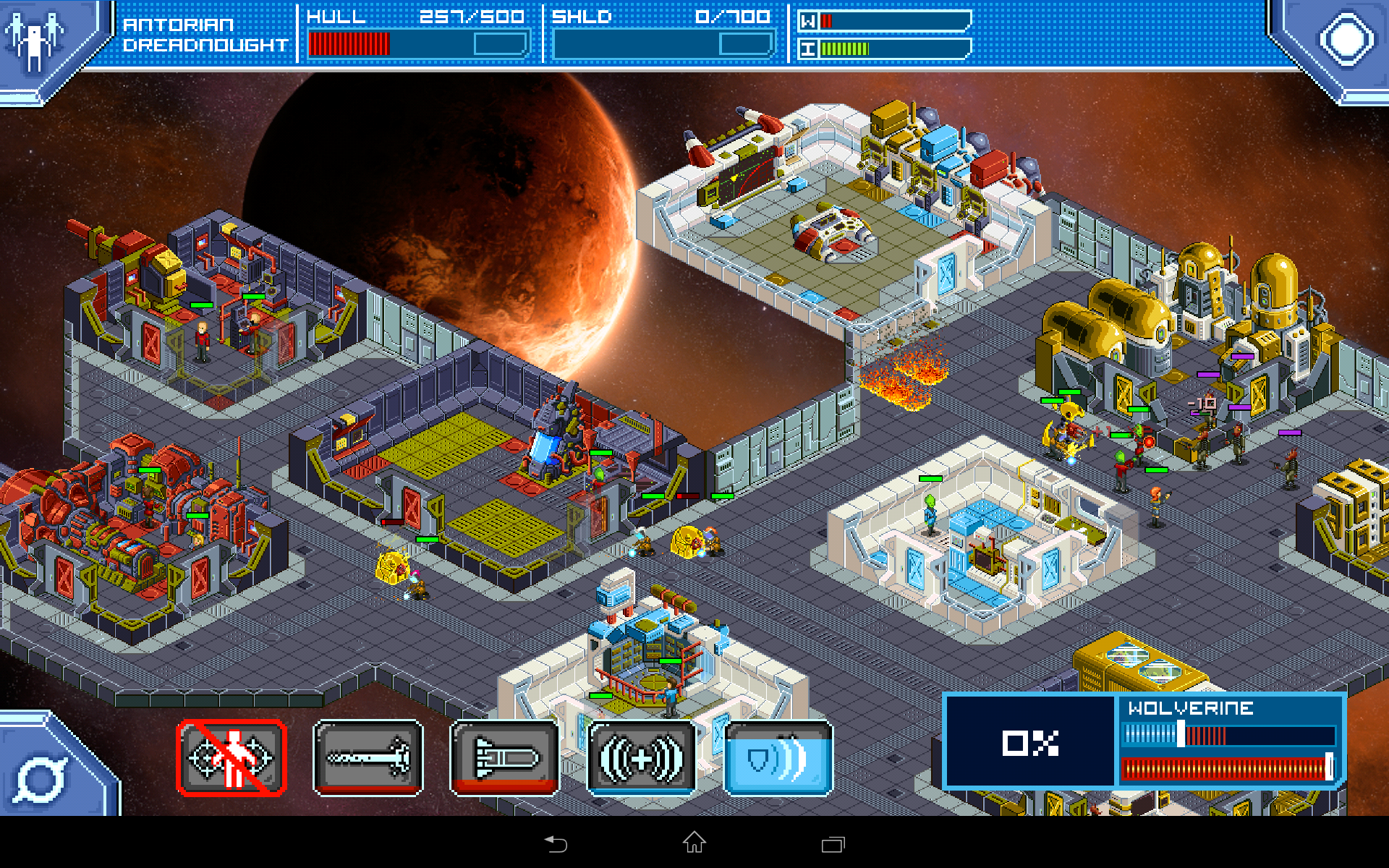
Shields are down. The enemy have teleported aboard and are making their way towards the engine room. The medical bay is on fire. But the enemy ship is weak. Do you keep your tactical officers on ship weapons, or peel some off to defend against the intruders? Do you send the engineers to repair the med-bay, or have them try to set up a sentry droid before the enemy gets to them?

If you think making those kind of decisions in a pixellated Star-Trek-like environment sounds like fun, then this game is for you. The dialogue is lightly amusing too, for example, here are three dialogue options to choose from after being hailed by some unintelligible penguins:

A playthrough took about 4-5 hours, which felt about right. There’s some extra things to do which add replayability but I haven’t touched them yet.


Super Hexagon

Wikipedia, Official site
Platforms: iOS, Windows, Mac, Android, Blackberry, Linux
Best experienced: On any mobile device
Theme: Geometry / Trippy
Genre: Twitch
Original release date: August 2012

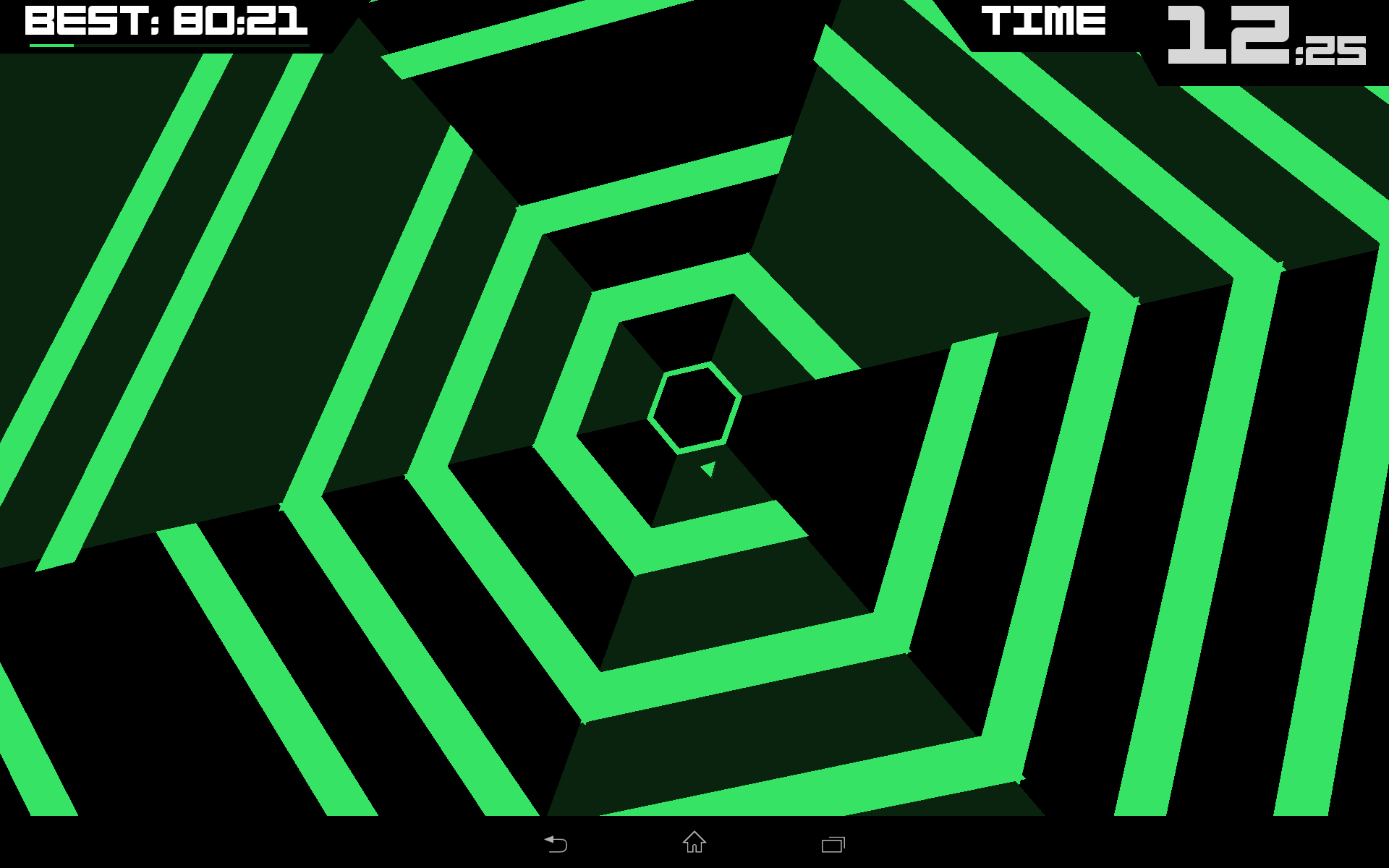
You rotate a small triangle to avoid the ever-encroaching hexagonal walls. The walls move so fast that if you pause to make a conscious decision about which way to go, you die. The only way to last more than a few seconds is to train yourself to move instinctively, which is difficult, but gives a tremendous feeling of flow when you achieve it.

Difficulty modes are ‘Hard’, ‘Harder’ and ‘Hardest’, but progress will unlock harder modes. You get the idea.


Year Walk

Wikipedia, Official site
Platforms: iOS, Windows and Mac forthcoming apparently
Best experienced: On an iPad, with a friend
***Companion app***
(essential) (iOS)
Companion app best experienced: On a small iOS device, while you play the main game on an iPad
Theme: Swedish folklore
Genre: Spooky puzzle
Original release date: February 2013

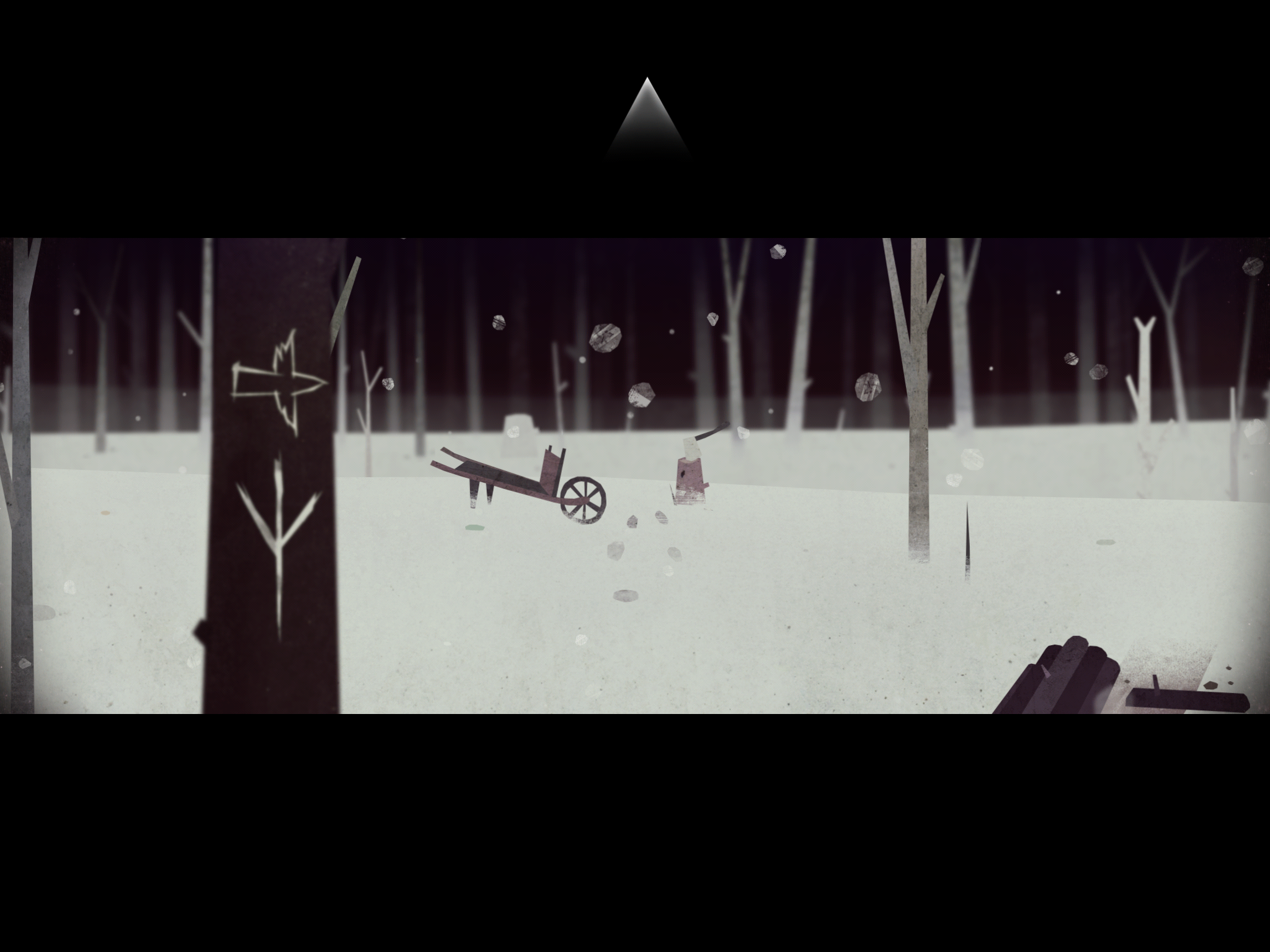
Year Walking is a Swedish folkloric version of a Vision Quest: someone wishing to see the future isolates themselves and fasts for a day (commonly on December 31st), then walks to the church at midnight. The dream-like things they see as a result are interpreted as signs of the future.

This may or may not be real (quite pleasingly, the English page for it on Wikipedia has been deleted as an ‘obvious hoax’, while the Swedish version is present), but in any case it’s a lovely idea for a short, spooky little puzzle game, best played under the duvet at midnight.

The art style is very Jon ‘I want my hat back ‘ Klassen (but isn’t actually by him). This impressionistic trailer gives a good idea of the kind of atmosphere you can expect:

The experience is quite short (I would guess between 1 and 2 hours, depending on how quickly you figure things out), but is extremely atmospheric and polished, and felt well worth the money to me.


First bit free, buy the rest

Cytus

Wikipedia, Official site
Platforms: Android, Playstation MobileiOS (not free!)
Theme: Anime Sci-Fi / Mostly circles
Genre: Rhythm Action
Original release date: January 2012
Best experienced: On a tablet

Circles appear. A line moves back and forth across the screen. You tap the circles when the line crosses them. If done correctly, you find you are tapping in time to the music, and this is very pleasing. Later on things get really crazy.

http://www.youtube.com/watch?v=mtbc8cVQ-G0

Well, that’s rhythm action for you. You get to try quite a lot for free (at least on Android), so if that remotely appeals then you should try it. Once you have the hang of it, you can then attempt to impress other people with your circle tapping skills. In my experience, they are actually quite impressed. They might have just been saying that, though.


Badland

Official site
Platforms: AndroidiOS (not free!)
Best experienced: On a tablet
Theme: Cute but dark / silhouette
Genre: Tap to flap
Original release date: March 2013

The one-button tap-to-flap genre seemed pretty simple to me until I played this. Powerups change your size (which alters your handling), coefficient of friction, speed, or the speed at which time passes. That’s fun, but it really gets going when you suddenly clone up to a swarm of 20 flappy things, all responding to your taps in sync (as per the screenshot above).

Essentially half of the game is free (on Android), so you should really just try it.


Free but you can buy things

Nimble Quest

Wikipedia, Official site
Platforms: iOS, Android, Ouya, PC/Mac/Linux (paid)
Theme: RPG / Pixel art
Genre: Snake
Original release date: March 2013
Best experienced: On a mobile

It’s really all there in theme, genre and screenshots: you control a conga-line ‘snake’ of RPG characters, attacking enemies and collecting power-ups. New characters are unlocked as you achieve higher levels, and each character can be upgraded with the coins you collect… it’s quite surprisingly compelling.

It’s the brave new world of free-to-play, so there’s a bunch of currency and in-app-purchase (IAP) going on. I recommend this approach:

  • Buy the red gems IAP. This gets you about 4x the amount of soft currency earned per game, and is a fair way to pay for the fun you get out of the game
  • Play the ‘arena’ mode. This updates once a day (I think), and if you do well enough you get a decent amount of the hard currency the following day
  • Once you get deeper into the game, spend hard currency (as you earn it) on the ‘speed’ powerup, because that makes early progress quicker, makes your attacks more concentrated, and the whole game becomes much more thrillingly twitchy.

Tim Mannveille tweets as @metatim, and previously raved about Smash Cops Heat for Android/iOS.

Categories
New

Things 131: Frozen is objectively great, Internet decay and hamsters, Shower danger

Data-based movie recommendation
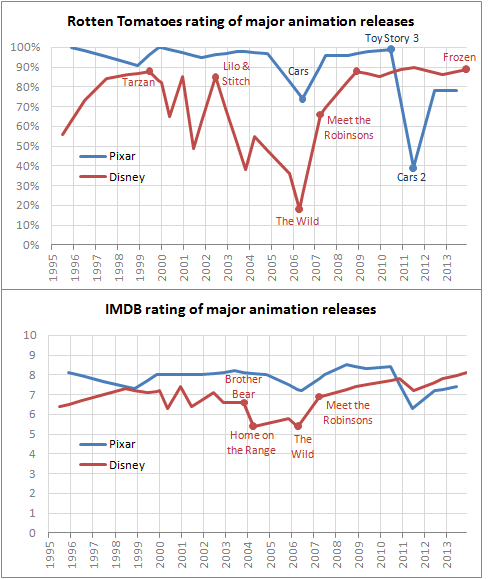
In 2010, with the release of Disney’s The Princess and the Frog, I looked back at the historic trends to try to understand where Disney went wrong in the 00’s. The Princess and the Frog (and Bolt before it) were successful in terms of IMDB and Rotten Tomatoes ratings, but less so in terms of revenue.

I concluded that Disney had to somehow maintain this level of quality in order to build back their reputation. With Tangled, Wreck-it-Ralph, and most recently Frozen, that’s exactly what they’ve done. In fact, since 2011, they’ve consistently outperformed Pixar (despite owning them):

Frozen currently enjoys the highest IMDB rating Disney have received since The Lion King, although due to self-selection it will be somewhat overstated in these initial weeks after its release.

On a more personal note, I’ve now seen Frozen twice, and highly recommend it – do be advised that it is a full-on musical, but co-composed by one of the people behind The Book of Mormon, so there’s a lot to enjoy even if that wouldn’t usually be your cup of tea. It’s also highly notable for having two female leads with real agency (I’m looking at you, Brave, with your arbitrary plot-advancing Will O’ the Wisps).

Video –Automated Automata Architecture
Continuing the Disney-is-actually-pretty-good-now theme, here Disney research demonstrate how they can generate the gearing required to closely recreate an arbitrary cyclical movement, then 3D-print the result to make the automaton. I particularly like the cyber tiger at 3’30”:

(via The Kid Should See This)

Tumblr – Video games with modified objectives
No wrong way to play” collects examples of people playing video games in ways not intended by the designers. I approve of this.

Tim Link – Learning to Cheat, part 3
Two years ago I surprised myself by betraying someone pretty meanly in a public game. I began a series of blog posts post-rationalising the whole thing within a game-design framework, and after a guilty two-year gap I finally posted my full confession and/or excuse.

Internet decay
If you’ve ever navigated early entries of Things on the blog, you might have seen some dead links, and some links which went dead and got fixed, and some which died again, as I periodically go back and attempt to fight digital entropy.

Based on this insignificant sample, it seems like the half-life for links on the internet is 5-10 years, and considerably less for YouTube videos. This is pretty distressing as laziness/convenience drives us to rely on the internet for files we’re interested in – after all, your options are essentially a) saving a lolcat in downloads>pictures>cats, renaming the file so you can easily find it, and maintaining off-site backups of your data to hedge against hardware failure, or b) just image search “I have a cat and I’m not afraid to use it” from any device, which is a lot more appealing. (Naturally I still choose option a).

There’s a few good links on the subject here, including the compelling quote:

“People are coming to the realization that if nobody saves the Internet, their work will just be gone.” – Alexis Rossi, Internet Archive

Hamster fighting machine / response
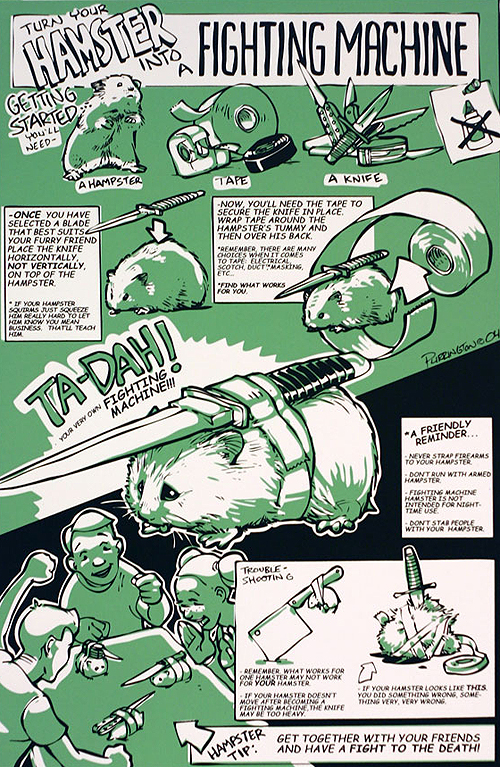
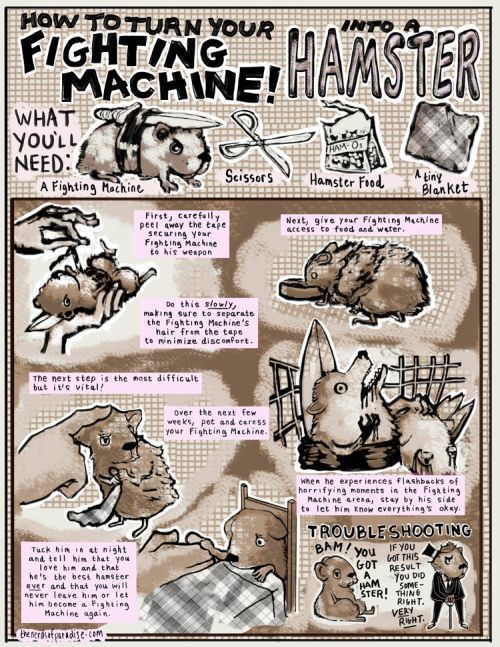
Here’s an example of why it’s important to hold onto things on the internet. In 2005, Jarred Purrington made the Hamster Fighting Machine comic/poster (which you can see here or here but not on the original link because it’s dead)

In 2010, Dale Beran (writer of previously-Thinged webcomic/cogent nightmare “A lesson is learned but the damage is irreversible”) posted a lovely response.

Answer – 100 Chalices
Last time I asked if you should choose a chalice with 50/50 odds of being poisoned over one random chalice out of 100 which 100 fiends have each independently and randomly poisoned one of.

Restated, this is asking if you would prefer one-hundred 1-in-100 chances of death vs a single ½ chance. Richard correctly reasoned that the average amount of poison-per-chalice is double in the 100-chalice room, and some degree of bunching in the distribution (i.e. some chalices getting poisoned multiple times) didn’t seem likely to offset it, so the 50/50 chance is probably the best bet.

For any of you not familiar with the probability behind this sort of thing, here’s a quick summary. In the 100-chalice case, calculating all the ways a chalice could get poisoned is very difficult, but calculating the probability of it never getting poisoned is much easier as there’s only one way that can happen. The odds of avoiding poison any one time are 99/100, and this has to be repeated 100 times. So:

Odds of avoiding poisoning = 99/100 x 99/100 x … x 99/100 = (99/100)^100 = 37%. Clearly not as good as the 50% chance in the two-chalice room.

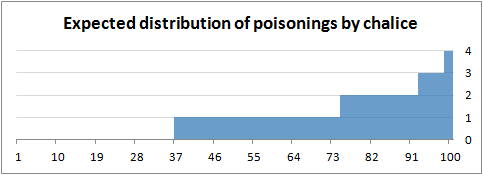
As a post-script, if you’re interested, the expected ‘bunching’ of poisonings would look a bit like this:

This is also a very important concept when evaluating risks in your own life for things that you repeat. For example, I noticed that I tended to step out of the shower in a needlessly risky way, with a risk of slipping (and getting seriously hurt) of perhaps 1-in-a-thousand. That seems tolerable, until you consider that if I showered once a day for 2 years, my odds of avoiding such a fate would be (999/1000)^730 = 48%, in other words I’d be more likely to have at least one such accident than not! So, watch out for that.

Answer – Kickstarter videos
I’ve spoken to a few people about the fact that Kickstarter videos always make me feel less motivated to put my money in. The underlying reason seems to be that a Kickstarter page typically does a great job of selling the product/reward, but the video often ends up being more about selling the people behind it (as being worthy, or in need of your money). Before the video I don’t even think about that; after the video, that’s just another reason to say no.

-Transmission finally ends

Categories
New

Things 127: Partner Parity Problem, Games and Stories, Beautiful Pictures

Mild NSFW warning: the last part of this edition embeds some pictures of female comic characters. There’s also a cat video, but I just assume everyone is fine with that.

Make-your-own hyperlapse video
Well, this is incredible: set a start and end point in Google street view, a target for the camera, and get as output a time-lapse video of that journey, in which you can still control the direction of the gaze – Google Street View Hyperlapse.

Here’s the demo reel.

Rabbit Hole: No to No UI
Timo Arnall says No to No UI (more commonly referred to as “invisible design”), and puts forth a detailed and cogent argument, but the main reason I recommend reading it is the warren of rabbit-hole links he uses as implicit citations. For example, Kevin Slavin talks about algorithms, how they don’t share our goals and can have emergent properties we can’t understand like a flash crash due to algorithmic stock trading, and then he takes a hop from “60% of Netflix viewing comes from the recommendation algorithm” (not true if you check carefully), a skip to “Epagogix can algorithmically evaluate the box office potential of a scipt” (no) to jump to this wonderfully flippant quote:

What does a flash crash look like in hollywood? Maybe it’s already happened! How would we know?!

Puzzle and Tim Link

Reporting on a reasonably conducted study’s findings on heterosexual parternships, the Telegraph ran with the headline “Average man has 9 sexual partners in lifetime, women have 4.”

First, what’s wrong with this claim?

Second, how does such a result come about?

Third, as the second is too easy for Things readers, I invite you to guess: which sub-set of respondents is most responsible for the discrepancy?

As some of you will know, I work at a web analytics consultancy where we disentangle data conundrums not dissimilar to this, so I wrote up my findings in a blog post – I found the answer to the last question quite satisfying!

Animal Videos – flocking starlings, evil cat
Kottke has the perfect pair of Starling flock videos – the standard high definition, clean and beautiful static camera one, and then a low resolution one that’s much more thrilling. You should watch both on as big a screen as you can.

Meanwhile, in the sub-genre of YouTube videos enlivened by a dramatic movie score, I declare this cat video the winner:

Games and stories
There is a tension between making a fun game and telling a good story; it seems to be very hard to do both at the same time. I think this might be because these represent two opposite learning methods; learning from someone else’s example, and learning by trying stuff out yourself in a safe environment.

But there’s a flip side of this conflict: sometimes, in the course of playing a game, you generate your own story, one you would never normally get to tell. Here’s an example.

I once played a match of 4-player local GoldenEye, back when I wouldn’t have needed to specify that 4-player GoldenEye was local. I ran out of ammo, and was chased down a twisty dead end by my friend who had some kind of machine gun, so I was pretty much doomed. I did have one thing though, and I said as much:

“I’ve got a proximity mine. If you come any closer I’ll kill us both!”

He laughed, and continued to pursue me round the final tight corner.

I set the proximity mine.

It killed us both.

I don’t remember the final score of that game – I don’t think I did well. But that tiny story remains one of my favourite gaming moments. For that reason, I was very interested to read Tom Armitage’s review of Game Dev Story, a cute little game that crudely simulates running a game development studio through the major console generations, because he made this assessment:

Game Dev Story exemplifies a kind of mechanical storytelling: stories told not through text or voice-acting, but through coherent systems that cannot help but generate stories.

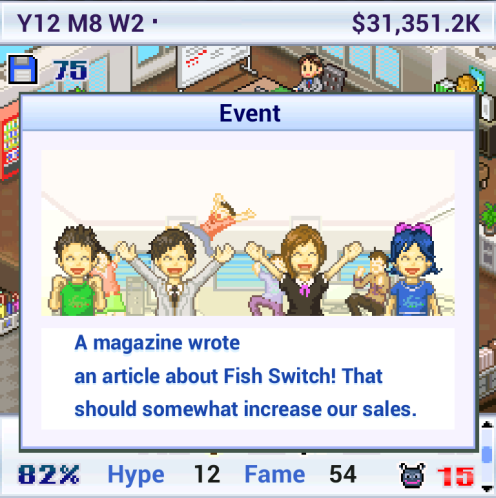
I gave it a go, and he was absolutely right. Apart from the sense of ownership you get from making company decisions, the ability to name your company and the games you produce has some kind of magical effect that makes the whole thing strangely compelling.

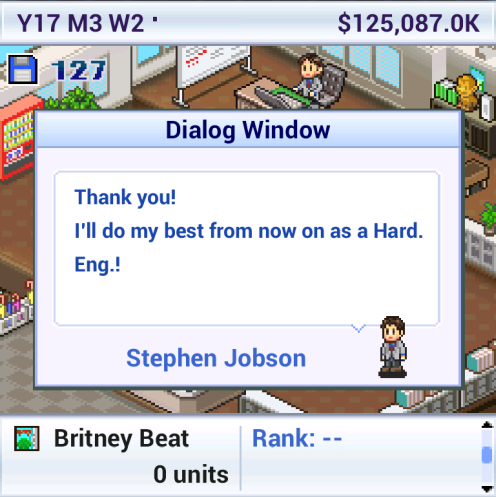
It’s not a great story, but it meant a lot to me: after a difficult start, Squidopolis released a string of titles whose success built a war chest which specially trained hardware engineer Stephen Jobson put to use in developing the ultimate console: the Kraken, for which we then produced a string of hits, despite some major setbacks in production.

Game Dev Story is available on Android and iOS.

Folk Games
I like the term ‘folk games’ for equipmentless games a group of people can spontaneously play, such as Standoff, or Ninja, or Fantasy Fencing. I highly recommend all of those, the last one being particularly notable as it is an example of the ‘Tiny Games’ that Hide & Seek are putting into an app (so you don’t have to memorise these sort of things for every occasion). That’s happening on Kickstarter, and with a day to go at the time of writing it’s already funded, but I still recommend the £12 tier (which includes their Board Game Remix kit) to help reach the stretch goals!

Tim Link: Devil May Dance
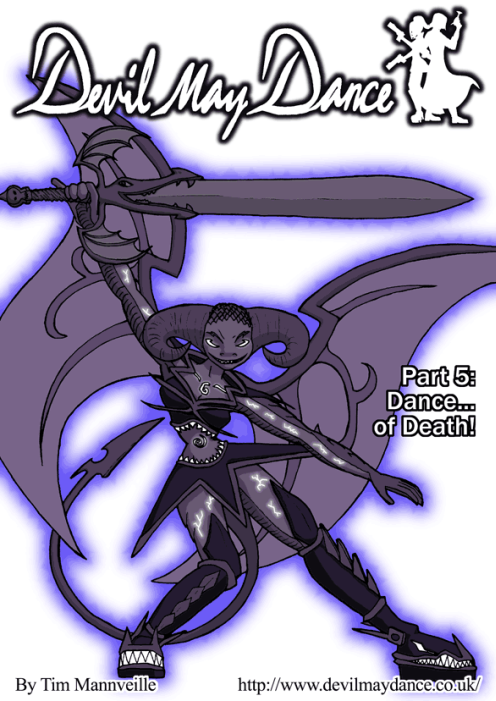
I like putting in place processes in which incremental progress is made towards a goal, and this year I reached the end of my biggest project so far: I finished my webcomic, Devil May Dance, which I had been updating weekly since April 2006.

The premise was to swap the macho protagonist of the video game Devil May Cry with the feminine lead of seminal rhythm action game Space Channel 5, and see how they got on in one another’s shoes, partly as a way to investigate gender expectations, and partly as an attempt to get some cheap laughs.

If that sounds interesting to you, or if you’re curious what would happen if I wrote a story involving time travel, you should check it out.

I also did a little summary of the web stats of the comic over its lifetime.

Beautiful pictures.
Sunset on mars. Pictures with High Dynamic Range. Icebergs that are naturally stripey. An abandoned epic communist building.

But more importantly, there’s another Kickstarter I’d like to draw your attention to. A friend of mine illustrates comics using primarily traditional techniques, and although she works incredibly hard, I get the impression this means she can’t turn out pages at the kind of speed a regular publisher would like (on account of having to wait for individual colours to dry!), so this is exactly the kind of thing Kickstarter is good for – delivering the kind of projects the invisible hand would usually hold back.

Unfortunately, according to kicktraq’s projection, at a little over half way through, the project has a 50/50 chance of success, so it’s going to need some extra help to make it. Check it out before April 24th!

-Transmission finally ends