Categories
New

Things 122: Linda, Sledding Crow, Brand Promises as Modern Myths

Puzzle The Linda Problem
I see this come up every few years, and get annoyed by it every time. Here’s a typical wording:

Linda is 31 years old, single, outspoken, and very bright. She majored in philosophy. As a student, she was deeply concerned with issues of discrimination and social justice, and also participated in anti-nuclear demonstrations.


Which is more probable?

  1. Linda is a bank teller.
  2. Linda is a bank teller and is active in the feminist movement.

Most people get this wrong. Why?

Usually I follow up on a puzzle in the next edition, but this one is so annoying I’ll address it below, after these other things.

VideoCrow Sledding
The Atlantic has the perfect headline for this video: “Science Can Neither Explain Nor Deny the Awesomeness of this Sledding Crow.”

At the time of writing, their version of the video is down, but this one isn’t:

(Extended version with same amount of sledding but more corvid activity here)

LinkColour perception and language
Ever since reading 1984 I’ve been doubtful but curious about the extent to which language can influence the way we think or even perceive. In a brilliant couplet of articles about colour on Empirical Zeal, I found out about some really nice experiments that demonstrate a real (albeit small) effect, so I highly recommend reading both part 1 and part 2.

ComicMartin Zutis – Being
In a comic shop in Vienna I came upon a small self-published comic, ‘Being’ by Martins Zutis. Packed with surreal imagery and insights that float around the border between madness and brilliance, I particularly liked this observation:

The news reports we don’t question are myths.

Here’s a tiny snippet, or you can read a slightly longer extract here.

Martin Zutis - Being

Answer – The Linda Problem / Conjunction fallacy (see above)
Most people (85%, apparently) will answer that option 2 is more likely, “Linda is a bank teller and is active in the feminist movement.”

At this point the person who set this problem usually laughs like a supervillain and points out that the probability of two things both being true must always be less than or equal to the probability of just one of those things being true. They will say this is a demonstration of the Conjunction Fallacy.

However, these people are wrong. What it actually shows is that if you choose to go against the cooperative priniciple in communication, people will misunderstand you so much that any attempt to isolate the Conjunction Fallacy is lost.

Consider a slightly different scenario:

Boris: I have two sisters. Alice is a bank teller. Eve is a bank teller and a feminist.
James: Oh, that’s interesting. Why do you think Alice doesn’t consider herself a feminist?
Boris: I didn’t say she wasn’t.

When I ask people where the mistake arose in this conversation, the surprisingly consistent judgement is that Boris was “being a dick”.

More formally, as noted in that article on the cooperative principle, we tend to implicitly assume that when someone is telling us something, they will narrow their focus to only that which is relevant. When Boris states that Eve is a feminist, this suggests this information is (for whatever reason) relevant, so the fact is was not noted for Alice strongly suggests she isn’t a feminist.

Some researchers then restate the problem by making it clear that option 1 is “Linda is a bank teller and may or may not be active in the feminist movement”, and still 57% of people think option 2 is more likely. But the assumption of relevance is still a confounding factor: the lead-in to the question is assumed to be relevant (when in fact it’s explicitly designed to be misleading), so I suspect people will be drawn to option 2 more because of this assumption (perhaps assuming they’ve misunderstood some part of the question) than because they misunderstand probability.

The Wikipedia article on the Conjunction Fallacy is much better than when I first reviewed it, covering these concerns and giving a much better demonstration of the fallacy in question.

(As an aside, I will note that I’ve often indulged in similar deviations from the cooperative principle for the sake of setting some kind of puzzle, although hopefully this is usually clear by context – for example, as I asked in Things 4, how far can a dog run into the woods?)

Categories
New

Things 106: Best at Chess, Art of Science, Crowdfunding

Tim Link – Competitive Sandwich Making
Last week Clare and I ran a game based on tessellating pieces of cheese to make the best sandwich for the Hide&Seek Sandpit event. You can read about it and see the photos on my project blog, Tower of the Octopus.

Puzzle
In a chess tournament in which anyone can use any means available to them to come up with their moves, who would win? Some possible answers to give an idea of what kind of thing I’m talking about here:

  • A high-ranking chess Grandmaster
  • A really good chess-playing supercomputer
  • A huge team of moderately skilled players with some method of combining their ideas
  • A moderately skilled player with access to a moderately good computer that can run some basic chess calculations

(I had wondered about this in an abstract way before, but recently found out that has actually been done. I’ll relate what happened in that event next week, but you could of course try to Google as well as guess the answer if you wanted).

Video
(Via Phil): Art out of Science:
(Two views of the same thing. If your browser is up to it, you could try watching both videos simultaneously – start the bottom one 20s after the top):

Links
Kickstarter is one of my favourite things on the internet: people with an idea for something get a platform from which to shout about it, and to collect pre-orders or donations from people that like the idea. If there’s enough interest, the project can go ahead, and everybody wins.

So far I’ve helped fund two comics, the Wormworld Saga app (which saw so much success the creator, Daniel Lieske, decided he could give up his day job), and I’m currently backing The Endangered Alphabets Project, which is the kind of thing I like to imagine in a vague way is going on in the world, but I now have the opportunity to facilitate it directly (also, it’s only just on track to hit target, so do go check it out).

You can follow Kickstarter on Twitter, or go to their home page and scroll to the bottom to sign up for the weekly newsletter which highlights the most interesting projects.

IndieGoGo is similar but for reasons I can’t really pin down doesn’t work as well for me.

Crowdfunder is a UK version which I don’t tend to find as inspiring, but would probably be the best one for someone in the UK to create a project with (since Kickstarter requires a US bank account).

Quote
Overheard in the maths common room when I was studying for my PhD at Royal Holloway:

But nobody knows what probability is! Probability is defined in terms of randomness, and randomness is defined in terms of probability!

Answers to Monty Hall and the Two Envelopes
Last week I asked about the Monty Hall problem, which I should have introduced before the Two Envelopes problem I set two weeks ago.

The Monty Hall problem has a nice Wikipedia page, the most helpful part of which is probably the decision tree showing all possible outcomes.

In brief, the answer is that you should switch after Monty shows you an incorrect door, but certain misguided instincts steer most people away from that choice. The Endowment Effect and Loss Aversion mean that regardless of probability, people fear they would regret “giving up” their first choice more than sticking with it if they end up losing.

The more subtle effect is an instinctive (or partially trained?) feeling that the choices of others have no effect on the probabilities of our own choices in these kind of contexts. This is true when the other person has just as much information as you, but that is not the case here – Monty knows where the car is, and uses that information to ensure that he always opens a door with a goat behind it. So he has more information than you, and when you see his choice you gain some information.

Or to give an answer that might go with the grain of instinct for some people, consider this: there is a 2/3 chance that the car is behind one of the doors you don’t pick. Monty shows you that it definitely isn’t behind one of them. So there’s still a 2/3 chance the car is behind the other one, and a 1/3 chance it’s behind the one you first chose.

As for the Two Envelopes, it turns out this is more difficult than I originally remembered. Again, there’s a great Wikipedia page on the subject, which has quite a lot of detail.

As Thomas noted, a key phrase missing from the subtly specious argument for swapping is “Without Loss of Generality” (WLOG), which one must always be careful to check whenever substituting a variable (in this case, the amount in the envelope) with a specific figure (£10 in the example I gave).

Is it true that the reasoning I gave based on having £10 in the envelope truly retains the generality of the problem – would the reasoning also hold for any other amount? In short, no. For example, there could be 1p in the envelope, or any odd number of pence, in which case we would have to conclude that we had the lesser envelope (although this still means you should swap). More dramatically (here we imagine the envelopes contain cheques, and that these cheques are totally reliable), your envelope could theoretically contain over half of all the money in the world, in which case you can be sure the other envelope contains less. More realistically, it could contain more than 1/3 the amount of money you expect the person filling the envelopes to be willing to give away, in which case you would strongly suspect the other envelope to contain the lesser amount.

If you’re interested, do read the full Wikipedia article, and meanwhile, remember to watch out for unjustifiable WLOGs.

Categories
New

Things 101: Mystery Mirror, Cutaway Lens, Scientific Method Madness

Puzzle
I saw this strange insect-eye mirror on the ceiling inside a bank in Vienna. What is its purpose?

Quote
This puts into words something I’ve been feeling strongly over the past few years:

“Excellence is an art won by training and habituation. We do not act rightly because we have virtue or excellence, but we rather have those because we have acted rightly. We are what we repeatedly do. Excellence, then, is not an act but a habit.” – Aristotle

Link
Lifehacker brings together different pieces of research to look at the Cognitive Cost of Doing Things. For me the most important one is Activation Energy (emphasis mine):

[S]tarting an activity seems to take a larger [amount] of willpower and other resources than keeping going with it. Required activation energy can be adjusted over time – making something into a routine lowers the activation energy to do it. Things like having poorly defined next steps increases activation energy required to get started.

The idea in the Aristotelian quote above is the reason I’ve built routines around all the things I want to do; the above sounds like the reason it’s been working.

Picture
Physical cutaway of a Leica lens, one of a few different angles you can see here.

Last Week’s Puzzle
Last week I linked to a New Yorker article that implicitly asked “What is Going Wrong with the Scientific Method?”

The article brings together an interesting collection of anecdotes, observations and studies that suggest in different ways that across many fields, after an effect is observed (e.g. effectiveness of a drug to treat a disease, ability of an individual to telepathically identify Zener cards) subsequent measurements of the same thing will see progressively weaker versions of that effect. This seems to undermine the scientific method, which uses replicability to sort chance results from real ones.

Unfortunately, the article is constructed in a way that tends to disguise how the different pieces of the puzzle relate to one another. I think the apparent effect can be adequately explained by the following:

1) Regression to the Mean
The article mentions this key idea relatively late on, but this is an essential background problem that many of the anecdotes have to be considered against. Cut straight to the ‘conceptual background’ section in the Wikipedia article to understand how this will tend to arise. (Note that this also tends to explain the Sports Illustrated Cover Jinx).

2) Bad Luck
The main thread of the article follows Jonathan Schooler’s experience of the “decline effect”. The poor fellow saw his most interesting result seem to decay away with subsequent replication attempts; he later tried measuring some more fanciful things specifically to see if those would also show effects that seemed to weaken over time, and sure enough, they did. He could put the first instance down to some kind of Regression to the Mean, but to have this happen repeatedly seemed all too unlikely.

He doesn’t really help his case by testing for paranormal effects, but in any case with hundreds of thousands of scientists testing different things all over the world, statistically, someone will end up seeing a lot of Regressions to the Mean.

3) Intentional and Unintentional Cheating or Bias
In the article, a telepathy experiment from the 30s is cited in which one undergraduate defied chance to make a series of seemingly miraculous correct guesses of Zener cards. Just as the experimenter was about to write papers on the result, the student “lost” this ability. It’s very hard to take such a result seriously, as it seems far more likely the undergraduate had found some way of cheating, which he chose to stop using as soon as he saw how high the stakes were going to get.

More importantly for conventional research, the paper “Why Most Published Research Findings Are False” highlights the kind of systematic effects that will unfortunately tend to produce a misleading overall impression if one considers the evidence for an effect purely based on published results. The New Yorker article mentions this paper by name and covers some of the observations, but it’s well worth a detailed read.

4) Placebo Effects in medicine
Even taken together, the above three ideas don’t seem to refute the large-scale “decline effects” the article mentions being observed in the field of medicine. I would suggest this is due to something else: problems with the placebo effect.

Richard recalled an article from New Scientist (which I can’t find online) that pointed to a general problem with double-blind drug studies: active drugs will often have side-effects, and placebos won’t. Patients in such a study that experience side effects are likely to assume they have been given the real drug and not the placebo, and will therefore enjoy a stronger placebo effect, so confounding the ability of any medical study to be truly double-blind.

Even more disastrously, as this Wired article notes, the placebo effect seems to be getting stronger over time, presumably because it relates to social perception of drug efficacy. This is exactly the kind of thing that would drive an apparent decline in effectiveness of many different drugs over time.

In Conclusion
The Scientific Method is fine. We just need to remember a few things about statistics. This XKCD should help somewhat.

Categories
New

Things 98: Weakest Link Puppets, GPS Doom, Visual Metaphors

Video
I really like The Weakest Link Puppets Special. There’s something about the way these worlds collide that just keeps me smiling as I watch – childish responses to adult questions, adult responses to childish questions, and a wonderful willingness of all concerned to make what’s ultimately one of the simplest illusions going really work. If you want to see the rest of the episode, YouTube will show you the way.

Link
A New Scientist article on how a surprising amount of our technological world is reliant on GPS.

Puzzle
After last week’s question on old-stuff-on-the-internet, I was looking back at my old Geocities site (now living on my own domain after Geocities shut down) and came upon my old Alternative Newsletters. I like to think of these as precursors to the Things email, but they’re really completely different, so I probably shouldn’t.

Anyway, one of them had the following quiz, which I thought I’d adapt for Things:

1) Is the answer to this question yes?
2) Is the answer to this question no?
3) Is the answer to question 4 maybe?
4) Are most of the answers yes in this quiz?
5) Have you stopped worrying about logical yes/no question traps?
6) If you answered maybe to questions 1-5, ask yourself another question in place of this one: If you cyclically rotate ‘maybe’, ‘no’ and ‘yes’ forwards through the alphabet, then answer questions 3 and 5 again, does this change whether or not you have to answer this question?
7) Answer this question last: What is the answer to question 8?
8) Is the answer to this different in comparison with the answer to the last question?

You don’t need answers, you know how many you got right.
Scoring:
0-2 questions correct: congratulations, you could be sane.
3-5 questions correct: bonus question! Did you get more than 3 correct? Answer, mark, and re-score.
6-8 questions correct: you do not need my congratulations, getting this many correct is its own reward (and punishment)
9+ questions correct: See Me.

Picture
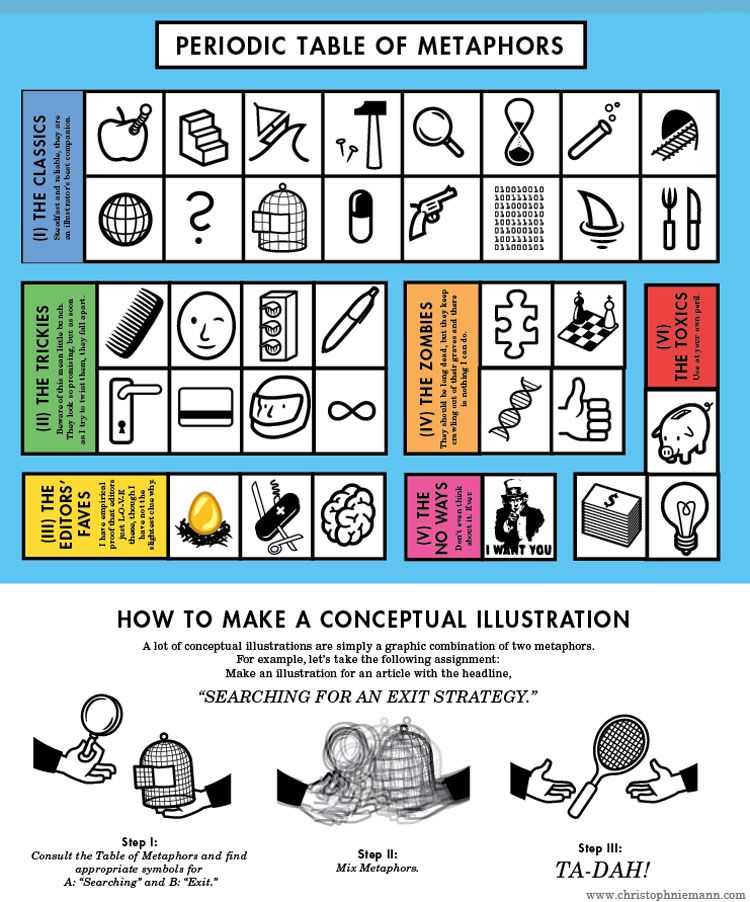
A periodic table (actually not really periodic) of metaphors:
(click for big)

Last Week’s Question
Last Week I asked “What is the oldest evidence of your own activity on the internet you can still provide a live link to now”.

For me personally, it’s this review on Amazon dated 24th September 2001. I was active in a few other places before that, but they’re all dead now. Let this serve as a reminder to back up any data you hold dear.

Richard beats this by a long distance, with his usenet post dated 4th February 1992. Nearly 20 years ago! That’s a long time in the world of the internet.

By the way, the natural conclusion of this little game would be to try to find a link to the oldest thing on the internet. I’d have no idea where to begin, but let me know if you do.