Categories
Old

Things 49: Galaxy Rising, Tube Time Visualisation, Back Flip Variation

(Originally sent May 2009)

Video
Time lapse of the stars at night – be sure to watch to the end to see the Milky Way rising:

Galactic Center of Milky Way Rises over Texas Star Party from William Castleman on Vimeo.

Link
A simplistic but interesting data visualisation showing travel times from and to different parts of the tube network – this explains why everything in London seems to be about 30 minutes away:

Quote
In a self-consciously long and disappointingly poorly argued article titled “In Defence of Distraction“, the following quote made reading it all worthwhile:

“Priorities are like arms: If you have more than two of them, they’re probably make-believe” – Merlin Mann

Picture
An animated gif (2MB) showing a fantastic variation on a back flip.

Puzzle: Newspaper eyeball value
We often hear that newspapers are in terminal decline and it’s all the internet’s fault. But much of a newspaper’s revenue comes from advertising, and many have created their own ad-supported websites, and many of these websites reach very large numbers of people. So they are losing eyeballs looking at print and gaining eyeballs looking at a screen, both of which will also see adverts. Why isn’t this helping?

(Perhaps more than other puzzles I have set in the past, there are many possible answers. Don’t hedge your bets – if you have multiple solutions, put them in order of importance! I’ll summarise the results and stick my own oar in next week.)

Categories
Old

Things 47: Flying Robot Penguins, Hamster Wheel Projection, Space Stick

(Originally sent May 2009)

Film
I saw Wolverine. I found it to be acceptable. I was particularly impressed that they held almost all shots of the enjoyably over-the-top climactic battle back from the trailer.

Video
In this video there are giant flying robot penguins, after the small swimming robot penguins, after the pre-roll ad, after the video loads. But worth the wait.

Link
Since the media make it very difficult to tell if a manageable disease outbreak has grown into a rampant society-threatening pandemic of doom, here’s a map that collects data on the progress of Swine Flue cases.

Semiotically speaking, the size of the circles when zoomed out subconsciously suggests a more severe situation than is actually the case, but zooming in quickly brings things into perspective.

Quotes
Going through my old archive of things-I-heard-people-say-and-wrote-down recently, I found a cluster of baffling utterances all made by the same individual, who shall remain nickless. Er, I mean nameless.

“I’ll take your word for it – but I’m still not convinced.”

“Is it one of those things you can only see when you look at it?”

“I don’t like shopping, it’s really boring. Except when you’re buying something for yourself… or someone else.”

Picture
I’ve come across this three times this week, but feel compelled to add to its viral propagation. Here and There is a “horizonless projection” map of Manhattan, which some have more intuitively described as a “hamster wheel projection”.

Previous Puzzle – The Inconvenient Hobby

Last time I asked for a time-based goal that can easily become part of a routine but sits somewhere between once-a-day and once-a-week. Given some of the answers, it became clear I hadn’t emphasised the ‘easy’ part sufficiently!

One answer was to tie different aspects of the same goal to different days of the week For example, if the goal is to exercise 3 times a week then one could do three activities once a week each, assigning each one to a particular day of the week.

My own answer has been to create a spreadsheet which automatically pops up when I boot up my PC and tells me how many days have elapsed since I last did the six things I’m trying to do with non-trivial frequencies, and whether that exceeds my target number of days to elapse for each one. Or at least, that will be my solution, but I haven’t got around to implementing it yet, which perhaps speaks to a greater problem.

Puzzle – the Space Stick
Information cannot travel faster than the speed of light. If it did, you just need to apply a bit of special relativity (not even general relativity) and you quickly get paradoxes. There’s a deeper argument to be made there, but trust me, if information could travel faster than the speed of light, It Would Be Bad, in the Ghostbustersian sense.

(Side note: that link was an example of something Kevin Kelly has spoken about – bringing the tools we have for literacy (cut and paste, footnoting, referencing) to moving pictures. Unfortunately the audio is very quiet on the YouTube video I linked to so it probably doesn’t quite work, but it’s close. See http://kk.org/ct2/2008/06/tools-for-vizuality.php )

[We now see further problems interfering as the video has been taken down. It linked to the utterance of the phrase “that would be bad” in Ghostbusters. – T.M. 30/4/11]

Unfortunately this important speed limit on information transfer seems to break if you have an extremely long stick.

It’s difficult to state the problem both precisely and concisely, but here we go:

Imagine you are at one point in space and your friend is one light-year away. You are about to have a baby and your friend will want to know if it is a boy or a girl as soon as possible. If you were to send this message at the speed of light, which is incredibly fast, it would still take one year for the message to reach them, since you are one light-year apart.

Anticipating this issue, you have got hold of a Space Stick, which is one light-year long and as rigid and low-mass as a substance can possibly be. With the Space Stick spanning the distance between you and your friend, you arrange for it to sit above a button that activates a buzzer at their end, the idea being that you simply press on your end of the Space Stick and the button is pressed pretty much instantaneously.

With a pre-arranged code (tap for a boy, long press for a girl) it seems as if this could be used to transmit information faster than light. Why could it never work?
Things 47

Film

I saw Wolverine. I found it to be acceptable. I was particularly impressed that they held almost all shots of the enjoyably over-the-top climactic battle back from the trailer.

Video

In this video there are giant flying robot penguins, after the small swimming robot penguins, after the pre-roll ad, after the video loads. But worth the wait.

http://www.newscientist.com/article/dn16996-bionic-penguins-take-to-the-water–and-the-skies.html

Link

Since the media make it very difficult to tell if a manageable disease outbreak has grown into a rampant society-threatening pandemic of doom, here’s a map that collects data on the progress of Swine Flue cases:

http://flutracker.rhizalabs.com/

Semiotically speaking, the size of the circles when zoomed out subconsciously suggests a more severe situation than is actually the case, but zooming in quickly brings things into perspective.

Quotes

Going through my old archive of things-I-heard-people-say-and-wrote-down recently, I found a cluster of baffling utterances all made by the same individual, who shall remain nickless. Er, I mean nameless.
“I’ll take your word for it – but I’m still not convinced.”

“Is it one of those things you can only see when you look at it?”

“I don’t like shopping, it’s really boring. Except when you’re buying something for yourself… or someone else.”

Picture

I’ve come across this three times this week, but feel compelled to add to its viral propagation. Here and There is a “horizonless projection” map of Manhattan, which some have more intuitively described as a “hamster wheel projection”:

http://schulzeandwebb.com/hat/

Previous Puzzle – The Inconvenient Hobby

Last time I asked for a time-based goal that can easily become part of a routine but sits somewhere between once-a-day and once-a-week. Given some of the answers, it became clear I hadn’t emphasised the ‘easy’ part sufficiently!

One answer was to tie different aspects of the same goal to different days of the week For example, if the goal is to exercise 3 times a week then one could do three activities once a week each, assigning each one to a particular day of the week.

My own answer has been to create a spreadsheet which automatically pops up when I boot up my PC and tells me how many days have elapsed since I last did the six things I’m trying to do with non-trivial frequencies, and whether that exceeds my target number of days to elapse for each one. Or at least, that will be my solution, but I haven’t got around to implementing it yet, which perhaps speaks to a greater problem.

Puzzle – the Space Stick

Information cannot travel faster than the speed of light. If it did, you just need to apply a bit of special relativity (not even general relativity) and you quickly get paradoxes. There’s a deeper argument to be made there, but trust me, if information could travel faster than the speed of light, It Would Be Bad, in the Ghostbustersian sense.

[Side note: that link was an example of something Kevin Kelly has spoken about – bringing the tools we have for literacy (cut and paste, footnoting, referencing) to moving pictures. Unfortunately the audio is very quiet on the YouTube video I linked to so it probably doesn’t quite work, but it’s close. See http://kk.org/ct2/2008/06/tools-for-vizuality.php ]

Unfortunately this important speed limit on information transfer seems to break if you have an extremely long stick.

It’s difficult to state the problem both precisely and concisely, but here we go:

Imagine you are at one point in space and your friend is one light-year away. You are about to have a baby and your friend will want to know if it is a boy or a girl as soon as possible. If you were to send this message at the speed of light, which is incredibly fast, it would still take one year for the message to reach them, since you are one light-year apart.

Anticipating this issue, you have got hold of a Space Stick, which is one light-year long and as rigid and low-mass as a substance can possibly be. With the Space Stick spanning the distance between you and your friend, you arrange for it to sit above a button that activates a buzzer at their end, the idea being that you simply press on your end of the Space Stick and the button is pressed pretty much instantaneously.

With a pre-arranged code (tap for a boy, long press for a girl) it seems as if this could be used to transmit information faster than light. Why could it never work?

Categories
New

Things 100: Spaceship Earth, Fake Hacking, List, Scientific Method, Owlbears

It’s Things 100. Time for some particularly epic Things.

Video
I remember reading (in Critical Path, lent to me by John) that Buckminster-Fuller felt it was very difficult to watch a sunset or sunrise and intuitively apprehend that what you see is due to the earth turning – but that if we could succeed at doing so, we would come to better appreciate our place in the universe, and perhaps make wiser long-term decisions.

Even though I’ve seen plenty of night-sky time-lapse before, for some reason this video is the first I’ve seen that really gives me that feeling:

The Mountain from TSO Photography on Vimeo.

Link
A while ago I thought it would be neat to make a program that took as input random keyboard mashing and produced as output  the appearance that you were doing some movie-style hacking, complete with big secret-service logos and password fields that flash up “ACCESS DENIED”, “ACCESS DENIED” and then “ACCESS GRANTED”, and obviously lines and lines of clever-looking code, but I didn’t have the know-how to make it happen.

Fortunately, the internet provides – it doesn’t do the whole window thing I imagined, but you do get to mash the keyboard while apparently producing reams of commented hacking-type code (none of which I understand). If you want a version that also makes bleeping noises for no reason, just like in the movies, you can use this one instead.

Tim Link
I blogged my responses to the first 10 questions in the “30 Days of Video Games Meme”. Probably worth reading if you’re interested in games, or in gamers, or the formative life experiences of me.

Quote kind of thing
Diving back into my own archive, I was quite pleased with this list of self-referential things I collected and created on my old Geocities self-referential page:

Imagine a world with no hypothetical situations.
This sentence has cabbage six words
There are no redundant redundant words in this sentence.
This statement is false
This statement is not provable by me. (Useful illustration of Godel’s incompleteness theorem)
The smallest number that cannot be stated in fewer than 22 syllables
Consider the set of all sets that have not yet been considered.
Mispeltt
Ptyo
Repetition
sdrawkcaB
The ‘pre’ in prefix
Quinquesyllabic
Self-referential
Word
Ineffable
Recherche
Sesquipedalian
Non-phonetic
Illiterate illiteration
“All clichés should be avoided like the plague” (attributed to Arthur Christiansen, found in “The Joy of Clichés” by Nigel Rees)
This is not the last example on the list.
Inelegantness
Pseudo-Greek
Aibohphobia (credited to Imre Leader, although the Wikipedia cites the Wizard of Id)
Grammar message in Microsoft Word: “This may not be a complete sentence”
TLA
Abbr.
This sentence contains three a’s, three c’s, two d’s, twenty seven e’s, four f’s, two g’s, ten h’s, eight i’s, thirteen n’s, six o’s, ten r’s, twenty fives’s, twenty three t’s, three u’s, three v’s, six w’s, three x’s, and four y’s.
In order to understand the theory of recursion, one must first understand the theory of recursion.
I don’t speak English (Je ne parle pas Francais, etc…)
Stretching a metaphor to breaking point, then snapping it, shredding it into small pieces and mashing them into a pulp.
Adjectival
Illegitimate
There are 3 kinds of people in the world; those that can count, and those that can’t.
Actually, there are 10 kinds of people in the world; those that can count in binary, and those that can’t.
“a7H.4hwJ?22i” is an example of a good password.
Repetition
A rag man
Penultimate
This is the last example on the list.

Puzzle
What is going wrong with the scientific method? That’s a very long article, but it’s a very big question, so worth a read and a ponder. (And hey, this is Things 100 after all.)

Picture
And finally… what do Owlbears look like? The ArtOrder asked, and a bunch of different artists came up with a really fantastic range of answers.

Categories
New

Things 96: Rocket Path-Dependency, Lipstick Animals, 3D Doesn’t Work

Link
When speculating on the subject of extraterrestrial space-faring life, it’s all too easy to forget the many development factors that are likely to be local to us, and to assume that too much of what we have done will generalise to other life forms out there. This article puts forward a compelling argument that our rocket-based space-faring only arose because of certain very specific and not particularly likely events.

Quote
While I don’t think it could be objectively assessed, I rather like Arthur Koestler’s observation on originality:

The more original a discovery, the more obvious it seems afterwards.

Picture
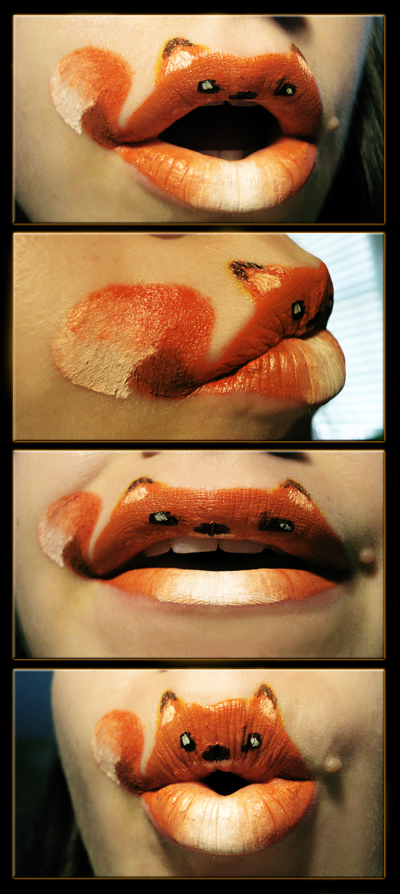
This is one of the things that makes me think of that Arthur Koestler quote: lipstick animals.

Lots more here.

Question
Why 3D doesn’t work and never will. Case closed.”
Roger Ebert quotes Walter Merch, as a Man Who Knows What He’s Talking About, who presents several arguments as to why 3D cinema can never work.

I’ve heard a lot of bad arguments on both sides of this debate, so it’s nice to see someone with a deep understanding of the medium draw out their arguments clearly. My question is, is he right?

Previous Puzzle
Last time I asked how a mouse could fall any distance and survive.

As Phil pointed out, the statement is strictly false: “a mouse certainly can’t fall further than the size of the universe, for example.” So instead we restrict ourselves to consider mice falling off things that are attached to the earth, and no higher than the point at which the atmosphere becomes too thin for a mouse to breathe, and that the survivability criterion is assessed upon landing, and that the landing area itself is not deadly to mice.

First we must address the idea some people recall from school that all objects fall at the same speed, as per Galileo’s thought experiment and his apocryphal dropping-objects-from-the-tower-of-Pisa experiment. This is clearly false as a feather falls more slowly than a hammer, and the confounding factor is air resistance. Rather excellently, the hammer-feather experiment was conducted on the moon to show that in the absence of significant air resistance, they will actually fall at the same speed:

When air resistance is introduced the shape and particularly the downward-facing area dimensions of the falling objects matter, and although it’s hard to have a good intuitive feel for this when comparing such random objects as animals, I find it’s much easier to imagine a kind-of equivalent parachute with a weight attached.

A small parachute with a big bag of hammers attached will be pulled down more quickly than the same parachute with a feather attached. Alternatively, if two parachutes have equal weights attached, but one parachute is much bigger than the other, it’s easy to imagine that the bigger parachute has greater air resistance and so will fall slower.

Now if we imagine a parachute the size of a mouse, with a weight attached that is the same weight as a mouse, we can imagine it will fall pretty slowly, particularly compared to a parachute the size of an elephant with a weight attached the same weight as an elephant. So we can intuitively understand that the mouse survives.

Or perhaps we can’t? I realise that wasn’t very scientific, but I tend to prefer thought experiments of this kind as they seem to help most people grok ideas better than formulae.

This article over at Everything2 also has some concise words to say on the subject of falling animals.