I’ve built up a backlog of interesting videos I think are worth sharing, so it’s time for a Video Special. Whenever someone links me to a video I always have two questions I want to know before committing to a click – how long is it, and do I need sound – so I include this information after each link. [In the blog version videos are embedded so you can see the run time; I’ll just note if you need sound – T.M. 7th August 2011]
Everything is amazing, nobody is happy
Standup Louis C. K. gets some great mileage out of how the incredible speed of technological change is still exceeded by the human capacity to adapt to and take for granted new concepts (sound is all you need):
Mad Skills
“A man who taught himself rock climbing and acrobatics to escape poverty in India” – most amazing climbing move features at 30s (no sound needed):
http://www.youtube.com/watch?v=BPN3gLVDsOY
The idea mill
Assuming I saw the same trigger video, this is the fastest turnaround from an individual’s creative work going viral to the same idea being used in an ad I’ve ever seen (sound optional for all of these):
9th April 2009: “Wolf vs Pig”, using a kind of meta-Stop Motion:
2nd July 2009, 84 days later: same concept used in an ad for the Olympus PEN:
A bit later (as it doesn’t seem to have been officially uploaded), the same thing again, this time for Land Rover:
Simplicity
I find this kind of video reassuring – a simple concept and attention to detail in the execution, rather than incredible extravagance, can still produce a really nice result (sound essential):
Teaser trailer
Christopher Nolan (Memento, Dark Knight) has a new film coming out next year. I think this is my favourite teaser trailer ever, for conveying just an atmosphere and a single fun idea (sound not essential but awesome):
Forthcoming film
“Surrogates” is due to be released in the UK on the 25th of September. An adaptation of a graphic novel, it looks to be a solid Sci-Fi in what I consider to be the technically correct sense: positing a potential technological development, the story investigates what might happen in a society where such a thing is possible.
In this case the development is ‘surrogates’ – robot avatars that people control remotely, an idea just nicely at the edge of conceivable possibility.
I think the trailer gives too much away, so if you want to see the basic premise just watch the first 60 seconds, and I strongly recommend not watching beyond 1 minute and 30 seconds (seriously!) if you can possibly resist it!
http://www.youtube.com/watch?v=L7NWdxFAHdY
Video
I saw a video pair on YouTubeDoubler (here – pause the left video until the right one tells you to start it) in which two people use two webcams together to create a video for a duet, and I thought “Good, but could do better”. Someone did:
(Starts to get clever at 40”, goes nuts at around 3’10”)
Quote
Webcomic ‘Pictures for Sad Children’ suggests an improvement(site was taken down in 2014 – T.M. 17/5/22) on the ever-unsubstantiated ‘never more than 3 meters from a rat’ saying:
“We’re in earshot of two terrible things at all times”
Link
“Freaks survive because they are strange” – a great headline, a slightly silly experiment involving food-bearing model salamanders, and a plausible-sounding partial answer to the ‘maintenance of variation’ problem with evolution.
Potato Puzzle
You have 100 kilograms of potatoes that are 99% water by weight. You store them in a cupboard, and when you test them again a week later you discover they are now 98% water by weight. How much do the potatoes weigh?
Magical Ground Squirrel Puzzle Answer:
If the magical ground squirrel is able to position the bridges (say) East-West with such accuracy that an imp wanting to go North could not work out which one pointed slightly more Northerly and so had to choose randomly, then the squirrel has good odds of working out the result of the election by doing exactly that and leaving the bridges there the entire time.
If the imps are headed to the good training centres in the East and West, there will be no random choice made by them and when they have all come out 500 will have gone East and 500 West.
However, if the imps want to go to the evil training centres in the North and West, they will be choosing a bridge randomly. In that case, there is (by my calculation) only about a 2.5% chance that exactly 500 will choose each bridge. There’s a 97.5% chance more will go one way than the other, and in this case you could be sure they were evil.
Puzzle
Here’s a cute data analysis puzzle, which I’m amazed I didn’t encounter sooner in my line of work.
You run a website that sells guns and banjos, and one day you notice from your web analytics data that the conversion rate of your site (orders divided by visits) is steadily declining over time.
Realising that you essentially cater to two quite different needs, you look at the performance of your two main site sections: the gun section and the banjo section. There is no significant overlap between the people visiting these sections.
Here’s the problem. The conversion rates in both the gun and banjo sections of the site are going up over the same period that overall conversion is going down. How is this possible?
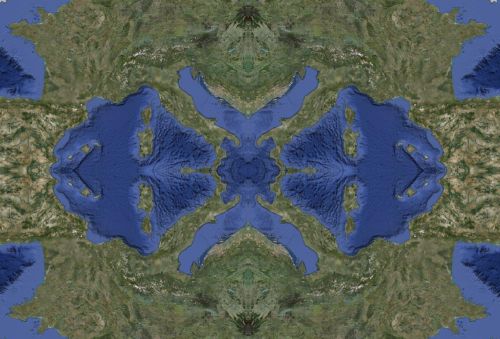
Picture
I’ll let the name of the idea do the talking: Rorschmap.
Puzzle Answer – Cyborgs beat Robots
In the last Things I invited you to guess who would win in a chess match in which humans and computers could team up in any combination.
I recently read of an empirical answer here, which makes the excellent point that there are actually three criteria at work in any team: the chess skill of the computer(s), the chess skill of the human(s), and the friction in the way they work together as a team.
Some may be surprised to learn the most basic observation from the event: that a team of human + computer is much stronger than even an extremely powerful chess-playing computer. As Kasparov puts it: “Human strategic guidance combined with the tactical acuity of a computer was overwhelming.” Humans are useful!
More impressively, the winner of the tournament was a team of two amateur players working with three computers. The lack of friction in their system of working together beat the raw power of chess-playing supercomputers and the strategic brilliance of grandmasters.
This has some serious implications, too. Most simply, since mediocre computers and mediocre humans are more common than highly skilled ones, and since systems can be invented once and then used by all, there is in some general sense much more potential to solve hard problems than we might otherwise have expected in the world.
More extremely, anyone worried about a technological singularity in which we invent AI that is smarter than us (leading to runaway self-improvement of the AI and a very dangerous 4 hours for humanity) can rest assured that human-AI combinations will probably be smarter than pure AI.
“Most problems are side effects of solutions to other problems.” – Eskil Steenberg
Video
Once you have built a machine or robot that can do something, the really cool part is you can then see how fast it can do that thing. In the case of this astoundingly dextrous robot hand, the answer is: alarmingly fast.
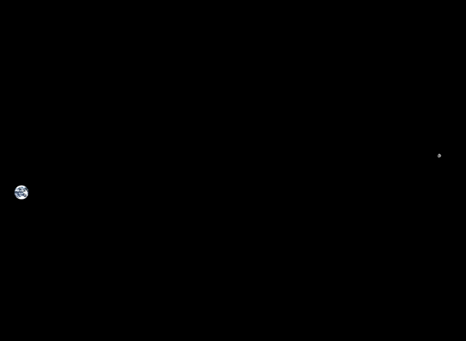
Picture
A simple idea – a picture representing the earth, the moon, and the distance between them, in the correct proportion.
(Click for description and links to bigger versions):
Last Week’s puzzle
Why are ~10% of people left-handed?
Implicitly, the question is really why 10% instead of 50% or 100%, either of which would be intuitively more obvious (although you’d still wonder why it was one out of those two).
A frequently given answer is that in combat there is an advantage to having a handedness that most others don’t have, since you will be practiced at fighting opposite-handers whereas most of the competition will be practiced against fighting same-handers. An increased number of left-handed players succeeding in adversarial sports such as tennis is cited as evidence.
What’s fascinating about this argument is that it manages to sound convincing but it cannot possibly be the whole answer. If there was an advantage to being in the minority, and if that trait is genetic, then we would expect that over evolutionary time-scales a 50/50 split would emerge. (If fewer are left-handed and have a survival advantage by this argument, then more of the next generation will be left-handed, and so on until no advantage remains).
For the theory to work, there would need to be an evolutionary pressure that goes the opposite way, making left-handedness disadvantageous in some way, with the net effect of the two pressures to be a 10% incidence rate.
As it turns out, it seems we don’t have a definitive answer, but surveying the various theories and research presented in this wikipedia article below it seems to be connected to asymmetry in brain development (a deeper question in itself), with cultural effects (such as fighting) giving an additional skew in the short term.
This Week’s puzzle
There’s a very nice puzzle in quantum information theory. This is my attempt to set the same puzzle in less specialist terminology, and although it ends up being quite long, it does involve a magical ground squirrel.
There is an island in the centre of a large lake.
On the island is the entrance to a tunnel that goes deep underground to the imp underground city.
To the North and South of the lake are two evil imp warrior training centres.
To the East and West of the lake are two good imp warrior training centres.
There has recently been an imp general election, and they will either have elected a good leader or an evil one. 1,000 imp warriors will now be allocated a training centre, with exactly 500 allocated to each one. So, if an evil leader has been elected, 500 imp warriors will be assigned to the North training centre, and 500 the South training centre. If a good leader has been elected, 500 imp warriors will be assigned to the West training centre, and 500 to the East training centre.
You are a magical ground squirrel that lives on the island.
A pair of bridges connect the island to the lake shore in opposite directions.
Your magical power is exactly this: you can rotate the pair of bridges so they lie in any direction from the island, so long as they remain directly opposite one another. So you could choose to have one bridge head directly North and one directly South, or one directly North-West and the other directly South-East, and so on. However, you must never use your magic when an imp is on the island or a bridge, as they will notice and put you in their magical animal zoo.
The 1,000 imp warriors are about to be sent out, one each hour, to go to their respective training centres. Imps are highly random creatures, and they also have a pretty amazing sense of direction. They will be coming out in a random order, and they will head along the bridge that most closely matches the direction of their training centre. If the bridges seem to be perpendicular to the direction they want to go (for example, if the bridges lie East and West and the imp wants to go North) then the imp will pick a bridge at random.
Using only your magical ground squirrel powers, what is the best way to work out whether the imps have elected a good or evil leader?
(Note: this is not intended as a lateral thinking puzzle! You just have to decide how to rotate the bridges and interpret the resulting imp behaviour. But I suppose you could try solving it laterally as well. P.S. Imps can cross a bridge in under half an hour).