Categories
Old

Things 42: Baby Chaos, Gigapan, Energy Forecast

(Originally sent March 2009)

Movies
I saw and enjoyed Watchmen. I think having already read the graphic novel helped a lot, but it is certainly an interesting bunch of things to see on a screen in any case. Despite an unhealthy obsession with being true to the graphic novel (I personally think changes do need to be made to present a story in a different medium) the director couldn’t resist pumping up the strength of the characters, thereby undoing one of the most interesting aspects of the original, which was having superheroes that aren’t super, they’re just people who are a bit weird.

Video
A time lapse video demonstrates how babies are agents of chaos:

Link
Gigapan
is a clever system for taking and knitting together photos into a zoomable panoramic image such as this one.

Quote
Last week’s quote about a dog finding a chainsaw was from Disney’s Lilo and Stitch which I highly recommend to everyone.

This week, an amusing line from Rousseau’s ‘Discourse On Inequality’:

“Savage man, when he has dined, is at peace with all nature, and the friend of all his fellow-creatures.”

Puzzle
On the subject of the body’s constituent molecules being replaced every seven years, some interesting things to consider are tattoos, memories, teeth, and ova. A proper scientific answer with real experiments and references and everything can be found here.

Now, a geometry classic: if you had a piece of string long enough to go around the earth’s equator at sea level, how much longer would it need to be if you wished it to be one meter above sea level?

Picture
Below, a rather fascinating forecast of global energy production. Had I been asked to guess, I would have thought the yellow area indicated nuclear fusion, which turns out to be conspicuous by its absence. Presumably on the basis of always being about 30 years away.

(Click for big)

Categories
New

Things 97: Vertical Ship, Climbing Game, State of 3D

Video
A brilliant solution to the problem of stability at sea:

Link
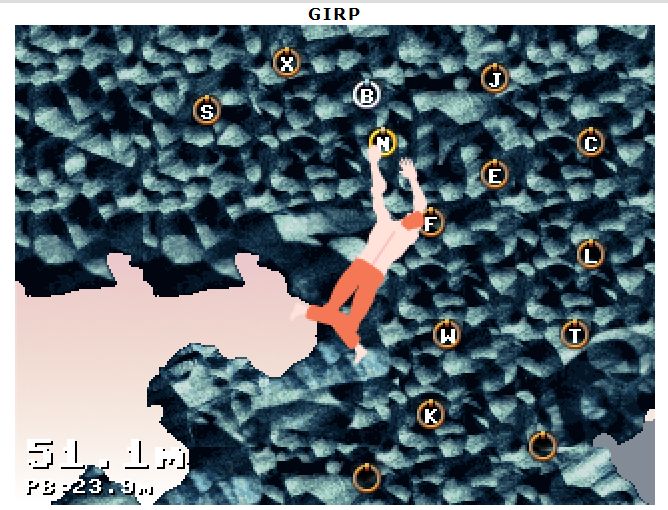
GIRP, a really nice little climbing game (probably easier to get to grips with if you know from the start that feet are not involved).

Quote
Chris Lake, in his self-referential post 10 Reasons Why List Based Posts Work Well Online, makes the key point:

We are all cognitive misers

Question
What is the oldest evidence of your own activity on the internet you can still provide a live link to now?

Last Week’s Puzzle
Last week I asked if it was true what they say, that 3D can never work. I think there are two compelling clues towards an answer here.

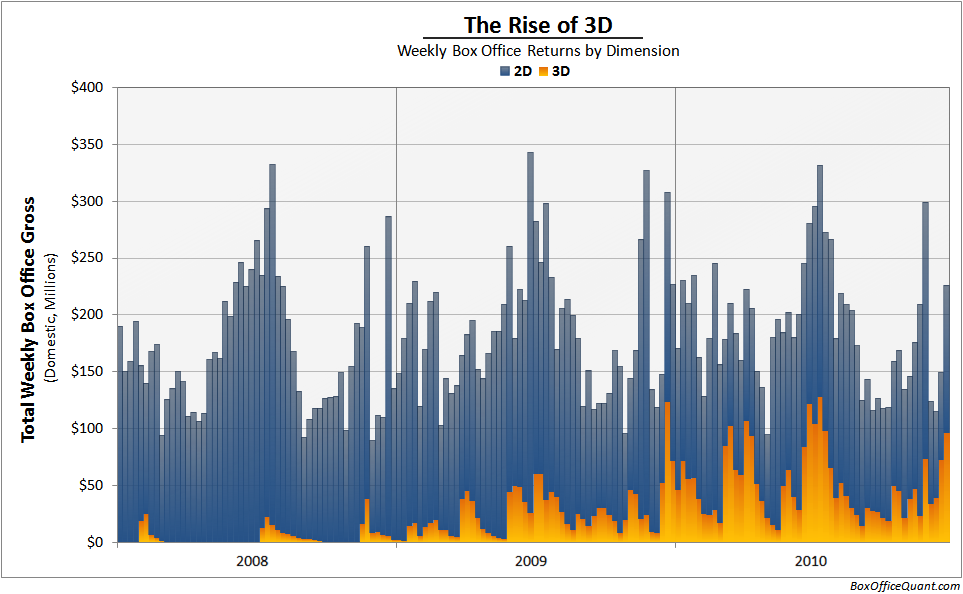
First, Box Office Quant takes a good solid look at what the money in 3D cinema is looking like. The conclusion is that after two years of 3D cinema being a serious consideration, it’s looking pretty solid. There’s lot of great data and visualisation of it over on the original post, but I’ll just reproduce the weekly revenues by dimension here:

It’s clear that something is working, anyway.

On the other hand, there was this development with Nintendo’s autostereoscopic 3DS by its producer Hideki Konno:

“We want to get software out to as many people as possible, and there are some people who just can’t see 3D […] We’re moving away from any stance that says if you don’t use the 3-D functionality you can’t play this game.”

While I’m yet to see some solid data, the picture that seems to be emerging is that a significant minority (10%?) really do have an issue with the convergence/focus conflict that Walter Merch identified (and which is, incidentally, the underlying science behind the apparent paradox highlighted in this XKCD), to the point that watching a full-length 3D movie or spending a significant time playing a 3D game is an uncomfortable experience for them. Naturally there’s also a small proportion of people that for various reasons do not perceive 3D in real life, for whom a 3D film/game has nothing to offer above a 2D one (and I suspect they are being used as a kind of smoke-screen to hide the bigger concerns about the former group in Hideki Konno’s quote above).

It seems that minority is small enough that 3D cinema revenue remains robust, but large enough that Nintendo don’t want to undermine their universal appeal by allowing 3D to be a barrier to participation.

Incidentally, I find it an incredible sign of the times that we now have three dimensional full-colour moving image experiences at a fully commercial scale, which is really quite an amazingly neat trick, and yet so many people I’ve spoken to seem to feel it’s not particularly worth having. Or in Louis CK’s words, “Everything is amazing right now, and nobody’s happy”:

Categories
New

Things 96: Rocket Path-Dependency, Lipstick Animals, 3D Doesn’t Work

Link
When speculating on the subject of extraterrestrial space-faring life, it’s all too easy to forget the many development factors that are likely to be local to us, and to assume that too much of what we have done will generalise to other life forms out there. This article puts forward a compelling argument that our rocket-based space-faring only arose because of certain very specific and not particularly likely events.

Quote
While I don’t think it could be objectively assessed, I rather like Arthur Koestler’s observation on originality:

The more original a discovery, the more obvious it seems afterwards.

Picture
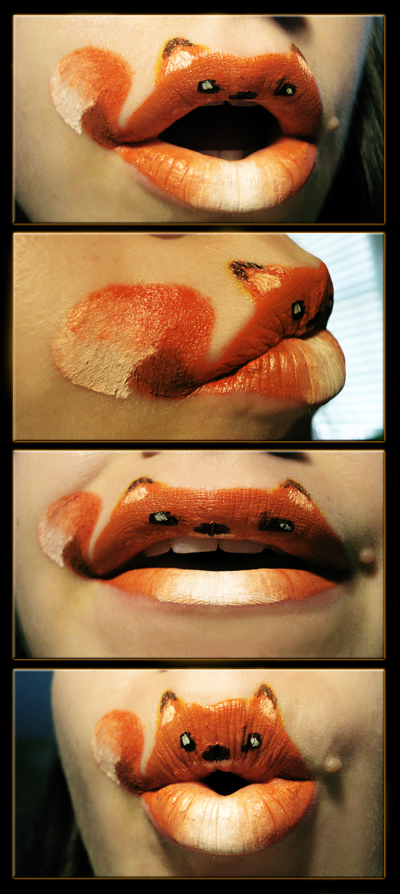
This is one of the things that makes me think of that Arthur Koestler quote: lipstick animals.

Lots more here.

Question
Why 3D doesn’t work and never will. Case closed.”
Roger Ebert quotes Walter Merch, as a Man Who Knows What He’s Talking About, who presents several arguments as to why 3D cinema can never work.

I’ve heard a lot of bad arguments on both sides of this debate, so it’s nice to see someone with a deep understanding of the medium draw out their arguments clearly. My question is, is he right?

Previous Puzzle
Last time I asked how a mouse could fall any distance and survive.

As Phil pointed out, the statement is strictly false: “a mouse certainly can’t fall further than the size of the universe, for example.” So instead we restrict ourselves to consider mice falling off things that are attached to the earth, and no higher than the point at which the atmosphere becomes too thin for a mouse to breathe, and that the survivability criterion is assessed upon landing, and that the landing area itself is not deadly to mice.

First we must address the idea some people recall from school that all objects fall at the same speed, as per Galileo’s thought experiment and his apocryphal dropping-objects-from-the-tower-of-Pisa experiment. This is clearly false as a feather falls more slowly than a hammer, and the confounding factor is air resistance. Rather excellently, the hammer-feather experiment was conducted on the moon to show that in the absence of significant air resistance, they will actually fall at the same speed:

When air resistance is introduced the shape and particularly the downward-facing area dimensions of the falling objects matter, and although it’s hard to have a good intuitive feel for this when comparing such random objects as animals, I find it’s much easier to imagine a kind-of equivalent parachute with a weight attached.

A small parachute with a big bag of hammers attached will be pulled down more quickly than the same parachute with a feather attached. Alternatively, if two parachutes have equal weights attached, but one parachute is much bigger than the other, it’s easy to imagine that the bigger parachute has greater air resistance and so will fall slower.

Now if we imagine a parachute the size of a mouse, with a weight attached that is the same weight as a mouse, we can imagine it will fall pretty slowly, particularly compared to a parachute the size of an elephant with a weight attached the same weight as an elephant. So we can intuitively understand that the mouse survives.

Or perhaps we can’t? I realise that wasn’t very scientific, but I tend to prefer thought experiments of this kind as they seem to help most people grok ideas better than formulae.

This article over at Everything2 also has some concise words to say on the subject of falling animals.

Categories
Special

Things Christmas Special 2008

(Originally sent… okay, you can probably guess)

It’s Christmas and Things has been running for over a year. I’m taking that as an excuse to break with the usual format, and also to highlight what I (and some others) consider to be the best of the year’s Things.

Urgent matters first
I bought 10 tubs of Celebrations chocolates, discovered the average distribution of the different types, then created tubs of each kind and put them on eBay for charity to determine their value. I wrote up the initial results in my new blog:

http://toweroftheoctopus.com/2008/12/the-celebrations-experiment/

The auctions end AT LUNCHTIME TODAY!

Check out how they are doing, or bid if you are so inclined, here:

http://www.tinyurl.com/TimEbay

[It’s long over now, read the final results here – T.M. 22/1/11]

Videos
Here are some videos that I like.

1) Tim ‘Speed’ Levitch is an extraordinary fellow that speaks in paragraphs that would take most other people hours to come up with. In the following video he holds forth on the New York grid plan and builds to a brilliant conclusion.

To sell you his style just a bit more, here’s his spontaneous introduction to a comment on a homeless person he passes while walking down the street: “[that person], under the white comforter, cuddled up with 34th street and Broadway, existing on the concrete of this city, hungry and dishevelled, struggling to crawl their way onto this island, with all of their machinated rages and hellishness and self-orchestrated purgatories…”

2) Somebody put a few frames of an anime featuring a woman spinning a leek around to a brilliantly loopy sample from an obscure band. A massive internet meme was born. Here’s where it all started (reposted).

Wikipedia article on the phenomenon.

3) This is my favourite tune and music video right now, and the intro guy is awesome too:

Pictures
This guy makes armour for cats and mice. Or perhaps more accurately, scale sculptures that resemble such things:

Best of Things 2008

Link:
Worst translated menu in the world

Quote
XKCD on dreams and possibilities.

Video
Acoustic Resonance – rice is used to illustrate standing acoustic waves on what I presume is a metal plate:

Picture
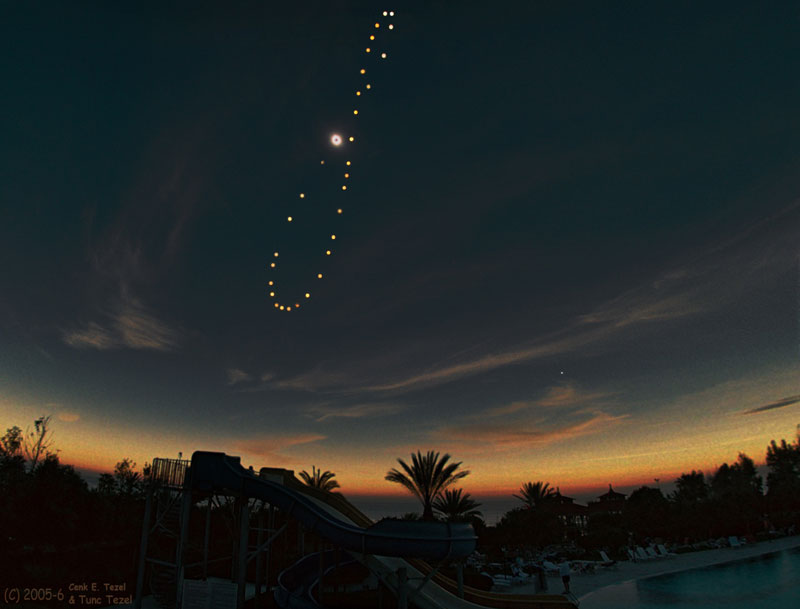
Analemma (click for big):

If you don’t know what an Analemma is, try to work it out from the photo.

Puzzle
The rainbow paradox, remains one of my favourite and (as far as I am concerned) unresolved puzzles:

Soundwaves can vary in frequency across a vast range, part of which we can hear. The lowest part we perceive as a deep bass, the highest as a high squeak.

Similarly, the electromagnetic spectrum consists of a vast range of frequencies, a small range of which we are able to see. The lowest frequency we can see is what we call red, and the highest frequency is what we call violet.

However, while we perceive the ends of the audible sound spectrum to be very different, the ends of the visible light spectrum, red and violet, seem very close to one another, and we even have a colour we call purple that is a mix of the two yet does not actually appear anywhere in the spectrum between them. In fact, we can draw a circle of the colours we perceive and it is not at all clear where the ‘ends’ are.

Why is this?

That’s it for Things until 2009.

Happy Thingking!

Tim