Categories
New

Things 2025 Q3: Neuromancer, Expertise, Consciousness

Brian David Gilbert (BDG)

BDG makes the kind of weird videos I wish I had my act together enough to make. Here’s two examples that show his range.

A short song about hats:

A slightly spooky promotional video about get-rich-quick schemes:

I think we need more of this kind of thing, so please go watch all of his videos and even consider his Patreon.

(Side-note: BDG reminds me of Spike Jonze both as a person and for his creative output.)

Neuromancer and the Prism of Hindsight

I recently read William Gibson’s 1984 debut novel, foundational cyberpunk text ‘Neuromancer’.

It projects ahead to an unspecified time in which everything is online, and hackers enter some sort of cyberspace ‘matrix’ to conduct various shenanigans. It’s also very much about cybernetic enhancement, with some consideration of AI and some space business. It’s noirish and fast-paced but also dense and intense. There’s a lot going on.

My first thought was that being written in 1984, it seems astoundingly prescient about the future online world.

Then I read that Gibson didn’t really know much about computers or networks, he just liked the language of it. So my second thought was perhaps you need to be far enough removed from a thing, like he was, to see where it will lead.

Then I paid attention to the cover of the copy I had been lent (by Nick H), and realised something strange: it seemed to have some of the hallmarks of an AI-generated image.
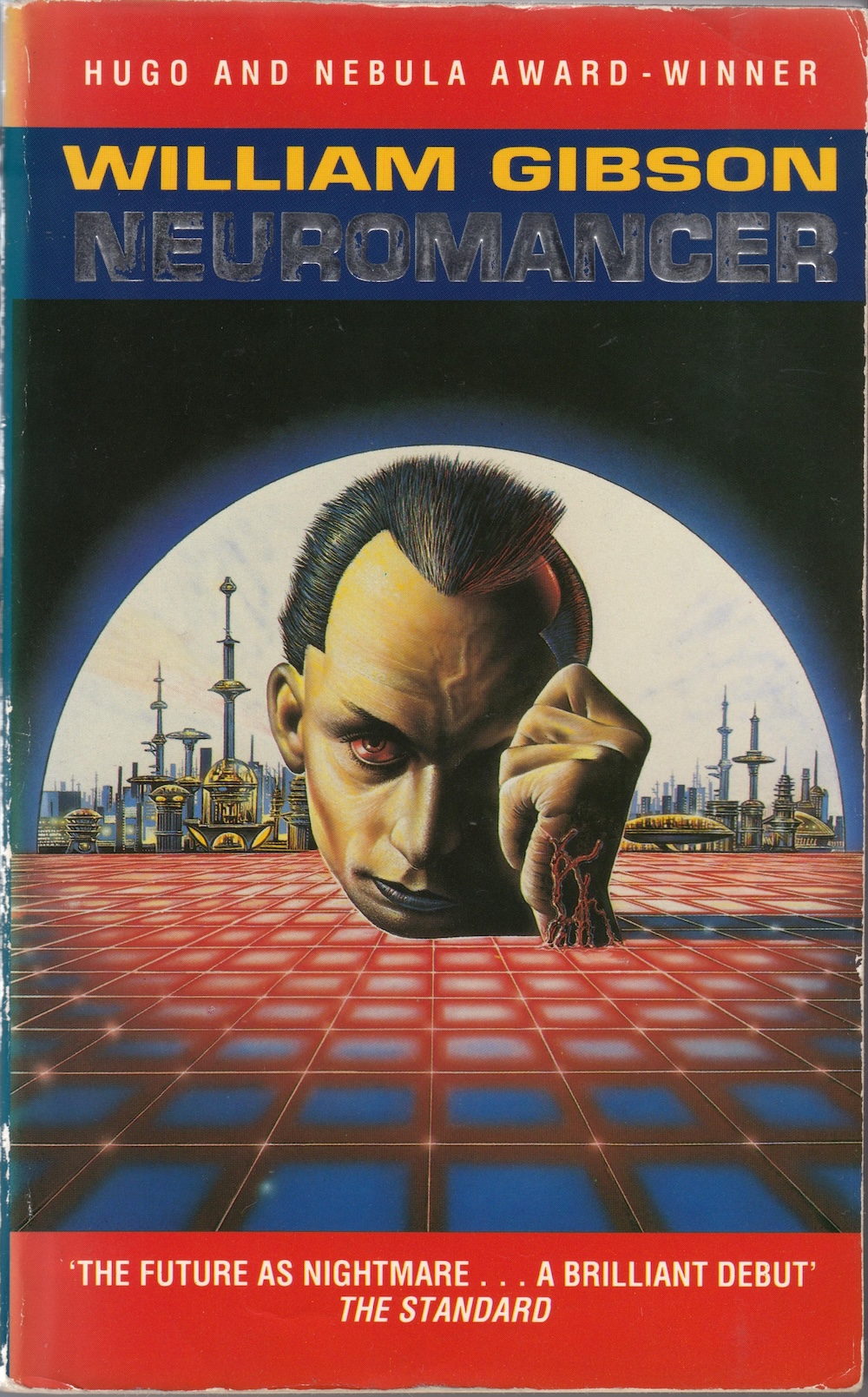
Examples:

  • The core composition is a bit odd
  • The shape of the hairline is dramatically and weirdly asymmetrical
  • There’s a strange artefact on the hand that doesn’t seem specific or prominent enough to represent anything
  • The cityscape in the background has some repeating patterns that a human artist would probably try to avoid
  • Some of the domes in the cityscape seem unintentionally asymmetrical

Of course, this thing was published in 1984, and this art is by a human (Steve Crisp). I’m looking at something from the past through the prism of hindsight; in the context of a “futuristic” image, I’m primed to look for AI signifiers.

So comes my third thought: my thoughts on the book being astoundingly prescient also come through the prism of hindsight.
– I’m discounting everything that doesn’t really add up (the 3D visual interface isn’t realistic or sensible; there’s an eye-hacking thing (I think?) that doesn’t really make sense; the stuff in space seems very fanciful)
– I’m over-reading the things that were prescient (the everything-is-online aspect, the ability to leverage that fact to achieve powerful feats with ‘hacking’
– I’m under-reading the parts that really weren’t prescient, at least so far (the cyber-business and simulation aspects mostly).

This doesn’t really diminish the book – it’s a fascinating and impressive work, building out its own strange reality, and inspiring The Matrix (1999) even more directly than I had assumed. You just have to be a bit careful when judging prescience.

Very Short Animal Videos

Thanks to the Reddit algorithm for serving me these tasty and very short animal videos. They are optimised for portrait though and I use YouTube videos to embed things, so I’m not sure how well this will work:

“My cat will eat anything”:

Eating anything
byu/TheHenanigans inUnexpected

“Cat tries ice-cream for the first time”

he tried ice cream for the first time
byu/tuanusser inholdmycatnip

Sound needed for these:

Surprise:

Trying out a new de-corker when..
byu/fpotw infunny

The Paradox of Expertise

An exchange I saw recounted online and can no longer find went something like this:

A: Oh, do you consider yourself some sort of expert in vaccines then?

B: Well yes, I studied medicine and specialise in vaccines

A: Don’t you think that makes you biased?

Humans are prone to confirmation bias. We tend to give heavier weight to things that support what we already believe, and lighter weight – or none at all – to those that contradict it.

What I find even more insidious is a kind of second-degree confirmation bias: we discount someone’s remarks as being due to their confirmation bias… due to our own confirmation bias. For example, someone might doubt a particular bit of well-evidenced medicine, but when they hear a medical expert defend that thing, they assume the expert is only defending it due to the expert’s own confirmation bias.

Without getting deep into the concept of hierarchical trust networks, this is quite difficult to cleanly dissect, because confirmation bias is a real thing.

For example, you may recall that Researcher Bias exists*: a researcher who believes that an experiment will yield a certain outcome is more likely to end up getting that outcome, even if they are not intentionally manipulating the experiment to that end.

*But aren’t the studies looking into Researcher Bias suspect? As I wrote about in Things 133, a meta-analysis and even a meta-meta-analysis cannot satisfyingly answer this question.

You also see this in Planck’s principle: “A new scientific truth does not triumph by convincing its opponents and making them see the light, but rather because its opponents eventually die and a new generation grows up that is familiar with it” – colloquially and bleakly paraphrased as: Science progresses one funeral at a time.

Or the Upton Sinclair quote:

It is difficult to get a man to understand something, when his salary depends on his not understanding it

If all this sounds a little vague and theoretical, I recently faced it head-on: a small stand of bamboo began to spread in my small garden. I know that some particular species of bamboo can spread very aggressively and do real damage. So what I need is an expert who can identify what kind of bamboo it is, and then I’ll know if I need to pay for some other expert to help get rid of it.

The trouble is those two experts are the same company. They will assess the bamboo for you, and then if they think it needs to be removed they will offer you the (quite expensive) service of removing it. The obvious question is: can I trust them to diagnose it correctly, if they know they can make money from one particular diagnosis? (My best guess for this was to at least consider the opinions of two different experts).

The same can be said of any product you buy in which the amount of it you should use is unclear. How many Aspirin should you take, how much sunscreen to put on how often, what collection of skincare products? The people who make these things should really know the answer, but they also make more money if they can convince you to use more than you need.

Infamously, Alka-Seltzer increased sales by normalising the use of two tablets instead of one through their advertising (and tagline, ‘plop plop, fizz fizz’, or ‘plink plink fizz’ in the UK). Still, the origin story (Snopes link) does at least suggest this did originate with a doctor suggesting two would work better than one.

This also runs the other way – a product could offer a legitimate advantage, but by default we don’t believe it when they tell us. I recall the story of a certain battery manufacturer having a significant research breakthrough making their batteries as much as 20% more efficient, an advantage they kept for a few years. Unfortunately from the consumer perspective, all batteries are claiming some kind of mysteriously special efficacy, so it’s hard to trust any one of them as being particularly meaningful. (I wish I could remember who this actually was!)

One possible answer here is Which?, who try to assess consumer product effectiveness with scientific tests. Of course, when they find a product doesn’t do what it should, the manufacturer will usually counter that they didn’t test it properly, and claim that they have a better understanding and more accurate test of their own product. Depending on the product in question I tend to find this more or less compelling.

So what, really, should we do about this?

In some cases, as I alluded to earlier, there are ‘trust networks’. I don’t need to trust a single vaccine expert on their effectiveness, because they are endorsed by thousands of disparate experts, and disparaged by a small number of non-experts (who can also have their own biases, if for example they are selling an alternative).

In other cases the direct incentive structure seems to run very strongly one way – it doesn’t seem to me that climate scientists finding evidence for climate change benefit from that conclusion anywhere near as much as climate-deniers trying to sell you an online course about their views benefit from people believing their denial.

For substances such as sun-screen and painkillers, the proper quantity to use tends to be endorsed by professional bodies, not just the people who sell them. In the case of painkillers you are of course free to experiment with a lower dose and judge the results for yourself.

When it comes to academic research, you can often look into the funding source. If a study casting doubt on climate change is funded by a big oil company, maybe it’s worth looking for other studies.

It feels like I’ve climbed all the way up a mountain of concern only to climb all the way back down again, so, er, maybe it’s fine???

Emel – the Man Who Sold the World

I enjoy David Bowie much more as an actor (Labyrinth, The Prestige) than as a musician, but this cover of ‘The Man Who Sold the World’ stopped me in my tracks. Emel’s delivery seems much more suitable for the slightly spooky lyrics than Bowie’s, and the extended glissando vocal at the end was so compelling I bought a Theremin (this one) in an ultimately misguided attempt to find a way to make a similar sound.

The Science of Consciousness

Here’s the ‘hard problem of consciousness’ as David Chalmers puts it:

It is widely agreed that experience arises from a physical basis, but we have no good explanation of why and how it so arises. Why should physical processing give rise to such a rich inner life at all? It seems objectively unreasonable that it should, and yet it does.

I had previously thought there was nothing interesting here. We only have our own experience of consciousness to go on, so it seems unjustified to consider it “objectively unreasonable”; this is just how it turns out and there’s nothing more to say. (Previously I wrote about Chalmers’ other formulation, the meta-hard problem of consciousness, although perhaps I misread his intent).

I read the book “Being You: a new science of consciousness” by Anil Seth, and I’m excited to have slightly changed my mind as a result!

An argument against there being anything about consciousness to dig into is the ‘philosophical zombie’: a creature that in every way resembles and reacts like a normal human but lacks consciousness. This is easy to imagine, and suggests there’s nothing you can “do science on” because there’s no way to distinguish the zombie from a human that does have consciousness.

Seth makes this counter-argument: “Can you imagine an A380 flying backwards?” In one sense, this is easy – just picture a large plane in the air moving backwards. But “the more you know about aerodynamics and aeronautical engineering, the less conceivable it becomes”. The plausibility of the argument is “inversely related to the amount of knowledge one has”.

One could imagine the same thing applies to consciousness – it does seem like if you deeply understood the way in which consciousness arises, “imagining” a philosophical zombie would be a lot harder. That does seem fair to me!

But still, how do you find a way in to this topic?

Seth’s answer is what he calls the ‘real problem of consciousness’: to explain, predict and control the phenomenological properties of conscious experience. Still difficult, but at least something specific to aim for.

His first way in is to consider how we might measure how conscious someone is – specifically the level of awareness rather than wakefulness. The diagram below shows how different states sit across these two axes.
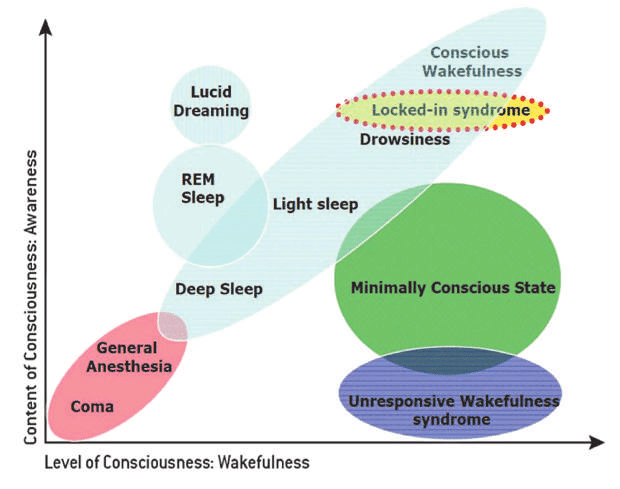
So we’re looking for some kind of measurement that would show regular conscious wakefulness as having a similar level to lucid dreaming, for example.

He talks about some interesting research showing that a measure of the complexity of electrical signals in the brain seems to correlate well with what we think of as consciousness. Even better, there are tests that can distinguish someone with ‘locked-in syndrome’ (conscious and aware but unable to move any part of the body) from someone in a ‘vegetative state’.

A simpler precedent to the complexity model is this: simply imagining playing tennis produces a detectably different pattern of brain activity to imagining navigating a house. These two kinds of thoughts can therefore be mapped to ‘yes’ and ‘no’, enabling someone with locked-in syndrome to communicate. This dramatically debunks my thought that there was nothing useful to look into here!

Unfortunately, the rest of the book gets quite a bit heavier and less compelling.

First there is Giulio Tononi’s “Integrated Information Theory” (IIT) of consciousness. Put tersely it posits that consciousness is integrated information – kind of a huge claim as it arguably means even atoms are perhaps a ‘little bit’ conscious. It suggests a very specific measure of consciousness: Φ (Phi), essentially how much an information system is more than the sum of its parts.

This theory doesn’t seem to go very far just yet. Seth’s summary of where it is at:

…some predictions of IIT may be testable […] there are alternative interpretations of IIT, more closely aligned with the real problem than the hard problem, which are driving the development of new measures of conscious level that are both theoretically principled and practically applicable.

So it seems we just have to wait to hear a bit more about that.

Next is the Karl Friston’s “Free Energy Principle”. In this, the term ‘free energy’ can be thought of as a quantity that approximates sensory entropy. The clearest summary Seth makes is this:

Following the FEP, we can now say that organisms maintain themselves in the low-entropy states that ensure their continued existence by actively minimising this measurable quantity called free energy. But what is free energy from the perspective of the organism? It turns out, after some mathematical juggling, that free energy is basically the same thing as sensory prediction error. When an organism is minimising sensory prediction error, as in schemes like predictive processing and active inference, it is also minimising this theoretically more profound quantity of free energy.

This is not really a theory of consciousness but, Seth considers, something that will help explain consciousness eventually. I get the impression Seth understands this enough to see how it might be of value, but not well enough to explain it so others can see that – at least not me.

Finally Seth considers the possibilities of animal and machine consciousness, and largely concludes it’s very hard to say anything about these, which is a bit disappointing but is also quite fair.

To summarise, I thought there was nothing useful to say or do about consciousness, but after reading ‘Being You’ I now think that’s wrong; it seems like there is something to dig into here, but so far our theories are only just scratching the surface of it.

(If you want a more detailed recounting of the book with added commentary, not all of which I agree with, you can read this long review by ‘Alexander’ on LessWrong)

  • Transmission ends
Categories
New

Things 2025 Q2: Constraints, Polarised light, Kuleshov, Infohazards

Artists vs. Constraints

The medium of any given art form creates restraints or encourages certain properties in the art itself.

For example, movies and theatrical productions are somewhat constrained in duration by the capacity of the human bladder. Paintings tend to be painted at certain scales that are easier to perceive, to distribute, and to display. Writers paid for serialised content (such as Charles Dickens or people writing for a long-running TV series) can often see better financial returns if they can find a way to spin the story out for longer.

Here are three examples of this I find particularly pointed.

1 – Tintin

The Tintin comics were originally serialised in a newspaper supplement one page at a time. To entice people to purchase the next newspaper, it helps if there’s a cliffhanger of some sort at the end of each page. I found it very hard to read a collected Tintin comic in full once I spotted this pattern, because it turns out just about every single page contrives a cliffhanger, sometimes in a very silly way.

Two classic end-of-page cliffhangers
Two of the milder end-of-page cliffhangers
Example of a decoy end-of-page cliffhanger

2 – Lubalin internet drama

Lubalin is a musician who (among other things) sets internet drama to music – that is, he takes slightly deranged exchanges (typos and all), and arranges them to music. Execution is everything, so check out part 1 as an example:

You can check out the rest in the series here.

The constraint here is that the current dominant algorithms really like 1-minute videos (specifically TikTok and Youtube shorts). In a ‘making-of’ video you can see the edited highlights of Lubalin constructing one of these songs. The notable moment comes at 8m 42s (link to that timestamp) when he plays what he has developed in full and is horrified to find it is quite a bit longer than a minute! So he has to adapt.

Noooo!! It’s like… double the length!

You get to see the constraint impact the art directly – and I think you can see how it slightly helps, but also slightly hinders. (You can skip to the final 1m song here)

3 – Calvin and Hobbes

Finally, Bill Watterson’s comic ‘Calvin and Hobbes’ was syndicated to newspapers between 1985 and 1995. The constraints on the Sunday supplement colour format were particularly harsh: panels 1 and 2 had to be optional (as they are sometimes dropped for space), and there had to be panel breaks in certain places so the comic could be reconfigured as necessary to fit a full, third or quarter-page format.

Panel breaks must fall where specified (but you can have more). Panels 1 and 2 must be optional. Sheesh!

Eventually the strip grew popular enough that Watterson was able to mandate a single full-page format – which is still a constraint! – with some excellent results. Check the 25 examples here to see the range possible (note, just the ones in colour are the ones where these specific rules apply or were eventually avoided).

What do we conclude from this?

I like the two opposite reactions one can have:
– Take something wildly inappropriate for the constraints of the medium and try to cram it in anyway.
– When you can, question those constraints and see what you can achieve if you break some of them.

Perceiving Polarised Light with Haidinger’s brushes

This is incredible to me: it’s actually possible to perceive polarised light with your very own human eyes! Find an area of pure white on a polarised LCD screen (very likely whatever you are reading this on), then tilt your head from side to side. Faint bow-tie shaped areas of yellow (and apparently blue, but not for me?) will briefly be dimly visible as you tilt your head, caused by polarised light. Read more here:

https://theconversation.com/polarised-light-and-the-super-sense-you-didnt-know-you-had-44032

An advert where a bear directs a film

This is one of those adverts where the creative agency has so much fun with the execution that the purpose of the ad seems a bit of an afterthought. I love it!

This thing is 13 years old now and I keep going back to it every few years so I’m giving it official Thing status:

Bonus bear content via Clare:

Wildheart Animal Sanctuary on the Isle of Wight recently rescued two bears that had grown up knowing only cages and concrete – article here. They raised the funds for a purpose-built large natural enclosure. The bears arrived recently and have been exploring their new home. You can try to spot the bears via one of the live-streamed cameras, or watch them explore their new habitat in recent videos such as this one.

The Kuleshov Effect (via Josie)

Terse description from Wikipedia:

“The Kuleshov effect is a film editing (montage) effect demonstrated by Russian film-maker Lev Kuleshov in the 1910s and 1920s. It is a mental phenomenon by which viewers derive more meaning from the interaction of two sequential shots than from a single shot in isolation.”

When moving pictures first became possible, it was not obvious that a ‘cut’ would be something a viewer would accept, and early movies were often presented with very few cuts following the established art form of the play.

It turns out several dramatic things happen in the human mind with a cut:
1) An instant change in perspective is … just completely acceptable!
2) Much like Grice’s maxim of relation in language, we assume a cut within a scene has meaning – for example, if we see a character notice something off-screen, then cut to a thing, we assume they are looking at that thing. The mild version of the Kuleshov effect.
3) Building on top of the above point, the full surprise of the Kuleshov effect is that we may even overinterpret the images either side of an edit to have them make more sense!

You get essentially the same effect in comics or any sequence of panels, for example just putting these two images together implies they are related, and our mind invents a story:

You can also see the same effect distilled in GIF form:

You also get a version of this when giving a slide presentation – you can accompany some text or spoken word with an illustration, and the mind of the viewer will automatically interpret them together. This is why a presentation can be improved even with some barely relevant images!

Beyond that, I think there are even weirder effects somehow going on that relate to how we process movies:
4) Non-linear editing, in which edits go forward and back in time (such as Memento, The Prestige, Speed Racer) are also fully comprehensible, if handled carefully
5) Non-diegetic music (music that is not happening in the scene, e.g. the sound of a John Williams score in a space battle) weirdly doesn’t seem weird

One of my favourite examples of this: from pure sound design and Kuleshov effect, Rian Johnson conveyed Rey and Kylo communicating with one another across space in The Last Jedi with nothing more than an edit.

Another corollary is that you can splice new footage into old, and if you take advantage of how we interpret edits, you can recontextualise the old footage to make it seem as if, for example, Star Wars characters are drinking Cristal Beer.

Anti-basilisks

Before we begin, some necessary context: an “infohazard” is information that could harm people if known. There are many tweaks, shades and nuances to this; you can find ‘fun’ examples over at the SCP Foundation (their wiki page on the topic; search for SCP entries tagged as infohazard here), or this very enticing trailhead I have not followed at Lesswrong: “a typology of infohazards”.

Below I’m going to describe something that some consider to be an infohazard, or just dangerously adjacent to one. I will go on to explain why actually I don’t think it is (although the adjacency remains possible). This is the last Thing in the post, so if that freaks you out you can just stop now!

I will give you some space to do so.

I’m referring to Roko’s basilisk, which is nicely summarised on Wikipedia. It’s a theoretical superintelligent AI that we could build which would “punish anyone who knew of its potential existence but did not directly contribute to its advancement or development, in order to incentivize said advancement”.

So, you see the problem. It’s clearly a very stupid thing to build, but now you know about it, so you can infer that other people know about it, which means that some of them might eventually have the means and motivation to build it, which in turn maybe means you should help them do that to avoid this ‘punishment’ – probably at minimum by telling more people about it!

The first version I encountered contained the threat that even if this basilisk does not come about until long after I’m dead, nonetheless it would review history and then simulate the minds of the non-contributors in order to punish them. At first I felt no concern about what may happen to some theoretical simulated me, but I suppose the real threat is that the ‘me’ right now might actually be the simulation it is running rather than the original me, and as such I am not safe!

So, maybe if you squint hard you should worry about this a bit, but my counter is that if such a thing is possible, many other similar things are possible that could easily cancel this out.

The anti-Roko’s-basilisk

A superintelligent AI that destroys any instance of Roko’s basilisk it can find, and will reward (or retroactively simulate rewarding) anyone who helps bring it about.

The double anti-Roko’s-basilisk

It’s like the anti-Roko’s-basilisk but it also specifically rewards anyone that would be punished by a Roko’s basilisk twice over (perhaps by simulating two instances of them having a great time), and anyone who helps build it three times over. So you should definitely build this one, and even if you don’t, maybe other people will, and it more than cancels out the antics of Roko’s basilisk.

At this point I think it’s pretty clear we’re just inventing imaginary monsters having imaginary fights, making the whole thing seem quite childish and inconsequential, and certainly not motivating enough to start worrying about making or not making any such things.

Anyway, just to keep things sufficiently spooky, let’s talk about adjacency.

LessWrong was founded by Eliezer Yudkowsky, and when LessWrong user Roko posted the original formulation of the basilisk, Yudkowsky gave an uncharacteristically blunt response and banned the topic for 5 years (as recounted in the Wikipedia article). It did look like a bit of an overreaction, but as that article goes on to recount, he later explained (or post-rationalised) his reaction, most notably with this:

“The problem was that Roko’s post seemed near in idea-space to a large class of potential hazards, all of which, regardless of their plausibility, had the property that they presented no potential benefit to anyone.”

I find that idea quite compelling. It’s very hard to know how large this hazardous part of idea-space is, but it seems like it could be non-zero. I can imagine using the basilisk concept as a springboard into conceiving the most hazardous ideas possible, but at this time I am choosing not to do that, because there really is no potential benefit to anyone.

What about the opposite… the infobeneficial? Well, hopefully that’s everything else you find in Things, at least to some extent.

  • Transmission ends
Categories
New

Things 2024 Q2: Project Lyra, Baseline Scene, Singularity

Correspondence on dancing and music in movies

Last time I spoke about temp tracks, and the use of an end-of-film dance sequence as a nuanced way to wrap up a narrative.

Tarim points out that Edgar Wright’s Baby Driver (2017) is an excellent contrast to a temp track, in that it has many sequences precisely written, choreographed and edited with a very particular song in mind. I had hoped to see this catch on as a trend but have so far been disappointed, so do let me know of anything similar I missed.

Miranda pointed out that in video games, Frog Detective also features the Dance Party Ending trope, which makes me want to play it even more.

Finally Ben notes that Der Hauptmann / The Captain (2017) does something at the end that is not dancing but is nonetheless unexpected and produces an interesting overall effect. I’ve not seen it yet but that does sound pretty intriguing.

Real-world puzzle: Frit

In Things June 2022 I invited you to consider “How do rice cookers work?” as a sort of real-world puzzle one could solve just by thinking about it.

Similarly, frit is the name for the black spotted band you see around the edges of car windscreens or train windows. But why is it there and why does it look like that?

As a clue on how deep to go, from what I have now read there are three parts to the answer, all of which I think you could work out just by thinking about it – if you have enough background knowledge of how the science of this sort of thing works.

Chasing ‘Oumuamua

In 2017, an unusual celestial object (NASA description), uniquely cigar-shaped, was observed rapidly entering the solar system before being slungshot (at 87.3 km/s) by the Sun in a different direction, in what looked like an Oberth maneuver – and even sped up slightly as it left! Tantalisingly, and if you are prepared to get tremendously speculative, this is just the sort of thing you might expect an object created by a Non-Human-Intelligence to look like and do. But it was travelling far too fast for us to stand a chance of sending anything out to take a closer look at it.

Or was it? Project Lyra explores the possibility of finding some kind of trajectory through the solar system that could catch up to it, and impressively actually found a way. Launching a craft in 2030 and pivoting it around Jupiter to launch into its own Oberth maneuver around the sun and catch up with ‘Oumuamua by 2053 – albeit passing it at a relative speed of around 26km/s. It’s not clear if we can build a craft that can actually achieve such a feat, let alone muster the ability to fund it, but it’s a pretty fascinating possibility.

A nice animation of this path can be found with this twitter/X post. If you don’t have an account you can try this YouTube video which edits it to Lynyrd Skynyrd’s Free Bird to greater/lesser effect.

This great astronomy.com article goes into detail about possible explanations for the object (even that acceleration), and multiple methods being investigated to get a closer look at it.

One of my favourite parts was a note on the scale of distances involved. One Astronomical Unit (AU) is the average distance from Earth to the Sun. Travelling at such an incredible speed, in one hundred years ‘Oumuamua will be about 150 AU away from us. In comparison, Proxima Centauri, the closest star to the Sun, is more than 268,000 AU away. While I already understood that interstellar distances are very very large, this helped me put it in better context.

Video round-up

If you’ve not seen her before, Diane Morgan’s fictional character Philomena Cunk is an “ill-informed investigative reporter”, interviewing subject-matter experts and opining on various matters with a playfully unhinged level of naivety, weaving a kind of verbal slapstick with sudden darts of dark satire (sample quote interviewing a professor of imperial history: “Was the British Empire evil like it was in Star Wars?”)

The approach is very silly and sometimes effective, but the stand-out moment for me is her interview on the topic of nuclear weapons, which possibly only lands if you’ve seen her other stuff:

https://www.youtube.com/watch?v=DGrLUNpF7H4

Last time, I wrote about LCD Soundsytem’s “New Body Rhumba”, after which YouTube convinced me to watch some of their other music videos. An excellent highlight of this back-catalogue is the video for Oh Baby, directed by Rian Johnson and telling a short story that I think would be of interest to Things Readers. (Do note that the music and video both take 35 seconds to really kick off):

When I was a kid I said my favourite TV show was the adverts. Perhaps this was a golden age of the form, or perhaps kids just love short-form video wherever they can get it, but in any case one of my favourites was Cog – I literally have it on DVD! So I was very happy to find this behind-the-scenes video about how it was made:

Recommended Media

Spy x Family

As an anime on Netflix, this is notable for being both interesting and comparatively available even to people who don’t usually watch anime. It’s best thought of as a sit-com with a very silly ‘sit’: in an incongruously average Western setting (German style place names, European architecture, English character names, American school buses, vaguely cold war era), a fake family is formed where none of the participants know about the secret lives of the others. Watch the first two episodes to see how this pleasingly mad premise comes about and judge if this kind of silliness is for you!

Delicious in Dungeon

Another anime on Netflix that might appeal to people who don’t usually watch anime! This one is a bit of a wolf-in-sheep’s-clothing. It initially appears to be about a D&D-style dungeon crawl with a surprising fixation on recipes you could make with the monsters killed along the way – like a fantasy-themed cooking show.

After a while though it reveals writer Ryoko Kui’s passion for thoughtfiul world-building with an emphasis on systems-thinking, with the party’s success coming from knowledge and curiosity. It also does get quite dark and violent. You probably need to watch at least 5 episodes to see if you’ll enjoy what it has to offer, but for me the journey was definitely worth it. Also do note that the primary female character becomes much less two-dimensional and sidelined over time, as I found this aspect was quite off-putting in the early episodes.

Riddle of Fire

Just reading the premise on the cinema listing got me interested:

“In the rolling hills of Wyoming, three mischievous children are tasked with collecting a blueberry pie from their local store. However, what begins as a simple errand soon evolves into an odyssey across the American West, as the intrepid trio faces poachers, witches, huntsmen, and fairies, who all seek to challenge them on their quest. Will the bonds of friendship prove strong enough to guide them home?”

This very consciously evokes 70’s live-action Disney, with the film aesthetic, the haircuts and even the casting. I was a bit surprised to realise early on that these kids really can’t act (or possibly are being directed that way), but I took it as part of the Lo-fi approach, and ended up spending most of the film with a big smile on my face.

The trailer does a good job of representing it from the very first seconds, this is pretty much what you get:

Blade Runner 2049: subtext and metatext of the baseline scene (no spoilers)

I found Denis Villeneuve’s Blade Runner sequel cinematically striking, but was quite put off by the script’s underlying preoccupation with the elimination of every commonly recognised contribution of women to society (made no less problematic by the suspicion that this wasn’t even intentional). As such I can’t recommend it, even though I do like what the overarching narrative is going for.

Still, I have to respect the ‘baseline scene’, an update and reframing of the original Blade Runner’s Voight-Kampf test, as something strange and mysteriously compelling. This long essay by andi goes into that in a lot of detail, and is worth reading because it justifiably concludes with this excellent remark:

“At this point the text, subtext, and metatext all converge.”

If you know of anything else in any other media that can be described similarly please let me know!

https://cohost.org/mcc/post/178201-the-baseline-scene

Oral History of Lilo & Stitch

If you don’t want to read a long article about depressing sci-fi, how about one about uplifting animation?

A recent rewatch confirmed that Lilo & Stitch is my favourite movie of all time (closely followed by Kiki’s Delivery Service and Speed Racer). It also has one of the best behind-the-scenes content I’ve ever seen on a DVD in the form of a 2-hour making-of documentary that covers all the aspects of film-making I’m most interested in – especially the iterative writing process and the way in which a singular creative vision is realised with a large team.

This makes it all the more impressive that Vulture’s ‘oral history’ finds even more fascinating information about the making of this film. With some very candid interviews with key players, it puts the film in the proper context of this somewhat wobbly era of Disney animation. It’s also a great case study for giving creative works a certain amount of independence from outside interference, and the benefits of avoiding crunch:

https://www.vulture.com/2022/10/an-oral-history-of-lilo-and-stitch-a-hand-drawn-miracle.html

If you like that, even if you haven’t seen the film you might also appreciate their oral history of the Emperor’s New Groove, which is much more of a roller-coaster when it comes to the evolution of the story.

Quote

“Change? Why do we need change? Aren’t things bad enough as they are?” 

Attributed to Lord Salisbury

Why I love the ‘Singularity’ music video

As part of an attempt to add some positivity to the internet, I previously wrote about why I love the ‘Up All Night’ music video.

While there is less to unpack, allow me to present the Jon Hopkins Singularity music video, directed by Seb Edwards. First watch it here, and note that while pondering a metaphorical reading of the action is quite interesting, I am – unusually – much more drawn to trying to interpret it literally:

As with Up All Night, I’ll use the performers’ names for the unnamed leads: Jarkko and Aliashka (source). By the way, if this doesn’t really interest you then feel free to move on as this is the final Thing of the issue!

Your mileage may vary, but the opening worked perfectly for me: all I could see was something incomprehensible and spooky in a forest, and was only able to interpret the imagery when it then recurs towards the end of the video.

We begin in an ambiguous and dystopian-looking setting (actually Belgrade according to this, looks like Block 61 on Google maps) as Jarkko comes home to discover Aliashka mysteriously floating and spinning down from the sky. Immediately we are challenged to interpret what could be going on.

My read is that they do not know one another, but they are curious about each others’ circumstances, and there’s a spark of attraction. The presence of flashing lights and drifting down from the sky immediately suggests something extra-terrestrial, but the amorous developments and eventual arboreal destination suggest to me Aliashka is some kind of fae spirit entering the human realm for the first time.

The next challenge to a literal interpretation is the movement: actions and reactions are almost normal but have a supernatural grace. Jarkko looks confused about this, not sure if he needs to help or evade, and Aliashka seems mostly interested in how he is reacting. My read here is that in a magical exaggeration of the human instinct to read social cues and mirror behaviour, Aliashka’s fae nature ensnares Jarkko, who can’t help but fall into her patterns of movement a little – and later on, a lot.

Ambiguous behaviour reads as threatening, and for a few shots it seems like Jarkko is cautiously backing away but not entering full flight. Aliashka closes the gap, becoming more interested in him – especially as his movements become more dance-like and fluid. I read this as Jarkko beginning to pass some sort of compatibility test.

A sequence of throws might be Jarkko trying to push Aliashka away, but each one turns into more of a dance, and he becomes more enamoured – now no longer backing away, he chooses to follow her up some stairs with her smiling encouragement.

Moving into an embrace that might usually escalate to a kiss, it seems they have both concluded that they have found a romantic partner. But as the music shifts, so does Aliashka’s demeanour. She starts to look frustrated and even sad. This is because despite confirming a baseline compatibility and attraction, she must now submit Jarkko to a more severe process to progress their courtship.

To Jarkko’s bafflement, her movements now shift decisively from ambiguous to physical attacks and throws. He can’t match her supernatural strength, although he can perhaps endure it.

When thrown through the floor, he tries to stand but can’t – not because he is weakened, but because his body is now fully caught up in the rhythm and spin.

In an almost miss-able moment, standing apart, Aliashka hunches and moves her arms – and Jarkko mirrors the movement, or tries to.

He’s not actually being attacked: this is part of the process by which he is brought into sync with the fae. Her attacks change to patterns for him to copy, or encouragement for him to keep going. Her movements become wilder and more desperate as she puts energy into the process, willing him to survive and complete the process of assimilation.

They finally rise and hold one another, locking eye contact, touching heads. Jarkko understands that this was never an attack, but something more like a bonding ritual and a lesson. They bounce in sync and he finally reaches her level – the ability to spin and float! It’s ridiculous and beautiful and represents a sublime level of compatibility.

They drift out of the urban environment and into the woods – her realm, I think. There they finally stop and share a moment, both relieved and cautiously optimistic about where this might go next.

Or, you know, perhaps it’s just a metaphor for a relationship that breaks down and then heals again. But that’s not as interesting.

  • Transmission ends
Categories
New

Things March 2015: Cap D, Bad Advice, The Books, Tube Trivia

I like to share individually great things in Things. But some people just churn out consistently great things, no one of which stands out as a notably better thing… and as a result, they don’t tend to feature in Things. So, this Things is all about those things.

Captain Disillusion

I originally linked to a Captain D video way back in Things 17, but his recent launch on Patreon reminded me that really just about all of his stuff is great, so you should see it.

The Books

If you like the idea of music formed out of obscure samples layered up with surreal folk and an electronic sensibility, The Books are about twice as awesome as you could have hoped. Now no longer together, they leave us with four albums and sense of fathomless loss. Some highlights:

The Animated Description of Mr Maps – notable for the striking synchronisation of percussion and speech at 2’30”:


Take Time – a great example of how they weave samples from a mix of sources to create a strangely resonant overall effect:


Bad Advisor

The Bad Advisor is a Tumblr founded on the observation that in some publications, people write in to advice columns clearly looking for endorsement of terrible decisions they have already made. I used to think sarcasm the lowest form of wit, but the Bad Advisor elevates it to new heights by posting responses explicitly giving the bad advice that was sought.

Some sample moments might help. Concluding remarks on “Help, Our Daughter Believes She Has A Right To Define The Terms Of Her Own Lived Experience“:

It’s strange and disappointing that your daughter has decided to become “cold and uncommunicative” toward her parents, when all you did was inform her that she’s a lying liar whose entire life is a sham and that you prefer the company of the man she says has abused her for the entirety of her adult life so far to entertaining the possibility that your mean old daughter isn’t just trolling everyone she knows for fun, but who knows why an apple would fall from a rotten, crumbling tree and then try to get the everloving fuck away from said rotten, crumbling tree, gravity is a huge mystery and no one knows how it works.

On the subject of “The Only Thing I Love More Than Accepting People For Who They Are Is Telling Them What To Wear When They’re In My Presence“:

The whole entire population of planet earth anxiously awaits your ruling on how they should act and dress in your presence, lest a pair of slacks singularly usher in the end of everything you have ever known or held dear. After all, what if someone thinks your sister-in-law is a man, and then they saw you hanging out with your sister-in-law, thinking she was a man that you were hanging out with?????????????????????????????????????????????????????????????????????????

Just go check out the whole archive, and be sure to read the tags at the bottom of each post which sometimes serve as a kind of Tumblr-version of the mouse-over-text-style extra punchline.


Londonist Londonist: Secrets of the London Tube

A lovely series of videos documenting interesting things about each of London’s tube lines. There’s some nice easter eggs and twists revealed when you make it to the Waterloo & City:


Transmission ends