Categories
Old

Things 37: Ideas of 2008, Centripetal Hamster, Pictures of 2008

(Originally sent January 2009)

It’s 2009. Time for some Things.

A quote
Richard Feynman:

“There are 10^11 stars in the galaxy. That used to be a huge number. But it’s only a hundred billion. It’s less than the national deficit! We used to call them astronomical numbers. Now we should call them economical numbers.”

A link
NY Times ideas of 2008, presented in a fascinatingly browseable format: http://www.nytimes.com/interactive/2008/12/14/magazine/2008_IDEAS.html#w-ideas-3

A video
Hamster demonstrates centripetal force:

A puzzle
Last time I asked if there were more households with dogs or with cats.

According to the data available to me (which covers the UK excluding Northern Ireland), 23.1% of UK households have 1 or more dogs, and 23.2% have one or more cats. So the answer is cats, but by an almost unbelievably small margin.

(6.1% of households have 1 or more cats and 1 or more dogs; there are about 14.7 million dogs and 17.7 million cats).

This week’s puzzle is a classic: the paradox of value.

Water is generally much more useful than diamonds, yet diamonds are more expensive by a gargantuan factor. Why is this?

Pictures
The Boston Globe ‘Big Picture’ section always does the best round-up of a year’s photos. Three pages of amazing images start here:
http://www.boston.com/bigpicture/2008/12/the_year_2008_in_photographs_p.html

Categories
Old

Things 36: Amara’s Law, Wondermark, hahahahah

(Originally sent December 2008)

The ‘Things’ email has existed in one form or another for over a year now. The fact that this is number 36 and not 52 shows that I clearly take too many Fridays off. (Actually it was mainly due to a big hiatus). Anyway, I have this Friday off, but have decided that that is not a good enough excuse.

Owing to the popularity of the chicken video last week and the sort-of anniversary of Things and the approaching of Christmas and the addition of more people to the list over the year, I thought it might be an idea to have a ‘Best of Things’ roundup next week.

So please reply and nominate your favourite items that have ever appeared in Things, and I will use these to compile a top 5, or something. I guess the people that just joined in the most recent wave don’t really have enough to go on, sorry! [Note, not a live question, this was sent in December 2008! – T.M. 22/1/11]

Quote
Roy Amara
:

We tend to overestimate the effect of a technology in the short run and underestimate the effect in the long run.”

Link
Wondermark
is a webcomic that is also a really great example of the value of copyright expiry. David Malki takes images from the 1800s (sourced from the public domain or his own collection of rare books), does a bit of photoshop and then adds speech bubbles.

He’s actually not bad at drawing either, but his writing is really very good, and this enables him to focus on that.

My personal favourite strip is a great example of how he makes humour out of philosophy:
http://wondermark.com/413/

My favourite sequence consists of four strips about getting rich, or not, which begins here:
http://wondermark.com/383/

A good example of his skill as a writer can be found in the following strip, in which there is a well-argued, thoughtful and erudite argument against the advertising for Shrek the Third, in about 60 words:
http://wondermark.com/298/

Puzzle
Last week we wondered why a chicken holds it’s head so still. A bit of Googling didn’t prove it immediately, but I am pretty confident that the reason is this: their vision, or processing of vision, is either movement-based or strongly prioritises movement. A bit like the dinosaurs in Jurassic Park.

This week a bit of estimation for you. In the UK, are there more households with dogs, or more with cats?

A Video (or two)
This video was brought to my attention by Richard. Alan Watts was a dude who knew what he was talking about, and said some wise things. The South Park guys did some animations that went with those things. Here is my favourite:

For you cat/Roomba fans, here’s another video of a cat riding a Roomba – this time the Roomba is behaving normally rather than being remote controlled. It gets a bit repetitive but do skip to the end if you get bored, as Something Happens:

Picture
A shrewd linguistic analysis of laughter:
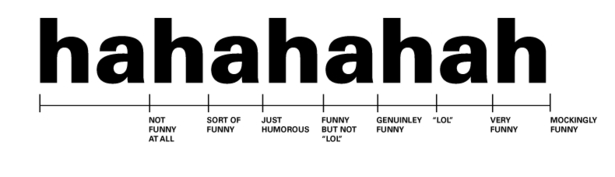
Not really a picture I suppose, but best expressed as one.
Categories
Old

Things 35: Lovefilm, People of the Screen, Chicken Head

(Originally sent December 2008)

I joined LoveFilm last week, mainly so I would know what I was talking about when giving a presentation to them on what I think they should be doing. It turns out they already do a lot of what I had first thought of so I knew to leave that out, and during the presentation I found out that they are planning to do a lot of the stuff I thought of too.

In other words, they do a lot of stuff that I think is good, and are going to do more. My name is Tim Mannveille and I endorse this message.

My Lovefilm profile is here so you can see what I’m doing with the service, and here is my referral link that gives you a 1 month free trial and me a referral bonus!

Films
So, I still don’t have time to see enough films for a Cineworld Unlimited card to be worth it, but the LoveFilm £3.99/month for 2 DVDs is about right. So this week I saw The City of Lost Children, by much the same team as Delicatessen and Amelie. It was visually incredible, inventive and dreamlike, as expected.

IMDb: 7.8/10
RT: 82%

Trailer viewable over at Lovefilm.

A link
While researching quite what is possible in terms of tracking mobile phones, I stumbled upon a bit of real life drama on Google Answers. “I’m trying to locate a friend who has gone missing and may be in a lot of trouble…”

A [long] Quote:
Kevin Kelly knows what he is talking about, and wrote an understated but amazing piece for the NY Times recently. A choice excerpt:

“When technology shifts, it bends the culture. Once, long ago, culture revolved around the spoken word. The oral skills of memorization, recitation and rhetoric instilled in societies a reverence for the past, the ambiguous, the ornate and the subjective.

Then, about 500 years ago, orality was overthrown by technology. […] The distribution-and-display device that we call printing instilled in society a reverence for precision (of black ink on white paper), an appreciation for linear logic (in a sentence), a passion for objectivity (of printed fact) and an allegiance to authority (via authors), whose truth was as fixed and final as a book. In the West, we became people of the book.

Now invention is again overthrowing the dominant media. A new distribution-and-display technology is nudging the book aside and catapulting images, and especially moving images, to the center of the culture. We are becoming people of the screen.”

A Video
Well, this week’s Things has been very serious so far, so it’s time for a video of someone moving a chicken around while the chicken holds its head incredibly still:

A Puzzle
Last week I asked people to guess why the search term ‘uncertainty’ showed such an odd annual trend. The most likely explanation seems to be students searching for Heisenberg’s uncertainty principle – if you put other terms students might be looking up into Google trends, you see the same annual trend cropping up. [Google Insights for Search also helps as it reveals what people tend to actually be looking for when searching for a given search term – T.M. 2/1/11]

This week, the question is: why do chickens keep their heads so still?

Pictures
It still feels like I’m taking Things too seriously, so here’s an article with pictures of loos with the best views.

Categories
Old

Things 34: Uncertainty, Cat on Roomba, Lemurs

(Originally sent November 2008)

Welcome to Things, a weekly email I send around with stuff that I have found or dug out from my archives. This week some new people have been added to the list, so it is now going out to:

6 people at RAPP
2 people that used to be at RAPP
3 members of my family
1 other cool person
1 me

The default is for everyone to receive Things privately. If you are happy to receive it on a CC list so that you can reply-to-all and discuss the contents with similarly interested people, let me know – so far two people from the above list are doing that.

Anyway, on to the Things.

Films
If I had time to see any film this coming week it would be Waltz with Bashir, which apparently breaks new ground both as an animation and as a documentary. (From the trailer it doesn’t actually seem to take rotoscoping much further than Richard Linklater already has with Waking Life and A Scanner Darkly, but it’s still cool).

IMDb: 8.1/10
Rotten Tomatoes: 91%

Trailer:

A link
The McCollough effect is a brilliant optical illusion effect which remains unexplained. Try it out here.

A quote
Tycho, Penny Arcade:

“Innovations are just gimmicks you happen to like.”

Last week’s puzzle
Last time I asked that if regular slow zombies represent the inevitability of death, what do fast zombies represent?

My personal answer is that fast zombies are just a distillation of our worst fears about other people – reduced to pure irrational rage and threat. It also unlocks a primal desire to defend yourself with violence, and by reducing other people to zombies we need not feel guilt about doing violent things to them. (Compare Carmageddon, a game in which the aim was to run people over, but since this was considered unacceptable by the ratings board the people were replaced by zombies).

This week’s puzzle
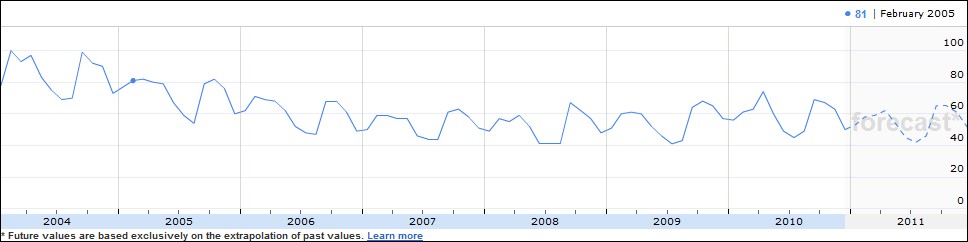
This week, it’s a graph puzzle. Take a look at the trend in search volume for the word ‘Uncertainty’:

It follows a clear annual trend. Why is that?

A Video
A cat riding on a Roomba, which is an autonomous vacuum cleaning robot. Interestingly, 2 out of the 12 people receiving this email own such a device.

Pictures
Google is now hosting the photographic archive from LIFE magazine, including photos that never made it into print. So far they have put up 2 million of an anticipated 10 million images at pleasingly high resolution. You can also buy a print of any image you like, for an only slightly exorbitant cost.

As with all new resources, I tested it out by seeing what it had on lemurs. The answer is: lots. It turns out that from page 2 onwards almost all of the results come from a brilliant photo shoot revolving around a family that has a pet lemur.