Categories
New

Things 123: Game weekends, Puffins, Lilith, Abstract Animated GIFs

Events Sandpit this very weekend (25th August), Weekender later (Fri 14th-Sun 16th September)
Hide & Seek are running one of their curated ‘Sandpit’ game events, taking place on Saturday and Sunday afternoons this weekend (25th and 26th August), unusually but awesomely located at the Natural History Museum. NHM page is here; a longer article about what’s happening can be found on Wired.

Then, from Friday 14th through to Sunday 16th September is Hide & Seek’s Weekender (facebook event here), mostly in the Clore Ballroom in that Royal Festival Hall place, this being as usual a whole festival of games, largely drawn from Sandpit events from the last two years.

This happens to include Competitive Sandwich Making on the Friday, which Clare and I will be running (here’s what happened last year when we ran first), this time featuring a secret rank beyond Earl of Sandwich, if people are competitive enough to discover it. There’s also lots of other amazing things happening, including two of my favourites: Die Gute Fabrik’s Johann Sebastien Joust and Viviane Schwarz’s Treasure Maze.
Tim Link – You’re In A Room
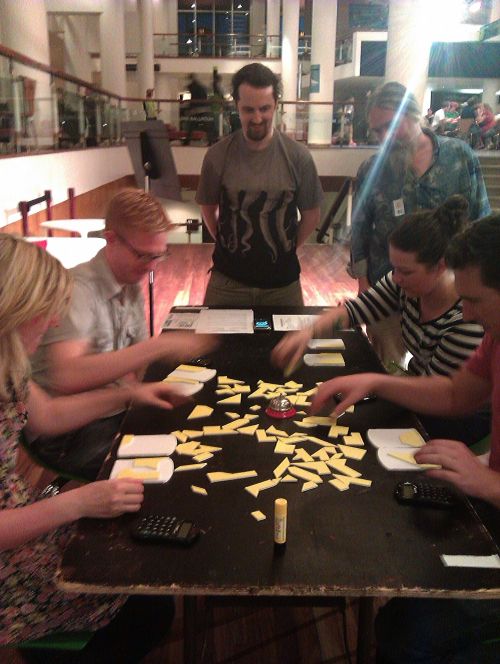
I finally wrote up the game Clare and I made for a more recent Sandpit: You’re In A Room, a sort of Whose Line Is It Anyway version of Knightmare; you can find out what on earth that means here.
Video – Puffin Webcam
In the exciting new world of putting webcam streams onto my TV for background entertainment, now that the Miranda’s Kittens feed is no longer live, I’ve had to find something else. It turns out there’s a whole range of great feeds available on explore.org, including a puffin cam.

Bonus videovia Clare while I was writing this
Dog swims with dolphins!

QuoteLilith
I recently wondered what really is the deal with the biblical (or is she?) character of Lilith, so I turned to Wikipedia on the subject, and found it fascinating – here’s just the section headings to give you an idea of the span of cultural records she appears in:

Mesopotamian mythology
Siegmund Hurwitz
In the Bible
Jewish tradition
Greco-Roman mythology
Arabic mythology
In Western literature
In modern occultism

The highlight for me was discovering that Lilith only appears once in the bible, and even then arguably so, in Isiah 34:

(13) [Edom] shall become an abode for jackals and a haunt for ostriches. (14) Wildcats shall meet with desert beasts, satyrs shall call to one another; There shall the lilith repose, and find for herself a place to rest. (15) There the hoot owl shall nest and lay eggs, hatch them out and gather them in her shadow; There shall the kites assemble, none shall be missing its mate. (16) Look in the book of the LORD and read: No one of these shall be lacking, For the mouth of the LORD has ordered it, and His spirit shall gather them there.

This makes “lilith” (in the bible at least) a hapax legomenon, a word only occurring once in the source and therefore challenging to decipher – given only this context, is she a demon, or just some kind of regular animal with sinister associations?

I also recommend reading this translation of Isiah 34 in full (it’s only ~400 words), as it’s use of hyperbole puts our modern tabloid newspapers and comment trolls to shame.

Pictures – Abstract Animated GIFs
I’ve seen some interesting abstract animated GIFs floating around the internet, and tracked them down to two artists: David Ope, and Mr Div. Here’s one example of each, and do click through to view the rest of their work:
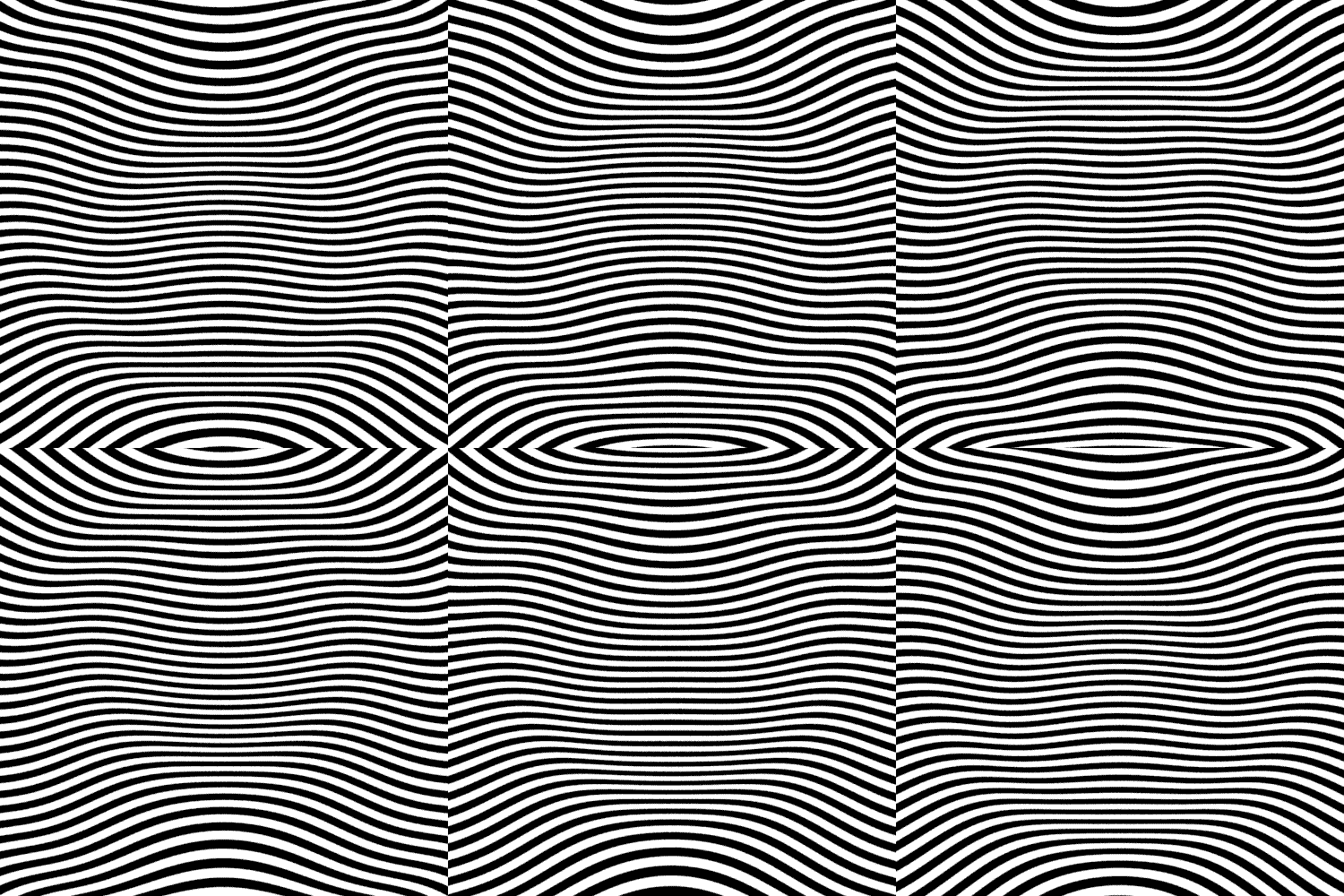

David Ope:

Mr Div:

Puzzle – The shrinking empires
Here’s an unfortunately small version of a fascinating visualisation of world history (which we bought as a poster for the office from Stanfords, although they don’t seem to have them any more), with time running from left to right, and rough location on earth from top to bottom, with identifiable countries/kingdoms/empires marked out:

You can just about see the Roman Empire as a big blob of orange in the middle, the Ottoman Empire in blue towards the right, and the British Empire stretching wide in patches of red before retreating back home by the time we reach the right-hand side representing the present day.

Even at this scale, one pattern is apparent: they just don’t make empires as big as they used to. The closer we get to the present day, the smaller the tribal groups become. Why is this?

Categories
New

Things 122: Linda, Sledding Crow, Brand Promises as Modern Myths

Puzzle The Linda Problem
I see this come up every few years, and get annoyed by it every time. Here’s a typical wording:

Linda is 31 years old, single, outspoken, and very bright. She majored in philosophy. As a student, she was deeply concerned with issues of discrimination and social justice, and also participated in anti-nuclear demonstrations.


Which is more probable?

  1. Linda is a bank teller.
  2. Linda is a bank teller and is active in the feminist movement.

Most people get this wrong. Why?

Usually I follow up on a puzzle in the next edition, but this one is so annoying I’ll address it below, after these other things.

VideoCrow Sledding
The Atlantic has the perfect headline for this video: “Science Can Neither Explain Nor Deny the Awesomeness of this Sledding Crow.”

At the time of writing, their version of the video is down, but this one isn’t:

(Extended version with same amount of sledding but more corvid activity here)

LinkColour perception and language
Ever since reading 1984 I’ve been doubtful but curious about the extent to which language can influence the way we think or even perceive. In a brilliant couplet of articles about colour on Empirical Zeal, I found out about some really nice experiments that demonstrate a real (albeit small) effect, so I highly recommend reading both part 1 and part 2.

ComicMartin Zutis – Being
In a comic shop in Vienna I came upon a small self-published comic, ‘Being’ by Martins Zutis. Packed with surreal imagery and insights that float around the border between madness and brilliance, I particularly liked this observation:

The news reports we don’t question are myths.

Here’s a tiny snippet, or you can read a slightly longer extract here.

Martin Zutis - Being

Answer – The Linda Problem / Conjunction fallacy (see above)
Most people (85%, apparently) will answer that option 2 is more likely, “Linda is a bank teller and is active in the feminist movement.”

At this point the person who set this problem usually laughs like a supervillain and points out that the probability of two things both being true must always be less than or equal to the probability of just one of those things being true. They will say this is a demonstration of the Conjunction Fallacy.

However, these people are wrong. What it actually shows is that if you choose to go against the cooperative priniciple in communication, people will misunderstand you so much that any attempt to isolate the Conjunction Fallacy is lost.

Consider a slightly different scenario:

Boris: I have two sisters. Alice is a bank teller. Eve is a bank teller and a feminist.
James: Oh, that’s interesting. Why do you think Alice doesn’t consider herself a feminist?
Boris: I didn’t say she wasn’t.

When I ask people where the mistake arose in this conversation, the surprisingly consistent judgement is that Boris was “being a dick”.

More formally, as noted in that article on the cooperative principle, we tend to implicitly assume that when someone is telling us something, they will narrow their focus to only that which is relevant. When Boris states that Eve is a feminist, this suggests this information is (for whatever reason) relevant, so the fact is was not noted for Alice strongly suggests she isn’t a feminist.

Some researchers then restate the problem by making it clear that option 1 is “Linda is a bank teller and may or may not be active in the feminist movement”, and still 57% of people think option 2 is more likely. But the assumption of relevance is still a confounding factor: the lead-in to the question is assumed to be relevant (when in fact it’s explicitly designed to be misleading), so I suspect people will be drawn to option 2 more because of this assumption (perhaps assuming they’ve misunderstood some part of the question) than because they misunderstand probability.

The Wikipedia article on the Conjunction Fallacy is much better than when I first reviewed it, covering these concerns and giving a much better demonstration of the fallacy in question.

(As an aside, I will note that I’ve often indulged in similar deviations from the cooperative principle for the sake of setting some kind of puzzle, although hopefully this is usually clear by context – for example, as I asked in Things 4, how far can a dog run into the woods?)

Categories
New

Things 121: Kitten Cam, Chain World, Hand-Waving Explanations

Tim Game Thing
If you ever watched Knightmare and wanted to be the kid in the vision-restricting helmet asking “Where Am I?”, or if you wanted to be the team responding “You’re In A Room” and then frantically shouting “Sidestep left”, or perhaps if you wanted to come up with your own ideas for dungeons for those players to explore, then I recommend you come along to Hide & Seek’s free Sandpit event this Friday 25th May (6.30pm-10pm at the Royal Festival Hall near Waterloo), where I’ll be running a game that gives you an opportunity to do exactly those things.

There will also be a lot of other games going on, which sound pretty amazing, so read all about it, and come along.

VideoCat and Kitten webcams
Which is more compelling: a high resolution webcam of some kittens, or low-resolution webcams you can move around and remotely operate cat toys through (if you’re prepared to use Internet Explorer and Silverlight)?

It turns out that even though the latter sounds superficially cooler and more engaging, it’s nowhere near as good as high-resolution kittens.

LinkJason Rohrer’s Chain World
Jason Rohrer has made some very interesting games (I particularly like Sleep Is Death (or at least the idea of it – I haven’t played it yet), Inside a Star-filled Sky, and Passage is apparently pretty amazing (and very short) if you don’t play it stupidly the first time like I did), so it’s not particularly surprising that he came up with the winning concept in a competition to pitch an idea for a game that in some way represented the abstract idea of religion, and which, when actually released into the world, generated some pretty fascinating results.

Heavily Caveated Film Recommendation
The Green Hornet is a Seth Rogen action/comedy vehicle directed by Michel Gondry. If you analyse that sentence you may realise that this was recipe for disaster. With Seth Rogen starring and also writing (with long-time friend and collaborator Evan Goldberg), there was inevitably going to be some creative conflict with a director as idiosyncratic and driven as Michel Gondry (the man behind some of my favourite music videos).

Trailer: (2’06” is the moment that screams “Gondry!”)

Refreshingly, listening to the commentary makes this very clear, as Gondry, Goldberg and Rogen frequently reference the arguments behind almost every good idea in the movie, and occasionally break into new arguments about them (“We had to convince you that this would work!” “No no no! This was my idea! You guys didn’t want to let me do it!”).

This conflict doesn’t particularly damage the movie, but I ended up wishing Gondry had had more things go his way, because all the really weirdly brilliant parts are unmistakeably his. For example, at one point, the bad guy wants to send a message out through his criminal network, and this is how Gondry represents it:

http://www.youtube.com/watch?v=UA5ZuJdrgyc

It’s also great to hear his enthusiasm for his own ideas in the commentary, as when this scene starts: “This is awesome, look! Two cameras from one camera! How… did… the hell it happen?!” (Answer: they got the actors to stay in position while shooting one part, then came back to them and picked up shooting from the same position, then forced the shot to match in digital post-production, which is fine, but just count the splits and think about actually pulling that off).

The real problems with this film (to save you the trouble, it’s a 6.0 on IMDb and 44% on Rotten Tomatoes) are I think twofold:

1) Goldberg and Rogen consciously chose to reverse many of the staples (some would say clichés) of a superhero movie, which is admirable, but as is so often said, you need to be very familiar with the “rules” of any art form if you want to break them and still have the thing work, so this sentence ends in just the way you would expect.

2) There’s a fine art to crafting an action movie in which the audience can root for the protagonists, even when they’re harming or even killing bad guys. I don’t know how you pull this off, and apparently neither did anyone making The Green Hornet, because these moments frequently feel wrong.

All of which was fascinating, and I don’t regret watching the movie at all.

Answer 2A and 2B – Temperature/Pressure Pairs
Do there exist a pair of points opposite one another on the earth with exactly the same temperature and pressure? I say yes, and here’s my hand-waving explanation for that.

Stage 1
Let T(x) and P(x) denote the temperature and pressure of point x.

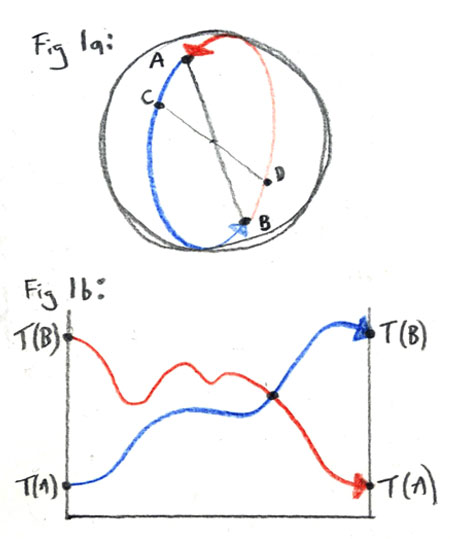
Choose two opposite points, A and B (if T(A) = T(B), do this stage with pressure instead of temperature). Consider a path from A to B (blue arrow in Fig 1a) and the corresponding opposite path from B to A (red arrow in Fig 1a).

In Fig 1b, we chart the temperature of the opposite points as we move around these paths. Just as with the Joss Whedon ascent/descent puzzle, since each line of temperature is continuous, they must cross at least once, and this represents a point at which the temperature is equal on opposite sides of the globe (points C and D in Fig 1b).

Stage 2
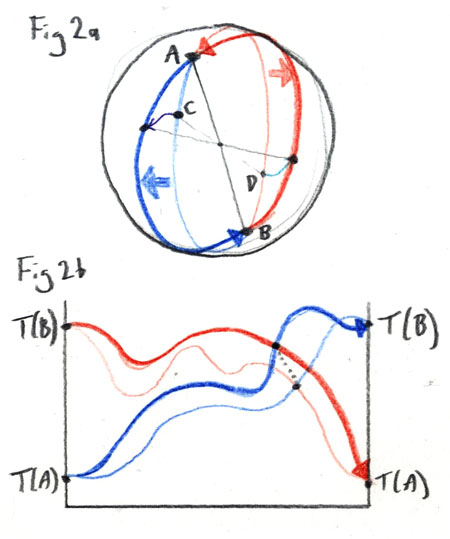
We now imagine rotating the circlular path we’ve considered about points A and B (Fig 2a). As we do this, the lines of temperature move continuously (Fig 2b), but since they always start and end at points A and B, the end temperatures remain fixed, and so the point at which the lines cross also moves continuously.

This starts to trace out a line of equal-temperature-opposite-points on the globe (turquoise and purple lines in Fig 2a).

Stage 3
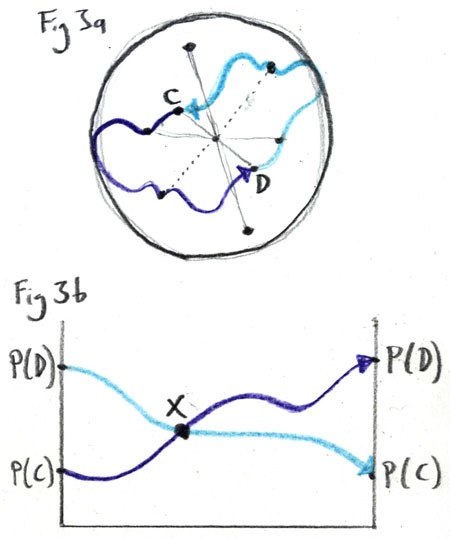
If we continue that rotation all the way around, we trace out a continuous wiggly line of equal-temperature-opposite-points around the globe (Fig 3a, purple and turquoise lines).

We now consider two opposite points on this line, C and D (Fig 3a). We consider the pressure as we trace out a path from C to D (purple line) and the corresponding opposite points on the path from D to C (turquoise line). We can now apply exactly the same argument as in Stage 1 – the two lines of pressure (Fig 3b) are continuous and so must cross at some point, X. At that point, both the temperature and pressure are equal on opposite sides of the globe.

While this is not a proof, it’s reassuring that the Borsuk-Ulam theorem does prove that the result is true, although that’s no garantee that this reasoning is completely sound.

Dom Camus supplied a similarly hand-waving explanation but with a much more audacious line of attack, so if you liked the above, you should definitely check it out.

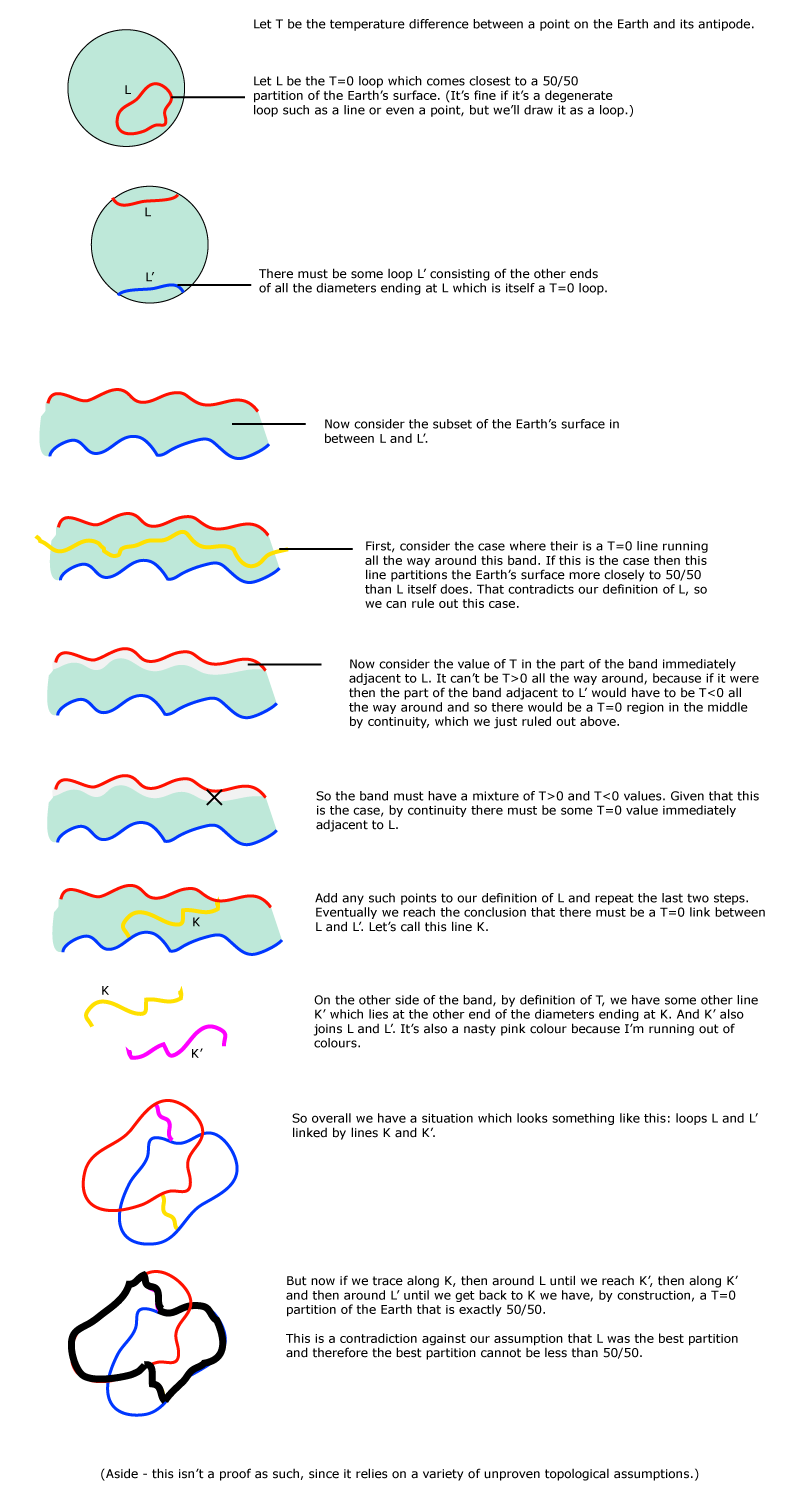
Phil has a pretty elegant approach, although he didn’t sound that convinced by it. He points out that “On any closed curve (not just great circles), the same sort of argument [as in Fig 1 above] holds […] I claim you can always construct a closed curve containing all its own opposite points and along which the temperature is everywhere equal at opposite points [like the turquoise/purple path in Fig 3]. Otherwise there would be some closed curve containing all its own opposite points, along which the temperature was never equal at opposite points, a contradiction.” You can then repeat Step 3, as above, to reach the same conclusion.

Puzzle Level 3The Crumpled Map
The final level in this series (suggested to me by Tarim) is one I don’t have any kind of hand-waving proof of, but I would love to see one.

Imagine you are on a lovely desert island with a selection of your favourite music, a pencil and paper, and an uncannily perfect map of the island. Actually, only the map is important.

If you lay the map on the ground and align it perfectly with the island itself, it’s quite easy to visualise that there must be a single point on that map which corresponds precisely to the bit of the island directly below it.

Now imagine folding and crumpling the map in any kind of way (but not tearing it) and throwing it anywhere on the ground. Wherever it happens to land, will there still be a point on the map that exactly corresponds to the place on the island directly below it?

Categories
New

Things 120: Olly Moss, Benjamin Franklin Effect, A Difficult Person

Pictures – Olly Moss
Sometimes, as you browse the internets, you get a lovely moment in which you realise the person that made this cool thing you are looking at is the same person that made that other cool thing you remember from a while ago. You check out the rest of their work, and if you haven’t already, probably think about whether it’s worth following their output more closely.

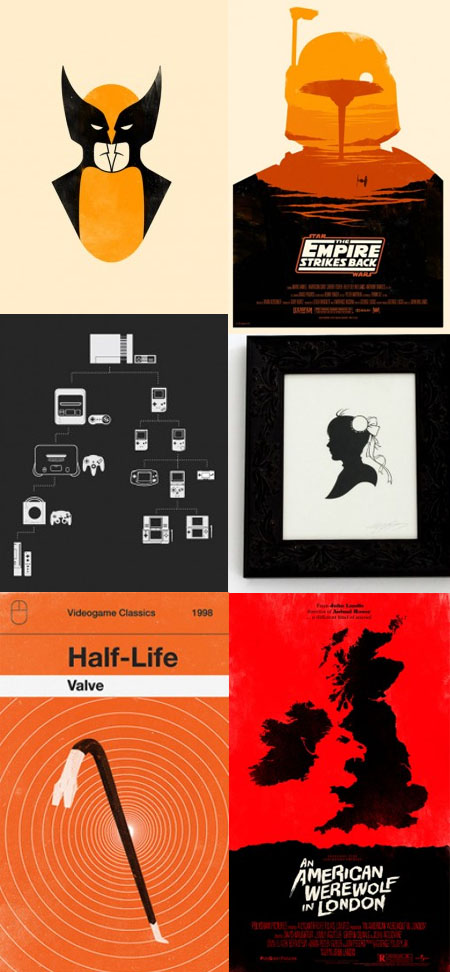
I recently had that, except it turns out that Olly Moss is behind at least six different things (or sets of things) I had admired in the past:

Clearly, they share a certain graphical elegance and pop-culture-ouvre, and in the end the coincidence isn’t that huge, because he’s most likely closely followed by one of the aggregators of content that I browse, although I do recall seeing at least three from reasonably independent sources, so I remain quite amazed.

In short, do go have a browse of his projects. There’s lots more great stuff there.

LinkThe Benjamin Franklin Effect
Summed up nicely at the start:

The Misconception: You do nice things for the people you like and bad things to the people you hate.
The Truth: You grow to like people for whom you do nice things and hate people you harm.

It’s not a totally airtight case, but the article weaves anecdote with data nicely, the results are certainly very suggestive, and I recommend that you read the whole thing.

Quote – A Difficult Person
What I would like to do now is present you with a quote which, out of context, is rather dry and uninteresting, which would be a rather pointless thing to do, so instead I will first attempt to provide you with that context, in the hope that the quote will then seem to you just as striking and memorable as I found it to be. So bear with me here.

In Face of the Crime, or in the original German, Im Angesicht des Verbrechens, arguably better translated as “Face to Face with Crime” or perhaps “All up in the face of crime”, was described by a friend-of-a-friend as a kind of Berlin-based version of The Wire, and unfortunately it isn’t, as the characters are much less engaging, and the realism level far lower, even when one ignores the strange touches of what I guess people would call magical realism. That’s not to say that it’s bad, I actually found it rather interesting in its own strange way, it’s just a matter of setting one’s expectations accordingly.

If you think that sounds promising, and if you are the kind of person that avoids any spoiler for something you might later watch, no matter how small the detail or slim the chances of you watching it, then you may or may not choose to watch the trailer below (which is in German without subtitles and is somewhat NSFW) to further firm up your opinion, and based on that you may prefer to skip straight past this section to the puzzle bit below; but just so you know, as spoilers go, where 1 is inconsequential and 10 is The Sixth Sense, I’d put this at a 3.

http://www.youtube.com/watch?v=4fcGaKWyrIY

So, we have someone I’ll describe as our hero, a straight-laced fellow who rarely betrays emotion, and is just trying to do the right thing, which is tough when you’re a cop in a crime drama with some back-story and Damoclean family tension hanging over you. One gets the impression that you’re supposed to root for him, on account of his moral rectitude, but it’s a little hard to do so, since he mostly does what is expected of him, and just occasionally does something else, but without getting remotely emotional about it.

Meanwhile, there is the heroine, who has a powerful vision of the hero’s face while swimming in a lake (and we know it’s a powerful vision because it gets repeated in the recap at the start of almost every episode), and whom it is strongly implied is destined to meet and presumably fall in love with said hero. She’s got a lot of common sense and a goodly amount of agency, but occasionally must put those things to one side in order to allow the plot to proceed, presumably because she realises that one way or another this will ineluctably lead to her destiny with the hero.

I don’t consider it much of a spoiler to say that they eventually meet, and we know and they know that something magical and destiny-related is happening, even though they’ve barely spoken to one another at this point, and despite the fact that the heroine seems to be all about hope and destiny while the hero is clearly married to his job and gives the impression that truly loving somebody would probably be beyond his emotional register.

I no longer remember the exact details, but there comes a slightly awkward conversational moment, and the heroine’s eyes flicker just slightly, and you can see that while she knows this is her chap-of-destiny, it might actually be that he’s not the best potential partner one could possibly imagine, and she suddenly says, quite bluntly (according to the subtitles):

Could it be that you are a difficult person?

Answer – Climb and Descent
Last week I asked if there was a single time on both the day of ascent and day of descent at which Joss Whedon could be found at the same altitude, given that he began both journeys at midday and ended them at midnight. A nice way to see that the answer is clearly yes is to imagine both journeys happening simultaneously, in which case there must clearly be a time at which the ascending Joss Whedon crosses paths with the descending one.

Perhaps more convincingly, you can draw the answer, as Richard describes:

Trivially proven by drawing two overlaid graphs of altitude vs time.  One line goes top-left to bottom-right, the other bottom-left to top-right.  Short of teleporter accidents, the lines have to cross at some point.  Read off the time and altitude to find where/when.

That was Level 1. Here comes Level 2:

Puzzle 2A – Temperature Pairs
Continuing the series of puzzles Tarim recently introduced me to…

Imagine a straight line that starts anywhere on the surface of the Earth, passes down through the centre of the planet, and comes back out on the opposite side. We take the air temperature at each end of the line. Now imagine rotating that line about the centre, describing a ~circular route of places on the earth’s surface that are all directly opposite one another, and we continuously record the air temperature of those places all the way around (and we do all of this, somehow, in a single moment in time).

(You might also like to imagine that this is all happening in some idealised abstract space where we don’t have to worry about the fact that this entails taking an infinite number of temperatures with infinite precision; I’m just painting the picture in this way because it’s the most convenient way I can think of).

The question (which you might have anticipated if you were trying to see the parallels with Climb and Descent) is this: will there be a position of that line for which the air temperature recorded at each end is exactly the same?

Given the parallels I’m drawing with the last puzzle, you’ll probably be thinking that the answer is yes. But can you prove it?

Puzzle 2B – Temperature/Pressure Pairs
Perhaps that was too easy, so instead consider this: what if we measure both air temperature and pressure at each end of the line, and we consider every possible pair of points on opposite sides of the Earth. Will we be able to find a point that is at exactly the same air temperature and pressure as its opposite on the other side of the Earth?

Trivially proven by drawing two overlaid graphs of
altitude vs time.  One line goes top-left to bottom-right,
the other bottom-left to top-right.  Short of teleporter
accidents, the lines have to cross at some point.  Read off
the time and altitude to find where/when.