Categories
New

Things 119: Journey, Tree Record, Climb and Descent

Game: Journey
If you’re a gamer, you’ve probably heard about Journey. If you’re not a gamer, then you should have heard about it anyway, because it’s quite beautiful and amazing, and only takes 2-3 hours to play through, which means you could visit a friend that has a PS3 and play it in one sitting.

But why would you want to do that?

In this interview, Jenova Chen, the game’s creative director, says:

“Augustine wrote: ‘People will venture out to the height of the mountain to seek for wonder. They will stand and stare at the width of the ocean to be filled with wonder. But they will pass one another in the street and feel nothing. Yet every individual is a miracle. How strange that nobody sees the wonder in one another.’

“There’s this assumption in video games that if you run into a random player over the Internet, it’s going to be a bad experience. You think that they will be an asshole, right? But listen: none of us was born to be an asshole. […] It is the system that made the player cruel, not the player themselves. So if I get the system correct, the players are human and their humanity will be drawn out. I want to bring the human value into a game and change the player’s assumption.”

The reason I say the game is amazing is that it succeeds at this seemingly impossible aim. I’ve played through it a few times now, and each time I’ve had at least one incredibly positive and sustained play experience with a complete stranger.

http://www.youtube.com/watch?v=_mF8KkDiIdk

[Video not working, try this search – metatim, 02/08/15]

Film: The Cabin in the Woods
If you like horror films, you really should watch The Cabin in the Woods. I don’t think it quite succeeds at Joss Whedon’s stated aim (which you shouldn’t look up until after you’ve seen it), but it’s worth it for the wonderfully insane final half hour or so, which, impressively, the trailer largely resists showing any of:

http://www.youtube.com/watch?v=7ENUBUdFswM

[Video not working, try this search – metatim, 02/08/15]

Video: Tree Record / Years
The technology to turn wistful ideas into a reality is in our hands. Look at this device and imagine what you want it to do:

Now check out the video, where it does exactly that:

Read a bit about it here.

Puzzle: Climb and Descent
Tarim recently introduced me to levels 1 and 2 of a puzzle I’d only ever previously heard set at level 3. This week: level 1.

On Day 1, Joss Whedon hikes his way up a mountain, starting at the bottom at midday, and reaching the top (with a few rest stops along the way) 12 hours later, at midnight. He basks in the glory of his achievement for 12 hours, then at midday on Day 2 sets off back down the mountain, reaching the the bottom 12 hours later again, at midnight.

The question: is there a particular time at which he passed through exactly the same altitude on both his Days 1 ascent and Day 2 descent?

Answer: Voice recognition
A long time ago I asked what one could do to improve the chances of having your words understood by one of the many would-be voice-recognition services we find around us today.

After a bunch of googling around, the answers seem to be:

  • Reduce ambient noise where possible
  • Don’t speak too loudly and close to the microphone
  • Leave longer gaps between words than you might in natural speech
  • Speak with the accent the device was tested for

That last point is the one I’m most interested in. The question is, what accent should you use?

It seems the various companies offering this service (Apple/Siri, Google voice search, Xbox Kinect) do have to release different versions for different parts of the English-speaking world (I don’t have a good source for that, but it’s the impression I get from their staged releases, people’s reported experiences, and common sense).

My next plan is to carry out a small personal test in which I try putting on different accents. Results will of course be reported here.
@metatim

Categories
New

Things 118: Cindy & Biscuit, Tron Dance, Into The Abyss

Comic
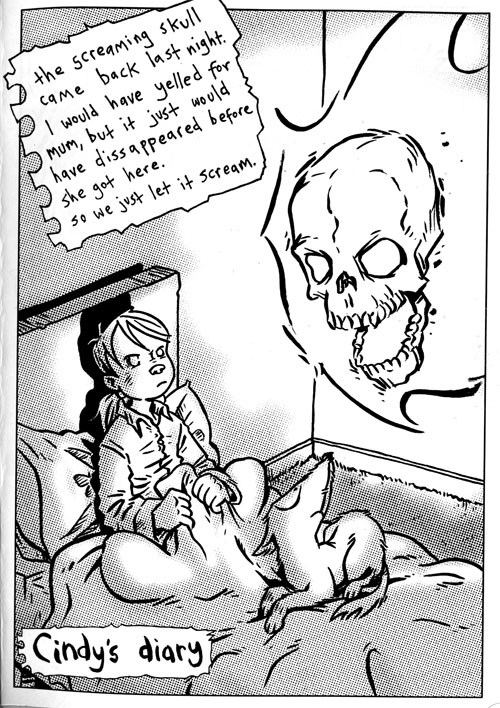
Cindy and Biscuit is a comic by Dan White which consists of various short episodes, and the best way to communicate what sort of thing they’re about is probably just to show you this representative one-pager:

Cindy is of a character-type I find particularly inspiring: defiantly unbowed by the insanity the world presents her with, and generally willing and able to tackle that insanity head-on. You can read Cindy & Biscuit in The Snowman here, or just enjoy my favourite panel below, or go ahead and order the comic directly, or pick up Vol. 2 from Gosh! like I did. (And if you’re on the fence on whether or not to spring for it, read this much more detailed review).

Video
This is a fantastic use of technology in combination with dance. It’s quite a slow build, so if you’re impatient just make sure you at least catch 1’12” to 2’37”.

Film / TV
Werner Herzog has been making documentaries in one form or another since 1969. I’ve only seen two of his more recent ones (Cave of Forgotten Dreams and most recently Into The Abyss), but the impression I’m forming is that these decades of experience must be the reason he’s able to elicit such insightful responses in interviews seemingly without effort and even while apparently willfully derailing the conversation along frivolous tangents.

The most striking example I’ve heard so far, which you can hear (but unfortunately not see) at the 2’34” mark in this Kermode & Mayo review of Into The Abyss, occurs when the death row pastor happens to mention seeing squirrels (and other animals) while unwinding at the golf course. This prompts Herzog to request “Please describe an encounter with a squirrel”, to which the pastor responds with an initially jovial anecdote that quite suddenly leads straight to the heart of his feelings about his role in executions.

You can watch the trailer for the film, but it doesn’t really do it justice:

There’s also a series of three 45-minute TV episodes (still viewable on 4oD at the time of writing) which I haven’t yet seen but will presumably be similarly insightful and gut-wrenching.

Picture
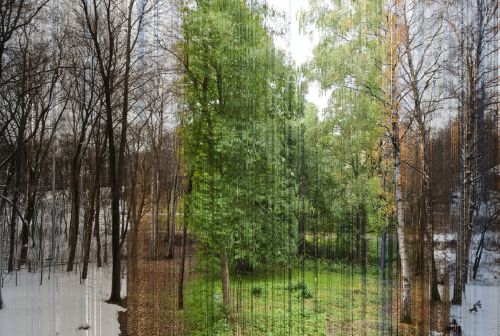
Such an elegant concept: Eirik Solheim extracted sequential vertical slices of  3,888 photos he took out of his window over the course of 2010, and composited them to produce one year in one image:

(You may recall a similar idea applied to video that I posted a short while ago, A History of the Sky).

Categories
New Special

Things 117: Dubstep special

Our story begins with this video, in which a rather sharp-looking old dude performs some kind of strange traditional dance, and some wag replaces the soundtrack:

http://www.youtube.com/watch?v=8-0J4SHJdvY

I originally saw this posted on BoingBoing, where Cory Doctorow described it as “fast-footed country dancing with a dubstep soundtrack”. Within minutes, commenters disagreed with the dubstep diagnosis, with hardwarejunkie9 observing:

I think we all need to shake this “everything’s dubstep” problem we have.

This begs the question: what is dubstep?

A good place to start is this animated visualisation, which charts the evolution of different musical genres from one to another over time, and also by location (which is quite a feat of research and design).

What struck me most about this data was a comparatively trivial point: dubstep is apparently the only new genre to emerge in the first decade of the 21st century.

We might wonder how long it takes for a genre to be recognised, and how we should define what constitutes a genre anyway. These are very tough questions, and I’m going to sidestep them entirely by instead waving my hands generally in the direction of this trended search volume data from Google.

So it seems that dubstep looks like a duck and sounds like a duck and so probably is a duck, if by ‘duck’ we mean musical genre.

We come now to the critical question: how can we successfully identify if something could fairly be described as dubstep?

A very informative definition was given by Bassnectar in an interview in 2007, with remarkable aplomb and cogency for an off-the-cuff response, which you would ideally watch with the visual aids in this video if there wasn’t some kind of dispute over the use of the audio, so instead you need to listen to the first 4 minutes of the full audio interview here:

Without the build-up it doesn’t mean much, but if you don’t have the time or audio capability to listen to that right now, his conclusion is:

Dubstep is […] this ultra-slow ultra-dirty spawn of hip-hop […] at a half-time breakbeat speed, so it feels abnormally slow, and just gives this really heavy feel.

Actually, that doesn’t sound very cogent at all in isolation, so I guess you really do have to listen to the whole thing. Sorry.

Anyway, there are some who say this definition is outdated, but at this late point in the cycle it seems likely that splinter subgenres are blurring the definition, and we may need a few more years of hindsight to accurately identify where dubstep ends and something new begins.

Meanwhile, this post has gone on for far too long without actually giving any examples of real live dubstep in the wild. I like to use this video as an illustrative example, since it also shows it’s possible to retain a performance element (including a self-indulgent “solo” interlude) and demonstration of skill in creating live electronic music, which some people feel are necessary for a genre to attain some sense of legitimacy:

Finally, some people will discount a musical genre if you can’t dance to it. While hardly something accessible to the typical club goer, I think this video demonstrates a closer link between movement and sound than many more conventionally danceable genres achieve:

As you might have noticed, there’s a notable difference in the music between those last two videos, and I think this represents one of the ways in which dubstep is beginning to diverge towards new genres after over a decade of development.

So, there you have it. Now you too can argue about what is and is not dubstep in the comments under any modern electronic music video on youtube.

Further listening:
Goldie Lookin’ Chain’s “Dubstep Christmas”
One hour of looped dubstep cat
Dubstep radio on last.fm

@metatim

Categories
New

Things 116: Cloud Phase Time-Lapse, 3D Map, Better Tube Map

Video
Point a camera at the sky, create a time lapse video of the clouds. Do the same thing every day of the year. Play back all the videos simultaneously in a grid. Voilà: a kind of phase-diagram visualisation, with seconds representing minutes and space representing seasons. Brilliant.

More detail here. Via Data Pointed.

Link
This is apparently pretty old, and with Google Earth and Street View already taken for granted it’s difficult to appreciate how impressive this is: in-browser 3D maps of major cities by Nokia. A plugin is required, and the sad thing is that I imagine that small barrier is enough to vastly reduce the number of people that will actually try it out.

Picture
Various incarnations of the London tube map regularly feature in Things: in the past I’ve posted about a to-scale tube map, a curvy tube map, and a travel-time interactive tube map.

Unsurprisingly, I rather like Mark Noad’s version, which is an ambitious attempt to make a tube map that is not just interestingly different but actually better than the current canonical version. By retaining the simplicity of design but improving geographic accuracy, I would say it succeeds.

Puzzle
This week, a very first world problem. If voice recognition software fails to understand something you say (e.g. Google voice search, xBox 360 Kinect voice commands, or Siri), what do you do? Having had this happen a few times now, I’m very aware that the natural human response of just saying the same thing but louder might not actually be the best thing to do. (I also imagine my neighbours don’t need to hear me shouting “Xbox go back! Xbox! Go! Back! Xbox go frickin’ back! Fine, don’t then!”)

For example, other approaches to ensure your input is recognised could include: reduce background noise; enunciate more clearly; speak in a monotone; move closer to or further away from the microphone; use a different phrasing; or attempt to put on an American accent.

Which of these is most likely to work? Is there a better approach that I’ve not included here? Is just speaking loudly actually the best approach after all?

Or is the failure rate of voice recognition inevitable and unacceptable in most contexts, and the whole notion flawed from the outset?

@metatim