Categories
New

Things 127: Partner Parity Problem, Games and Stories, Beautiful Pictures

Mild NSFW warning: the last part of this edition embeds some pictures of female comic characters. There’s also a cat video, but I just assume everyone is fine with that.

Make-your-own hyperlapse video
Well, this is incredible: set a start and end point in Google street view, a target for the camera, and get as output a time-lapse video of that journey, in which you can still control the direction of the gaze – Google Street View Hyperlapse.

Here’s the demo reel.

Rabbit Hole: No to No UI
Timo Arnall says No to No UI (more commonly referred to as “invisible design”), and puts forth a detailed and cogent argument, but the main reason I recommend reading it is the warren of rabbit-hole links he uses as implicit citations. For example, Kevin Slavin talks about algorithms, how they don’t share our goals and can have emergent properties we can’t understand like a flash crash due to algorithmic stock trading, and then he takes a hop from “60% of Netflix viewing comes from the recommendation algorithm” (not true if you check carefully), a skip to “Epagogix can algorithmically evaluate the box office potential of a scipt” (no) to jump to this wonderfully flippant quote:

What does a flash crash look like in hollywood? Maybe it’s already happened! How would we know?!

Puzzle and Tim Link
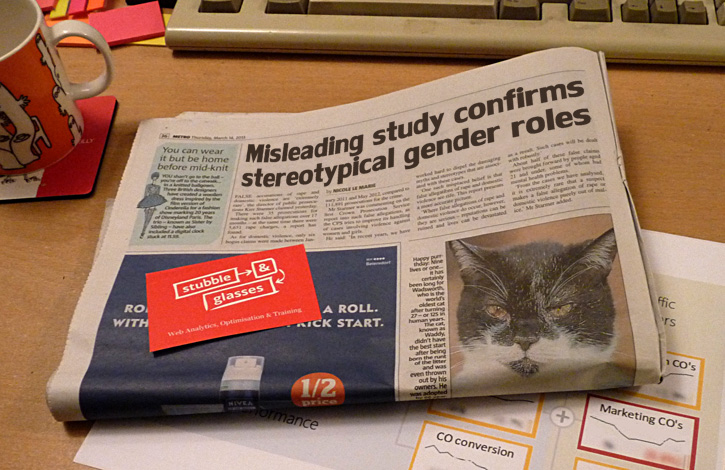
Reporting on a reasonably conducted study’s findings on heterosexual parternships, the Telegraph ran with the headline “Average man has 9 sexual partners in lifetime, women have 4.”

First, what’s wrong with this claim?

Second, how does such a result come about?

Third, as the second is too easy for Things readers, I invite you to guess: which sub-set of respondents is most responsible for the discrepancy?

As some of you will know, I work at a web analytics consultancy where we disentangle data conundrums not dissimilar to this, so I wrote up my findings in a blog post – I found the answer to the last question quite satisfying!

Animal Videos – flocking starlings, evil cat
Kottke has the perfect pair of Starling flock videos – the standard high definition, clean and beautiful static camera one, and then a low resolution one that’s much more thrilling. You should watch both on as big a screen as you can.

Meanwhile, in the sub-genre of YouTube videos enlivened by a dramatic movie score, I declare this cat video the winner:

Games and stories
There is a tension between making a fun game and telling a good story; it seems to be very hard to do both at the same time. I think this might be because these represent two opposite learning methods; learning from someone else’s example, and learning by trying stuff out yourself in a safe environment.

But there’s a flip side of this conflict: sometimes, in the course of playing a game, you generate your own story, one you would never normally get to tell. Here’s an example.

I once played a match of 4-player local GoldenEye, back when I wouldn’t have needed to specify that 4-player GoldenEye was local. I ran out of ammo, and was chased down a twisty dead end by my friend who had some kind of machine gun, so I was pretty much doomed. I did have one thing though, and I said as much:

“I’ve got a proximity mine. If you come any closer I’ll kill us both!”

He laughed, and continued to pursue me round the final tight corner.

I set the proximity mine.

It killed us both.

I don’t remember the final score of that game – I don’t think I did well. But that tiny story remains one of my favourite gaming moments. For that reason, I was very interested to read Tom Armitage’s review of Game Dev Story, a cute little game that crudely simulates running a game development studio through the major console generations, because he made this assessment:

Game Dev Story exemplifies a kind of mechanical storytelling: stories told not through text or voice-acting, but through coherent systems that cannot help but generate stories.

I gave it a go, and he was absolutely right. Apart from the sense of ownership you get from making company decisions, the ability to name your company and the games you produce has some kind of magical effect that makes the whole thing strangely compelling.

It’s not a great story, but it meant a lot to me: after a difficult start, Squidopolis released a string of titles whose success built a war chest which specially trained hardware engineer Stephen Jobson put to use in developing the ultimate console: the Kraken, for which we then produced a string of hits, despite some major setbacks in production.


Game Dev Story is available on Android and iOS.

Folk Games
I like the term ‘folk games’ for equipmentless games a group of people can spontaneously play, such as Standoff, or Ninja, or Fantasy Fencing. I highly recommend all of those, the last one being particularly notable as it is an example of the ‘Tiny Games’ that Hide & Seek are putting into an app (so you don’t have to memorise these sort of things for every occasion). That’s happening on Kickstarter, and with a day to go at the time of writing it’s already funded, but I still recommend the £12 tier (which includes their Board Game Remix kit) to help reach the stretch goals!

Tim Link: Devil May Dance
I like putting in place processes in which incremental progress is made towards a goal, and this year I reached the end of my biggest project so far: I finished my webcomic, Devil May Dance, which I had been updating weekly since April 2006.

The premise was to swap the macho protagonist of the video game Devil May Cry with the feminine lead of seminal rhythm action game Space Channel 5, and see how they got on in one another’s shoes, partly as a way to investigate gender expectations, and partly as an attempt to get some cheap laughs.

If that sounds interesting to you, or if you’re curious what would happen if I wrote a story involving time travel, you should check it out.

I also did a little summary of the web stats of the comic over its lifetime.

Beautiful pictures.
Sunset on mars. Pictures with High Dynamic Range. Icebergs that are naturally stripey. An abandoned epic communist building.

But more importantly, there’s another Kickstarter I’d like to draw your attention to. A friend of mine illustrates comics using primarily traditional techniques, and although she works incredibly hard, I get the impression this means she can’t turn out pages at the kind of speed a regular publisher would like (on account of having to wait for individual colours to dry!), so this is exactly the kind of thing Kickstarter is good for – delivering the kind of projects the invisible hand would usually hold back.

Unfortunately, according to kicktraq’s projection, at a little over half way through, the project has a 50/50 chance of success, so it’s going to need some extra help to make it. Check it out before April 24th!

-Transmission finally ends

Categories
New

Things 126: Echoes and Bubbles, Time Lies and Lapse, Many Maps

It’s been a while, so I’ve got a lot of links. Hold on to your hats.

Games: Costume Quest, Color

If you or someone you know has never played an RPG-style videogame, I highly recommend DoubleFine’s Costume Quest as the place to start (available on PS3, XBOX 360 and Windows). It’s a really delightful entry into the genre, with a lovely theme, brilliant writing, and it’s also quite short, which is a plus in my book. (via Clare)

Meanwhile, I’d previously linked to Method.ac’s kerning and spline games/competency-assessments. There’s now a fascinating one to do with colour, and by introducing a timing mechanic it’s more game-like than objective assessment-like. Give it a go!

Irresistable Entertainment
Some years ago I remember thinking that technology was just going to get better and better at finding content you’d be interested in, to the point where it would be impossible to drag yourself away from the internet. This compilation video of accidents and unlikely events captured by Russian dashboard-cams is about the closest thing I’ve seen to it, in that it’s 14 minutes long but surprisingly hard to stop watching:

http://www.youtube.com/watch?v=E-l4w-DIiXk#!

Kevin Kelly worries that this kind of thing will normalise extremely unlikely events:

We no longer want mere presentations, we want the best, greatest, the most extraordinary presenters alive, as in TED. We don’t want to watch people playing games, we want to watch the highlights of the highlights, the most amazing moves, catches, runs, shots, and kicks, each one more remarkable and improbable than the other.

I’m not so sure that’s the natural conclusion, since the tastes of both the collective in general and individuals in particular is evidently broader. I’m also not sure it’s that much of a problem either (or at least not much different to the norm), as storytelling through the ages has always concerned itself with unlikely (or even entirely fictional) events.

(Incidentally, Russian dash-cams are also the first noticeable stage in the development of an ubiquitous public surveillance network, which on the one hand enable us to get multiple videos of rarely-filmed events such as meteorites, but on the other hand demonstrate how crowd-sourcing is a convenient way to get over the installation-problem for achieving a 1984-style surveillance state).

Echo Chambers and Filter Bubbles
Another interesting effect of the internet’s ability to show us stuff we like is the danger of ‘echo chambers’ (people only reading the work of those they agree with and passing on links and sentiments from those people) and ‘filter bubbles’ (in which people only follow or get algorithmically shown content that supports their own views, reinforcing confirmation bias). Fortunately a study on Facebook’s data suggests that the echo chamber effect isn’t as bad as we might expect.

Meanwhile this review of the Filter Bubble book on BoingBoing raises the very reasonable counter-argument: “anti-filtering” tools are also developing.

Time Lies
Holly Gramazio of Hide&Seek consistently lies about time in order to make game experiences better. This seems reasonable and useful.

Grand Central train station lies in a similar way, although not by setting their clocks fast as this widely shared article’s headline suggests (which would make people panic and run more), but rather by lying about the real departure time of trains (which is slightly more likely to ease those crucial final seconds of a late boarding attempt).

Of course, both of these effects become weaker when more people know about them. What I’d like is a clock modifier for my mobile which sets the time 1 minute fast most of the time, but on a random, say, 2% of days it instead shows the real time, so I’d know I couldn’t simply factor in that ‘extra’ minute.

T.M. 12/04/13: Richard B adds a local example: “In Heathrow Terminal 5 the information screens in the duty free area lie about the gates opening for boarding in order to control passenger flow and disperse them when the concourse is becoming too crowded.”

Time Lapse
Tsuneaki Hiramatsu took some time lapse photos of Fireflies (with a bit of compositing), which turns out to be just as brilliant an idea as it sounds.

What if you just took a vertical slit of a photo, repeatedly, as something moved past, then composited those pixel-thin images? I’m glad you asked. (A technique along these lines may explain how Rainer Gamsjäger’s video “State of Flux — wave #1″, which baffled me at EIFF 2010, was achieved)

Finally, here’s a different kind of Time Slice by Giuseppe Penone, which incredibly is just what it looks like: an old tree, with parts cut away to reveal its younger self:

Tumblr Tips
Tumblr themes commonly hide the link to the ‘archive’ view, but you can get it just by appending “/archive” to the URL. This is really useful when you want to get a quick overview of a Tumblr’s contents. For example, instead of paging through iheartcatgifs.tumblr.com, you can instead go straight to iheartcatgifs.tumblr.com/archive (and then do something else while you wait for the page to load..!)

Alternatively you can use this tool to automatically identify the top 10 most popular items from a Tumblr by year, based on the number of ‘notes’ (although this can take a little while to process, which is fair enough). For example, you can see the 10 most popular comics from Horse eComics (which are based on a Twitter account that tweets random excerpts from books) here.

Maps: Tube maps, Rearranged cities
A popular semi-regular feature of Things is alternative tube maps (see the better tube map, to-scale tube map, curvy tube map, and travel-time interactive tube map).  So we might as well just cut to the chase and go straight to this site which excellently curates all manner of tube map variations. (via Sophie)

Meanwhile, in the world of rearranging maps based on non-locational criteria, Odd Things Happen When You Chop Up Cities And Stack Them Sideways.

I’ve sat on this link for far too long – a wonderful Gigapan exploreable photo of London. The distant London Eye, at maximum zoom, reveals the individual people in each capsule. It’s like having super powered vision.

Finally, not enough people seem to know about bird’s-eye-view in Bing maps, which provides a really useful mid-ground between Google’s satellite imagery and streetview. Try it out!

Categories
New

Things 125: Fun Club, Robot Books, Mirror Spider, Frog Fractions

Tim Link
As noted last time (which was, admittedly, a while ago), Octopus Fruitbat put on Competitive Sandwich Making at the Hide & Seek Weekender games event, with help from Phil and Deb. I wrote about it here, and it looked a bit like this:

Thing I Bought And Would Recommend: Fun Club
The webcomic “Cat and Girl” was originally recommended by me in Things 1, which I wrote so long ago the obscure Japanese game show video I linked to in the same edition has already spawned a UK version that in itself is now old news.

Cat and Girl is written by Dorothy Gambrell, who I’ve also mentioned in earlier Things as the author of Very Small Array, a sort of hybrid blog of data visualisation and cultural-critique.

What I’m trying to say is that Dorothy Gambrell is awesome, so when she makes a thing called Fun Club in which you buy a year-long subscription to receive monthly random things she makes, you should probably check it out. 2012 was the first year it ran, and included a diary for the year with complete-it-yourself personal data visualisations, a set of useful stickers that say ‘Bad Decision’ in large block capitals, and some postcards featuring combination bread/sausage creations she baked in the style of the electrical standards of various countries:

So if you like that sort of thing, you should probably sign up for the 2013 edition.

Video: The Spider
Here we see the fascinating results of confronting a spider with the Mirror Test. If you’re scared of spiders, you may find it worth gritting your teeth through to around 46s when the spider completely freaks itself out [note, the audio is not essential, but is quite apt]:

Link: Books by Robots?
I’m assuming that it’s some combination of things like Amazon Mechanical Turk and the recent developments in economical on-demand book printing that mean you can now buy this amazingly specific book on Amazon:

Imagine you were an aspiring bagel maker. How could you possibly resist such a perfectly titled book?

Well, you might be suspicious. If there’s a book like this for bagel-makers, how many other careers have they covered? Do a bit of searching, and you find further unlikely  variations on the theme, including books on how to land ‘Top-Paying’ jobs as a Binding Worker, Conservation Scientist, or Roughneck.

At this point, you might assume they are all essentially the same book with generally applicable advice on careers, interviews and the like, just with different covers.

But no!

Each book has a different author (so must be different), and thanks to the ‘look inside’ feature, we can see that the bagel book includes information specific to the baking industry:

We can’t be certain how much of this content was harvested automatically, but based on current trends I expect to see robots of the future writing arbitrarily many of books in this vein, and whole ecosystems of robot arbitrage emerging in the second-hand market for those books. Don’t let anyone tell you the future isn’t bright.

Game: Frog Fractions (via Dom)
This is a really fascinating flash game which you should definitely play if you like… games. I don’t want to say too much about it, but be advised that there is more to it than first meets the eye. Much more.

Set aside some time to improve your life by playing Frog Fractions.

-Transmission Ends

Categories
New

Things 124: Puzzles & Polaroids, Bond is now Bourne, Cooking Tips

OctopusFruitbat Game Write-upPuzzles & Polaroids at the British Museum
Clare and I were asked by Stubble & Glasses (who I also happen to work for) to design and run a company game event in a professional capacity, because some of them had enjoyed some of our earlier game events. So we formed a company called OctopusFruitbat, came up with something that combined puzzle-solving with creative instant-photo-taking, and it went a bit like this. If you’re ever looking for someone to come up with a similar event, of if you want advice on doing something yourself, please do get in touch!

Also don’t forget, this Friday I’ll be running Competitive Sandwich Making (which last year went like this) as part of the amazing all-weekend festival of gaming that is Hide&Seek’s Weekender at the Southbank Centre.

Quote
I’ve been nurturing the idea that films that follow the “They Made Him, Then Tried To Kill Him, Now He Must Fight Them” storyline are rising to such prominence that it must be some kind of Hero’s Journey for the modern age (I’m thinking Bourne, Hitman, Grosse Pointe Blank, Kill Bill, Blade, Ultraviolet…). The closest I could find on TV Tropes was Contract on the Hitman, which doesn’t quite nail it.

On metafilter, wuwei draws it out more explicitly by contrasting James Bond with Jason Bourne:

Who is our generation’s James Bond? Jason Bourne. He can’t trust his employer, who demanded ultimate loyalty and gave nothing in return. […] Bourne survives as a result of his high priced, specialized education. He can do things few people can do […] and like the modern, (sub)urban professional, Bourne had to mortgage his entire future to get that education. They took everything he had, and promised that if he gave himself up to the System, in return the System would take care of him. It turned out to be a lie.

(You can read the post in full here).

Is there any evidence that there really has been such a transition, that corporations are now violating the social contract in some way that they weren’t before? The three charts in this article do seem to actually endorse this idea – Corporate Profits Just Hit An All-Time High, Wages Just Hit An All-Time Low.

Pictures
Here are some pictures with captions that have some amazing food-preparation tips, for example:

Previous PuzzleThe Shrinking Empires
Last time I asked why Empires seemed to be getting geographically smaller. I’ve actually asked this question when interviewing analysts, and get two kinds of answers.

The most common answer is that population density is increasing, and apparently human political power tends to stabilise around the 10m-50m range. For example, the Roman Empire was pretty big, but probably only covered ~60 million or so people, ten times fewer than those living in the same geographical area today (according to Citation Needed, but hey, it sounds about right).

A more interesting idea is that it has something to do with technology and inequality. I once heard it said that technology is not politically neutral – for example, Nuclear Power requires greater centralisation of government power than, say Wind Power – and I find this an appealing idea. Perhaps, for example, improved forms of communication give greater power to the people, who are then better able to resist tyrants with aspirations of empire-building through war.

But the more I dig into this, the more it starts to look like post-rationalisation, because I can imagine giving examples to prove the opposite. If everyone can manufacture guns cheaply, is it easier to terrify your populace with asymmetric power you can give your enforcers, or is “a well armed population the best defense against dictatorship”? If you improve transport, is it easier to avoid conscription, or easier to wage war? If you combine Moore’s law with the internet to create continuous public surveillance, do you end up creating a single global culture with no crime, or do you permanently enforce the power structures that exist at the point of implementation? Well, that’s a question for another day.

PuzzleGoogle Correlations
Google Correlate lets you find closely correlating Google search term trends, which sometimes gives silly results by coincidence, and sometimes reveals something very interesting. The question is, how many of these correlations can you explain?