Categories
New

Things 93: Wormworld Saga, Newton and Pascal, Idiots and Maniacs

Link
If you like webcomics, or just enjoy seeing examples of excellent use of light in digital paintings, do check out the first chapter of Wormworld Saga.

Joke
Einstein, Newton and Pascal decide to play hide and seek. Einstein is it, closes his eyes, counts to 10 then opens them. Pascal is no where to be seen. Newton is sitting right in front of Einstein, with a piece of chalk in his hand. He’s sitting in a box drawn on the ground, a meter to a side. Einstein says “Newton, you’re terrible, I’ve found you!” Newton says “No no, Einy. You’ve found one Newton per square meter. You’ve found Pascal.”

Puzzle
This sprang out of the discussion on language pedantry last week on the RAPP CC list.

In “Eats, Shoots and Leaves” Lynne Truss makes the following observation:

Yes, as Evelyn Waugh wrote: “Everyone has always regarded any usage but his own as either barbarous or pedantic.” Or, as Kingsley Amis put it less delicately in his book The King’s English (1997), the world or grammar is divided into “berks and wankers” – berks being those that are outrageously slipshod about language, and wankers those who are (in our view) abhorrently over-precise.

A similar observation in a different field is attributed to George Carlin:

Have you ever noticed that anybody driving slower than you is an idiot, and anyone going faster than you is a maniac?

It seems to me that grammatical precision and driving speed fall into a very particular category of behavioural spectra in which we seem to be highly critical of others who vary from our own view in one direction or the other, even slightly. Other examples I’ve observed being described in a similar way and heard people comment on with varying degrees of politeness are alcohol consumption, smartness of dress, household cleanliness, and various aspects of personal hygiene.

The question is, what is it about these behaviours that makes us so sensitive to differences?

Picture
I’m not at all sure this diagram works fully, but I like it a lot anyway:

Categories
Old

Things 32: Busaba Toilets, Colour Test, Slow Motion Squirrel

Films
I saw Mirrors last night. It started off as rubbish and ridiculous as it looked from the trailer, but then got a lot better, with a suitably ridiculous climax.

This week, Quantum of Solace, no more need be said.

Owing to extreme hecticness in the next few months, I have cancelled my Cineworld Unlimited card. The Films section may well disappear for a bit.

Puzzle Part 1
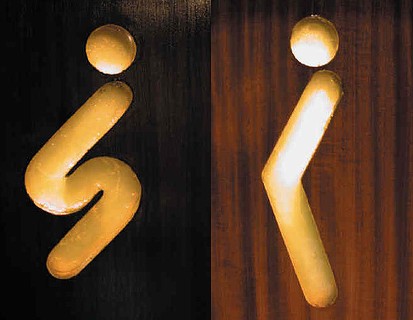
I ate at a Busaba Eathai last week. When I went to the toilets I was confronted with the two signs you see in the image below. I paused, then figured I had cracked the code. Where did I go? Make a guess now, then try part 2 at the end of this email.

A link
…which is also a puzzle. Test your ‘colour IQ’
http://www.xrite.com/custom_page.aspx?PageID=77

A quote or anecdote
When paying for my ticket to see ‘Mirrors’, the guy at the till dropped a one pound coin into the vat of popcorn. Pretty soon three employees were scooping the popcorn around trying to find it while a manager was shouting ‘just complete the transaction!’ at them.

A video
Link courtesy of my mum – squirrel leaping in super slow mo from Autumn Watch:
http://www.bbc.co.uk/apps/ifl/autumnwatch/video_archive/showrecord?Id=hppromo06

Pictures
Pictures of the sun taken using science:
http://www.boston.com/bigpicture/2008/10/the_sun.html

Puzzle Part 2
Looking at the Signs for the Busaba toilets (above) I concluded that they represented the two modes of toileting: standing and sitting. I further inferred that this implied gender. I entered the door marked by the kinked line. It was a simple square wood-panelled room, and all I could see was urinals and sinks. Urinals were not sufficient for my needs at that time.

What would you do?

Categories
New

Things 90: Inception Diagram, Clay Shirky on Wikileaks, United States of Autocomplete

Tim Link
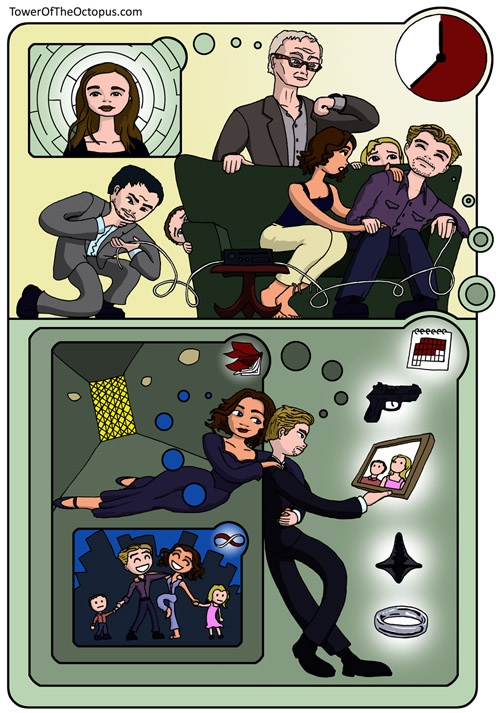
After a lot of research and a second viewing with a lot of note-taking, I felt like I had got to the bottom of Inception. My diagram and explanation of what I think is really going on can be found on Tower of the Octopus.

Link
Clay Shirky’s view of the Wikileaks situation seems much more balanced and reasonable than anything else I’ve read on it.

Also, see the Wikipedia article on the Streisand Effect.

Quote
I can’t actually find who said this first on Twitter:

Pissing off 4chan: free. Botnet hire: $1000/month. For everything else, there’s Mast– oh, wait, not any more there isn’t.

Puzzle
We are told that your ears go ‘pop’ in a plane after take-off because of the air pressure changing with altitude. But we also know that the cabin has to be airtight, as if air could get out the pressure would equalise and above 17,000 feet everyone would die. So why does the air pressure change in the cabin at all?

Picture
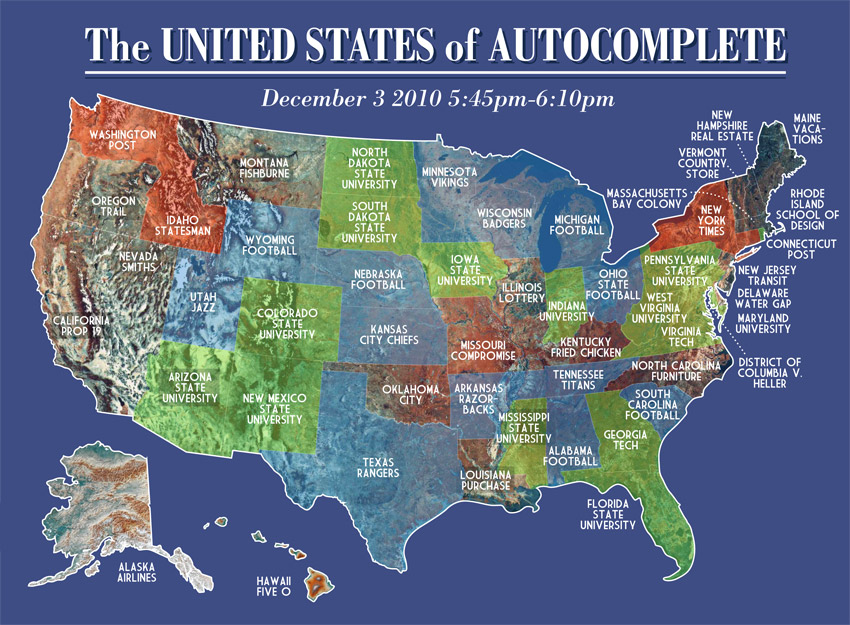
From Dorothy ‘Cat and Girl’ Gambrell’s visualisation site Very Small Array, the United States of Autocomplete gives Google’s autocompleted suggestion of what should come after each state name (note results are regional, we’ll get different results from the UK) (click for full size):

Last Week’s Puzzle
Last week I asked “why does the perceived attractiveness of any given individual vary so much depending on who you ask?”, which provoked quite a bit of discussion on the CC list.

Thomas points out:

It’s not enough for both parents to have ‘good” genes, but they should have “good” genes that are sufficiently different that any child will have the maximum possible genetic advantages.

Or as Xuan put it:

Attractiveness: Relative to your genes and where you want them to go.

Simon adds a practical consideration:

… people of similar levels of attractiveness find each other attractive (because your genes have the best chance of survival if you can maximise some function of beauty x propensity to shag me)

Phil counters:

So many couples look very similar though! Perhaps that is somewhat due to acquired mannerisms, but I’d have thought there’s a strong trend to find people similar to yourself attractive, to help similar genes survive

My summary of the situation was this:

To have the best chance of promoting themselves, your genes want to help others with similar genes (and procreating with them is pretty helpful), but also combine themselves with complementary genes. With both of these pressures in effect, and a distorting lens of nurture on top of the nature, we can’t be too surprised that people disagree on attractiveness.

Finally, Matt raises the logical next question – how to genes actually do this:

I think we may be giving too much credit to genes abilites to recognise similar genes and indeed complementary genes here. And after all, there are a lot of different genes with a vested interest here. I would posit that we decide who would be a good catch based on a set of genes (and so on) that try to recognise success in any form – one of the primary indicators surely being perceived social standing, but also apparent health, virility etc. So, regardless of precise genes, recognising good stuff.
I find the idea of encoding a DNA sequence that will give rise to a brain that will perceive the outside world and detect optimal reproductive opportunities almost completely mindboggling.
Categories
New

Things 89: Human Towers, Retroactive Prayer, Local Universe Map

Trailer
I saw Monsters at the Edinburgh International Film Festival, and it’s now on general release. As I said back in my big EIFF review post:

What: Low budget yet well-realised alien invasion as setting for semi-romantic road movie
Good: Beautifully shot, atmospheric, with an incredibly realistic-feel for its budget and a beautifully understated soundtrack from Jon Hopkins. And giant alien octopi.
Bad: Weakness in the development of the female character betrays a male gaze bias, undermining the main dynamic of the film
Conclusion: Essential viewing for anyone interested in what can be achieved on a budget, giant alien octopi, or Whitney Able’s legs

Trailer:

Video
Human Towers, some of which alarmingly do fall down:

Casteller from Mike Randolph on Vimeo.

Quote
Martin Bland, paraphrased by Peter Norvig in an excellent article on the shortcomings of evidence for prayer healing:

An ethical study proving the efficacy of retroactive prayer is logically impossible.

Puzzle
Since physical attractiveness has at least some part to play in our evolution, why does the perceived attractiveness of any given individual vary so much depending on who you ask?

Picture
I had previously wondered what the ‘local’ area of the universe looked like, for varying values of ‘local’, but some idle Googling didn’t produce an answer at the time. Just recently I came across a really nice image on Wikipedia giving the answer across some interesting different scales. Check out the file on Wikipedia, where you can also download a 7MB, not-very-compressed jpg of the image. (If that’s gone for some reason I’ve put a slightly more compressed version (2.5MB) of the image here).

Here’s a snapshot of just part of it:

Last Week’s Puzzle
Last week I asked why bedsprings make a ‘pyoing’ noise out of nowhere. Either this was too easy, too hard, or no one had any idea what I was talking about, because nobody had an answer. Consequently I turned to my not-very-secret research alter ego and asked the internet, as I did before on the shampoo question. The internet said springs get squinched down sometimes and will later pop back up. If that was the case, I would expect to usually hear these noises very soon after getting off a bed, with just a few rare occasions when it was released later. I remain unsure.