Categories
New

Things 94: Black Swan, Vampire Squid, Stock Market Returns

Video
I saw Black Swan recently and recommend it to anyone that likes the look of the trailer, so long as you’re not squeamish as that’s a whole side of the movie the trailer skims over:

With a reported production budget of $13m (which, as I never tire of telling people, would be just enough to cover Tron Legacy’s costume budget, and was also so restrictive that Natalie Portman opted to forego her trailer in order to afford an on-set medic), I was particularly fascinated by the beautifully subtle (and some not-so-subtle) digital effects they nonetheless managed to achieve. Most excellently, you can see a showreel of how these effects were put together on Look Effects’ website, although if you haven’t seen the film you should steer well clear as it will completely ruin the film for you.

Links
Have Instapaper or Read It Later at the ready because I’m about to flag up some serious long-form content. I don’t think it was available online when it was first published, but you can now read Matt Taibbi’s dilligently researched yet seething explanation of quite what Goldman Sachs does over at Rolling Stone, in which he memorably begins:

The world’s most powerful investment bank is a great vampire squid wrapped around the face of humanity, relentlessly jamming its blood funnel into anything that smells like money.

Over a year later even publications like The Week will casually refer to them as “Giant vampire squid Goldman Sachs”, which is I think excellent. It’s long, but well worth it, and it has a great twist ending.

As a nice follow-up (or much shorter way of cutting to the heart of the matter), Charlie Stross explains how we got to this point. Or if you want the whole thing in one pithy excerpt:

Corporations have a mean life expectancy of around 30 years, but are potentially immortal; they live only in the present, having little regard for past or (thanks to short term accounting regulations) the deep future: and they generally exhibit a sociopathic lack of empathy.

I think the way we tend to automatically expect groups of humans to behave like individual humans is one of the most disastrous mistakes we make on a daily basis.

Puzzle
All ovens that I’ve seen have some kind of temperature ‘input’ dial, but why do so few have any kind of readout of the actual internal temperature, to the point that there is a market for independently purchased oven thermometers? Shouldn’t market forces guide the manufacturers to include such a feature themselves?

Picture
I see a lot of data visualisations that make me angry because they do little more than treat data as almost random input for some kind of procedural image generation process (which is actually very cool when it doesn’t claim to be something it isn’t). This New York Times visualisation of stock market returns over the past 90 years, on the other hand, is actually quite practical at giving you both an overall sense of the patterns while still making each data point quite clear.
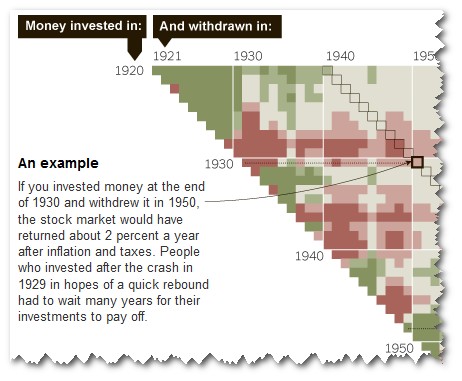
I'd just like to make it clear that I'm using the 'ragged edge' functionality of FS capture to show that this is only part of the image. A while ago, when everyone at work had just got in to FS Capture, it was used on just about every image you saw. Those were dark days.

Last Week’s Puzzle
Last week I asked why we seem to be so intolerant of variation in things like driving speed or grammar pedantry.

Angela suggests it’s all to do with herd instinct:

We are constantly (often subconsciously) comparing ourselves with others around us and balancing the desire to fit in (be part of the herd) with our desire to ‘self-express’ (stand out). Even small differences between us and others in the herd could potentially threaten us if they lead us to be ostracised or confer upon others some advantage in terms of survival or reproduction. I think that’s one of the reasons we a) notice and b) are so perturbed by even slight differences – they could signify a real risk to our deepest interests.

I think that’s part of the answer, although it doesn’t explain why we’re more tolerant of a lot of other things, or at least tolerant of variation in one direction (such as how we judge others’ use of free time).

I initially thought it covered those particular areas of life because we recognise them as prisoner’s dilemma / tragedy-of-the-commons areas, where a few people taking the easy way risk leading society to a collectively suboptimal Nash equilibrium.

However, I now think there’s two separate factors at work. In driving, even slight differences in speed add up to one car overtaking another, which we can’t help but read as a social signal that one is ‘doing it wrong’ (and we see the same thing with walking speed).

On the other hand, things like specific bits of grammar pedantry or household hygiene fall into a category of behaviours drummed into us as children, which we then cling on to tenaciously through a combination of Anchoring and Status Quo Bias. Deviation from these things is more on a sub-task basis (“I can’t believe they don’t clean their skirting boards!”) rather than a spectrum, as we adhere to whichever specific rules we were taught.
Categories
Old

Things 34: Uncertainty, Cat on Roomba, Lemurs

(Originally sent November 2008)

Welcome to Things, a weekly email I send around with stuff that I have found or dug out from my archives. This week some new people have been added to the list, so it is now going out to:

6 people at RAPP
2 people that used to be at RAPP
3 members of my family
1 other cool person
1 me

The default is for everyone to receive Things privately. If you are happy to receive it on a CC list so that you can reply-to-all and discuss the contents with similarly interested people, let me know – so far two people from the above list are doing that.

Anyway, on to the Things.

Films
If I had time to see any film this coming week it would be Waltz with Bashir, which apparently breaks new ground both as an animation and as a documentary. (From the trailer it doesn’t actually seem to take rotoscoping much further than Richard Linklater already has with Waking Life and A Scanner Darkly, but it’s still cool).

IMDb: 8.1/10
Rotten Tomatoes: 91%

Trailer:

A link
The McCollough effect is a brilliant optical illusion effect which remains unexplained. Try it out here.

A quote
Tycho, Penny Arcade:

“Innovations are just gimmicks you happen to like.”

Last week’s puzzle
Last time I asked that if regular slow zombies represent the inevitability of death, what do fast zombies represent?

My personal answer is that fast zombies are just a distillation of our worst fears about other people – reduced to pure irrational rage and threat. It also unlocks a primal desire to defend yourself with violence, and by reducing other people to zombies we need not feel guilt about doing violent things to them. (Compare Carmageddon, a game in which the aim was to run people over, but since this was considered unacceptable by the ratings board the people were replaced by zombies).

This week’s puzzle
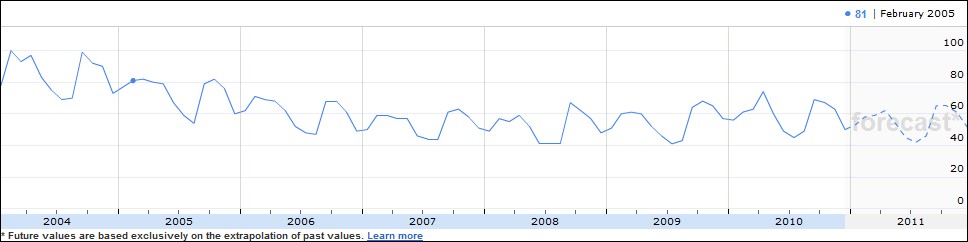
This week, it’s a graph puzzle. Take a look at the trend in search volume for the word ‘Uncertainty’:

It follows a clear annual trend. Why is that?

A Video
A cat riding on a Roomba, which is an autonomous vacuum cleaning robot. Interestingly, 2 out of the 12 people receiving this email own such a device.

Pictures
Google is now hosting the photographic archive from LIFE magazine, including photos that never made it into print. So far they have put up 2 million of an anticipated 10 million images at pleasingly high resolution. You can also buy a print of any image you like, for an only slightly exorbitant cost.

As with all new resources, I tested it out by seeing what it had on lemurs. The answer is: lots. It turns out that from page 2 onwards almost all of the results come from a brilliant photo shoot revolving around a family that has a pet lemur.

Categories
New

Things 93: Wormworld Saga, Newton and Pascal, Idiots and Maniacs

Link
If you like webcomics, or just enjoy seeing examples of excellent use of light in digital paintings, do check out the first chapter of Wormworld Saga.

Joke
Einstein, Newton and Pascal decide to play hide and seek. Einstein is it, closes his eyes, counts to 10 then opens them. Pascal is no where to be seen. Newton is sitting right in front of Einstein, with a piece of chalk in his hand. He’s sitting in a box drawn on the ground, a meter to a side. Einstein says “Newton, you’re terrible, I’ve found you!” Newton says “No no, Einy. You’ve found one Newton per square meter. You’ve found Pascal.”

Puzzle
This sprang out of the discussion on language pedantry last week on the RAPP CC list.

In “Eats, Shoots and Leaves” Lynne Truss makes the following observation:

Yes, as Evelyn Waugh wrote: “Everyone has always regarded any usage but his own as either barbarous or pedantic.” Or, as Kingsley Amis put it less delicately in his book The King’s English (1997), the world or grammar is divided into “berks and wankers” – berks being those that are outrageously slipshod about language, and wankers those who are (in our view) abhorrently over-precise.

A similar observation in a different field is attributed to George Carlin:

Have you ever noticed that anybody driving slower than you is an idiot, and anyone going faster than you is a maniac?

It seems to me that grammatical precision and driving speed fall into a very particular category of behavioural spectra in which we seem to be highly critical of others who vary from our own view in one direction or the other, even slightly. Other examples I’ve observed being described in a similar way and heard people comment on with varying degrees of politeness are alcohol consumption, smartness of dress, household cleanliness, and various aspects of personal hygiene.

The question is, what is it about these behaviours that makes us so sensitive to differences?

Picture
I’m not at all sure this diagram works fully, but I like it a lot anyway:

Categories
Old

Things 33: Fast Zombies, Eyeballing, Hallowe’en Pets

(Originally sent November 2008)

Films
I’ve cancelled my Cineworld card because there’s a lot of stuff I need to do in the next couple of months.

I did see Quantum of Solace, which I found to be surprisingly poorly scripted, directed and edited. Mark Kermode expressed my thoughts precisely, and also has some insight as to why it ended up this way:

Puzzle Answers
I forgot to answer the car light mystery from Things 31. It turned out that the back lights were not actually on, and only came on when braking (which is why they were on when I parked to check) – I proved this by nudging the brakes and looking at the cats-eyes on the motorway light up in my rear view mirror. After fixing this by finding out that the light-controlling dial also had to be ‘popped out’ to engage the rear lights (crazy design idea), cars continued to flash at me, which I eventually discovered was in fact due to me using fog-lights, which was because instead of being controlled by the dial that did everything else to do with lights, these were controlled from another, unlabelled part of the dashboard.

As for the Busaba Toilets, I went into the other room marked with the curving lines, only to be confronted by some unimpressed women. I went back to the room with the kinked line and it was only on closer inspection that I realised there were cubicles, but they were designed so their doors blended completely into the wall. So watch out for that.

This week’s puzzle
Simon Pegg has written an insightful article about why the modern trend for fast rather than shambling zombies completely misses the point.

I think he’s missed something himself though, as the question that naturally arises is this:

If shambling zombies represent our fear of the inevitable slow approach of death, what do fast screaming attacking zombies represent?

A quote
I used to do parkour/free-running with a small gang of similarly mad individuals on my university’s campus. Being the most cautious of the group, I never sustained an injury, whereas at one time or another everyone else did. The least cautious was a crazy second-year called Andy. One particular February night had left our playground icy and treacherous, but Andy was still ready to go ahead.

He reassured us by explaining:

“There’s more grip, because of the ice.”

A video
If you’re familiar with Pinky and the Brain, then you’ll be happy to know that it was dubbed into several different languages, including the excellent intro music, in German:

A link
Last week, Bex reported an unbeatable score of 0 for the colour-matching game. Here is your next challenge: eyeballing.

A picture
An amazing collection of pet Hallowe’en costume photos.