Categories
New

Things 92: Walk Straight, Marmite Looks, One Day Music Experience Timeline

Video
A nice bit of rotoscope animation that asks the question “Why can’t we walk straight?”

Link
As an intriguing to follow-up to the question in Things 89 on why perceptions of attractiveness vary, OK Cupid have posted a related result: greater variation in attractiveness rating scores tends to generate more messages on the service.
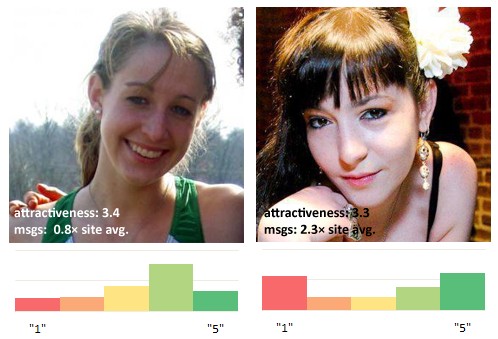
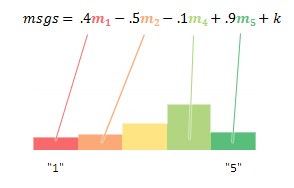
The fact they say “men will get their turn under the microscope” might mean that the same result does not hold true for men, or they might just not have checked yet.

Tip
I’ve recently been enjoying a handy little shortcut in Firefox that lets me jump straight to search results on certain sites without reaching for the mouse.

Start by clicking the dropdown option against the search box, and click ‘manage search engines’:

From this menu, pick a search engine you commonly use and click ‘edit keyword’, I recommend something very short:
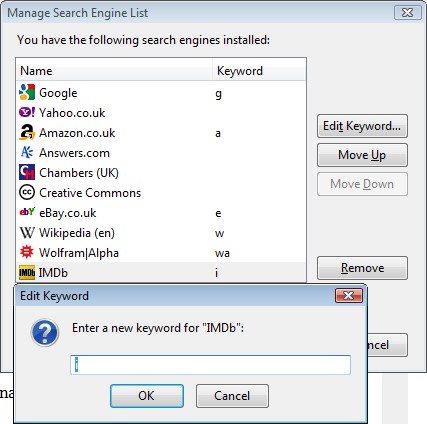
You can then query your chosen search engine by jumping to the location bar (Ctrl + L) then preceeding your search with your chosen keyword. For example, I can type “Ctrl + L” and then “wa how old was pat morita when karate kid came out”, press enter, and get straight to the answer without any clicks of the mouse.

(Rotten Tomatoes doesn’t seem to have this option, but there’s a Firefox add-on which is a slight improvement).

Picture
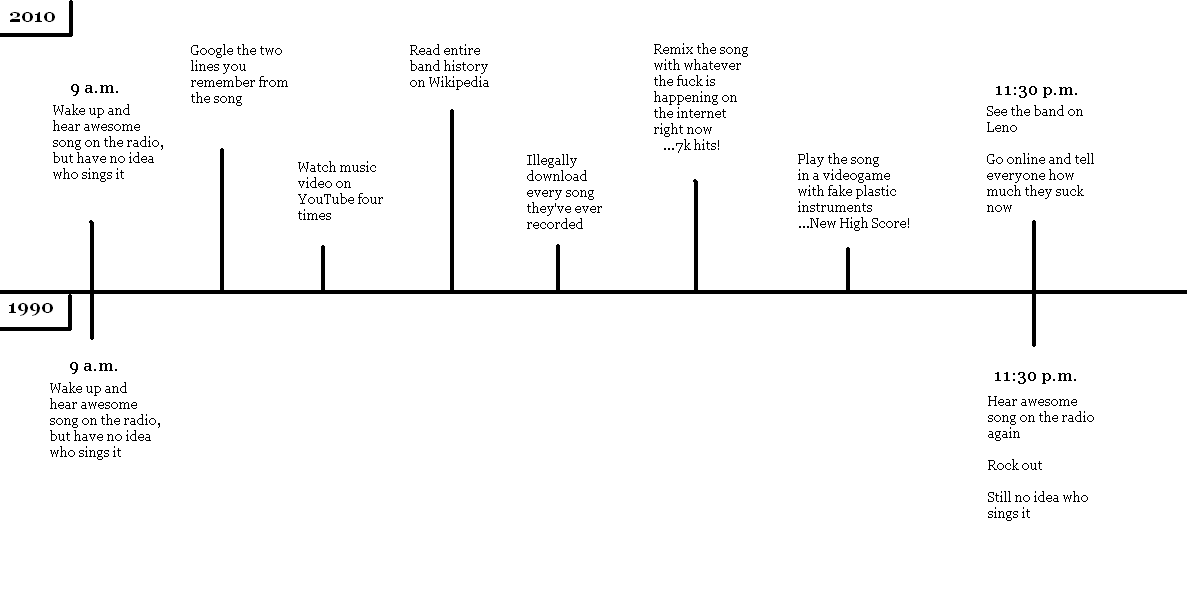
A nice way to illustrate the changes technology has wrought on the radio music experience over the last 20 years, with only a little exaggeration (click for big):
No Puzzle
According to the schedule of rotating absence, there’s no puzzle this week, but feel free to think about why we can’t walk in a straight line if you like.

Last Week’s Question
Last week I asked if anyone else had noticed a sudden surge in the misuse of “i.e.” and “e.g.”. Not many had, but a lot of people had something to say on the subject… probably enough for a whole post by itself, but I’ll attempt to quote in brief the different responses.

First, a few admitted to not being certain of the distinction themselves, even when they were sticklers in other areas, so I suppose that means I’ve done my bit to stem the tide somewhat.

The question on living vs prescribed language raised a few responses in itself. Maria noted:

The French spoken [in Montreal] is a pure and true form of ‘old’ french, ‘where for art thou’ for example. When Montrealers go to France their version of French is hardly understood which just goes to show that languages must and do evolve or we’d be speaking like players in a Shakespeare play.

Angela confessed that:

… I am afflicted and am involuntarily irritated by things like this that really should not be so irritating to me! The most frequent examples I can recall seeing include your i.e. / e.g.; everyday / every day; and unnecessary apostrophes e.g. potatoe’s, kid’s. In all cases I think that the incidence rate is increasing and we may well have passed a tipping point whereby ‘everyday’ will now mean both ‘everyday’ and ‘every day’ for ever more.

… and agreed that it’s better to let these things go, unless the error could lead to a misunderstanding, in which case it’s worth pointing out.

Rik provided a link to a tongue-in-cheek view on the book “Eats, Shoots and Leaves”, which among a lot of hyperbolic fuming makes the following point:

We are not computers which can be thrown off course by the insertion of a full stop here or a rogue hyphen there. We have a deeper understanding of meaning which you can check out for yourself by a quick reading of Chomskys writings on transformational grammar.

Simon identified a potential underlying factor behind rising misuse:

Latin stopped being taught in UK state schools during the 60s. At approximately the same time, English grammar died out as a subject because people thought it harked back to a redundant time. […] With the loss of learning through grammatical structure we have moved as a society from having a right way of doing something to adopting what society does. […] A case of crede quod habes – et habes if ever there was one.

Miranda gave further endorsement to the importance of Latin by nothing that in the case of “i.e.” and “e.g.” anyone lucky enough to have learned the language at school can easily remember which is which by recalling what the abbreviations stand for. She also pointed out that Dinosaur Comics recently addressed the issue of prescriptivism:
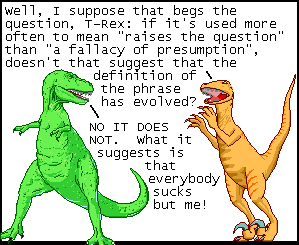
Finally, Xuan asks

Anyways, why did we start using e.g. and i.e. in the first place? Didn’t the Romans bugger off around 400AD?

Incidentally, in an attempt to find evidence that fewer people cared about the distinction between “i.e.” and “e.g.” I turned, as usual, to Google Insights for Search, only to find results that suggest the trend is going the other way. Alternatively, technological changes mean more is being written down by more people than ever before, so there’s more of both.
Categories
Old

Things 32: Busaba Toilets, Colour Test, Slow Motion Squirrel

Films
I saw Mirrors last night. It started off as rubbish and ridiculous as it looked from the trailer, but then got a lot better, with a suitably ridiculous climax.

This week, Quantum of Solace, no more need be said.

Owing to extreme hecticness in the next few months, I have cancelled my Cineworld Unlimited card. The Films section may well disappear for a bit.

Puzzle Part 1
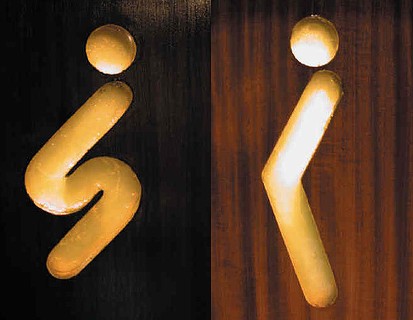
I ate at a Busaba Eathai last week. When I went to the toilets I was confronted with the two signs you see in the image below. I paused, then figured I had cracked the code. Where did I go? Make a guess now, then try part 2 at the end of this email.

A link
…which is also a puzzle. Test your ‘colour IQ’
http://www.xrite.com/custom_page.aspx?PageID=77

A quote or anecdote
When paying for my ticket to see ‘Mirrors’, the guy at the till dropped a one pound coin into the vat of popcorn. Pretty soon three employees were scooping the popcorn around trying to find it while a manager was shouting ‘just complete the transaction!’ at them.

A video
Link courtesy of my mum – squirrel leaping in super slow mo from Autumn Watch:
http://www.bbc.co.uk/apps/ifl/autumnwatch/video_archive/showrecord?Id=hppromo06

Pictures
Pictures of the sun taken using science:
http://www.boston.com/bigpicture/2008/10/the_sun.html

Puzzle Part 2
Looking at the Signs for the Busaba toilets (above) I concluded that they represented the two modes of toileting: standing and sitting. I further inferred that this implied gender. I entered the door marked by the kinked line. It was a simple square wood-panelled room, and all I could see was urinals and sinks. Urinals were not sufficient for my needs at that time.

What would you do?

Categories
New

Things 91: Dresden Codak, i.e., Paths of Flight

Link
In Things 48 (not yet blogged) I linked to an Aaron Diaz’s Dresden Codak update featuring 42 sharply observed 3rd-act plot twists, but recently realised that this may have misrepresented his work, which instead usually consists of astonishingly deft single-page stories revolving around simple but brilliant ideas.

Here’s 3 of my favourites to give you a much better idea of Diaz’s oeuvre:

Lantern Season:

Fabulous Prizes:

Girl vs Bear:

His blog on comic art theory is also well worth checking out if you are remotely interested in the art form.

Quote
During a characteristically interesting and varied conversation with Adam a few days ago, he suddenly revealed the following:

That reminds me of a really interesting thing I read in the Metro today – something like: 30,000 people… something. I can’t remember what it was, but it was really amazing.

Question
Sometimes I want to ask things in Things that are even more obviously not what people might call Puzzles than usual, so in these cases I’m going to be more direct and call a question a Question. So here is a Question.

When it comes to arguments about the English Language I tend to side with the people saying “most people say it this way so that’s now correct” against those saying “this is the way some Victorian guy wrote in a book that it should be said so everyone doing otherwise is wrong”, but I do admit that some distinctions are worth holding against a tide of misuse, one example being that I would correct instances of “i.e.” and “e.g.” being used in one another’s stead where polite and possible.

Fortunately, this didn’t come up very often.

Then in 2010 something terrible happened. About 95% of all instances of “i.e.” that I read were incorrect and should have been “e.g.”, which is particularly silly as it reads as if the author believes a set of many elements (e.g. social networks) consists of only one (e.g. “i.e. Facebook”).

So my question is this: have you also noticed such a sudden rise in “i.e.” misuse, or have I just been unlucky and/or suffered from confirmation bias?

Video
A while ago I realised you could collage time lapse photography of a flight path to obtain an image of a string of planes; I then realised you could do the same thing with video, but recognised that this was beyond my means to produce. Conveniently, GE have now done this:

Categories
Special

Things of the year 2010

It’s time to look back at the year in Things.

The Things newsletter was sent throughout 2010, although I only started blogging it in April with Things 67. Here I’m going to pick out my favourite 3 Things from each of the main categories, including some from the pre-blogging era.

But first:

Tim Link
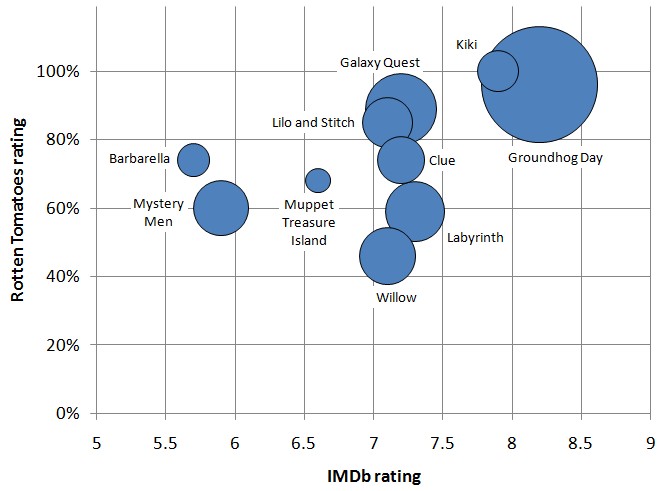
I compiled a list of my top 10 movies to watch at Christmas, not because they’re Christmassy but because they are perfect for the hazy lawless dreamlike days between Christmas and New Year’s Eve. Click through to see trailers, summaries, and other handy links, or if you just want to know what I chose, here’s how they stack up in terms of IMDb and Rotten Tomatoes ratings, with bubbles scaled by number of IMDb votes (as a proxy for famousness):

Last Week’s Puzzle
Last week I asked why our ears ‘pop’ when a plane takes off or lands, given that the cabin should be airtight and thus immune to changes in pressure.

Richard pointed out that actually maintaining that pressure differential at altitude must take a lot of strength, and therefore weight, in terms of materials. By allowing the internal cabin pressure to reduce to still-tolerable levels, the pressure differential is reduced, less strength and therefore weight is needed, making the aeroplane more efficient. Makes sense to me.

Now, on to the Things of the year:

Videos
From Things 70, a perfectly self-explanatory animated gif:

In Things 85 I highlighted the growing trend of cat dubbing:

http://www.youtube.com/watch?v=9bTbAsmPOKo

Most recently, in Things 88 I highlighted this beautiful short animation:

Links
In Things 63 (not blogged), I linked to this really nice way to comprehend the scale of the universe.

The Swinger – swinginating music automatically. As featured in Things 74.

Finally, in Things 86 I linked to Steven Steinberg’s informed musings on AI and Car Insurance. (Dead link, here’s the archive.org version instead – T.M. 19/5/22)

Quotes
Things 70
:

Phil: Doing stupid things can have certain positive beneficial effects.

Things 72 (Art Special):

Flaubert: Art is born of restraint and dies of freedom

Things 87:

dragonfrog, commenting on this Boing Boing post: A quote from Bruce Schneier I think is applicable here: “If you think technology can solve your security problems, then you don’t understand the problems, and you don’t understand the technology.” If you leave out the word “security” I think it remains just as valid.

Pictures
As featured in Things 66 (not yet blogged), from LukeSurl.com:

As featured in Things 81, from Cowbirds in Love:

Finally, from Things 87, because this never gets old for me:

Open-ended Puzzles
1) In Things 71 I asked what would be the best thing I could buy that would maximise hours saved per pound spent. This produced a wide range of responses, largely depending on which assumptions people chose to question, which I posted in Things 72:

  • Yasmin suggests Red Bull (and similar) to save time by needing less sleep.
  • Alam suggests a clone of myself
  • Xuan suggests slaves and a washing machine.
  • Angela suggests two books that could improve one’s efficiency and so save time — The Miracle of Mindfulness and Making Time. (Funnily enough I already own the latter… and I’ve now read it, and have applied the principle of Mindfulness, which was its main point, to rather good effect. But that’s another story).
  • John suggests grated cheese.
  • Phil points out anything free that saves any time would maximise the metric, such as DropBox. This technically lies outside the “buy” requirement. He also suggests a combi-microwave and a smartphone, and then finally a device to prevent time-wasting by cutting off internet access between certain hours. (I since got a Smartphone via work, saving a lot of time with the DropBox and notepad apps, but wasting a lot of time with Angry Birds).
  • Simon specifically attempted to address the “I” part of the question by recommending an iPad as being a particularly good purchase for me, by switching to digital goods (music, movies, comics, books); “Imagine all that time not wasted, going to shops, ordering physical products online and searching for things you can’t find.” I don’t exactly agree, but that’s a huge discussion for another time.

Finally, Laurence suggests a Time Machine, and insightfully adds:

The inevitable complexity of all the proposed solutions reminds me of
the following quote:

“If you want to make an apple pie from scratch, you must first create
the universe.”
– Carl Sagan

2) In Things 77 at Angela’s suggestion I set the Trigger’s Broom / Theseus’ Ship problem. While there was some excellent discussion, which I summed up in Things 78, my favourite answer came from Laurence, which I posted in Things 79:

“It has occurred to me that this could equally be applied to most armies,
governments, countries, football teams, religious cults, families, and
hell, humanity as a whole. At least one of these is the cause for things
like the situation in Northern Ireland, so I think if you could solve
Trigger’s Broom, then it could well go towards solving some larger
issues. (Albeit, possibly presenting people with some radically new ones
in the process!)”

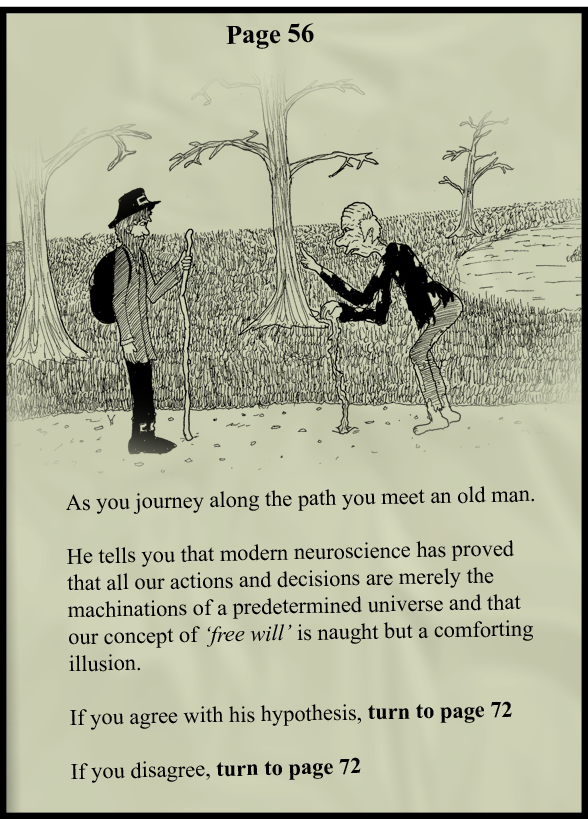
3) Reacting to a ridiculous news item on Free Will (URL broke, here’s the new one – T.M. 19/5/22), in Things 84 I asked:

given an arbitrary budget, and any science-fiction technology you care to imagine, how would you devise a test to see if Free Will exists? Feel free to use any definition of Free Will you think might be useful.

Again, there was some interesting discussion summarised in Things 85, but I had one preferred response, from Tarim:

I cannot think of ANY definition of Free Will.

Which I thought was a fair point.

Puzzles that had good answers that I didn’t know
Richard deserves a special mention for supplying quick, detailed and accurate answers to many puzzles where I had no idea what the answer was at the time I asked. Here’s my favourite three examples.

1) In Things 74 I asked why walk-in freezers have doors that cannot be opened from inside. Richard pointed out the answer is that actually, they generally don’t.

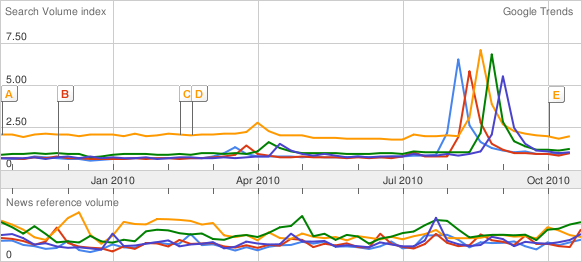
2) In Things 85 I asked about some very strange sequential spikes in searches for numbers on Google Trends:

As I posted in Things 86, Richard worked out that it must be people search for the latest fansubbed episodes of the anime series Bleach, which is pretty much confirmed by checking the search terms associated with these numbers over on Google Insights for Search.

3) The ear popping problem, as was posted in this very edition of Things.