Categories
Special

Things 115: Long-form Special – 5 Great Reads

I’ve built up quite a backlog of links to great long-form content to go in Things, so it’s time for a long-form special!

You’re unlikely to have time to read all these things now, so if you haven’t done so already I recommend getting Read It Later (or some prefer Instapaper) so that you can time-shift some of these links to somewhen more convenient.

Alternatively you may prefer to read these articles in printed form, in which case you might like to download this 27-page pdf I made, which contains each article in full.

|

1) Charlie Stross: Invaders from Mars

(1oth December 2010)

This is the shortest (at just over 500 words, so not really long-form) and probably the most important of the articles I’ll link to here, so you should really just read it right now.

If you can’t or won’t do that, here’s the key parts:

Corporations do not share our priorities. They are hive organisms constructed out of teeming workers who join or leave the collective: those who participate within it subordinate their goals to that of the collective, which pursues the three corporate objectives of growth, profitability, and pain avoidance.

|

Corporations … live only in the present … and they generally exhibit a sociopathic lack of empathy.

|

We are now living in a global state that has been structured for the benefit of [these] non-human entities with non-human goals.

|

In short, we are living in the aftermath of an alien invasion.

Put another way: it’s easy and instinctive to direct ire at individual humans that we see as being to blame for our woes – maybe bankers, politicians, lobbyists, or the 1%. But more importantly, the actions of those individuals are just emergent properties of the system we have created. Which is pretty terrifying.

|
|

2) Paul Ford: Nanolaw with Daughter

(16th May 2011)

With the above in mind, this makes for a particularly interesting slice of sci-fi about a potential emergent behaviour of the systems we’re building now. The most succinct part I can find (quoted below) also happens to be the driest, so if you think this sounds remotely interesting, do go ahead and read the story in full (~2,000 words).

My daughter was first sued in the womb … I’d posted ultrasound scans online for friends and family … A giant electronics company that made ultrasound machines acquired a speculative law firm for many tens of millions of dollars. The new legal division cut a deal with all five Big Socials to dig out contact information for anyone who’d posted pictures of their babies in-utero … The first backsuits named millions of people, and the Big Socials just caved, ripped up their privacy policies in exchange for a cut. So five months after I posted the ultrasounds, one month before my daughter was born, we received a letter … We faced, I learned, unspecified penalties for copyright violation and theft of trade secrets, and risked, it was implied, that my daughter would be born bankrupt.

|

Read the full version here

|
|

3) Johann Hari: How Goldman Sachs gambled on starving the world’s poor – and won

(2nd July 2010)

Once again, keep in mind the idea of emergent properties of the system while reading the story behind this (~1,600 words):

At the end of 2006, food prices across the world started to rise, suddenly and stratospherically. Within a year, the price of wheat had shot up by 80 percent, maize by 90 percent, and rice by 320 percent. In a global jolt of hunger, 200 million people – mostly children – couldn’t afford to get food any more, and sank into malnutrition or starvation. There were riots in over 30 countries, and at least one government was violently overthrown. Then, in spring 2008, prices just as mysteriously fell back to their previous level. Jean Ziegler, the UN Special Rapporteur on the Right to Food, called it “a silent mass murder”, entirely due to “man-made actions.”

|

Read the full version here

|
|

4) Alan Bellow, Damn interesting: Who Wants to be a Thousandaire

(12th September 2011)

All this is somewhat heavy going, so here’s some good news: after a prolonged period of silence, Damn Interesting is now back up and running, and kicked things off with a characteristically interesting story about something that happened back in 1984:

The scoreboard on Larson’s podium read “$90,351,” an amount unheard of in the history of Press Your Luck. In fact, this total was far greater than any person had ever earned in one sitting on any television game show. With each spin on the randomized “Big Board” Larson took a one-in-six chance of hitting a “Whammy” space that would strip him of all his spoils, yet for 36 consecutive spins he had somehow missed the whammies, stretched the show beyond it’s 30-minute format, and accumulated extraordinary winnings. Such a streak was astronomically unlikely, but Larson was not yet ready to stop. He was convinced that he knew exactly what he was doing.

You’ll have to read the full story to find out quite what was going on.

|
|

5) Eben Moglen: Freedom in the Cloud

(transcript from talk given on 5th February 2010)

This final link is the most extraordinary thing I’ve read in at least the last five years. Extraordinary because Eben Moglen discerns the big picture around where the internet came from and where it is headed. Extraordinary because he has put his finger on the defining emergent property of our age. And most of all, extraordinary because  he also has a strong and compelling recommendation on what to do about it.

In a nutshell: client-server architecture encourages centralised services, which create irresistable temptation for surveillance. So we should decentralise the architecture.

That doesn’t remotely do it justice though, so you should really read the whole idiosynratic, fascinating piece here (all 7,000 words of it!).

I can understand that might be quite intimidating, and this is important stuff. So if you can’t see yourself ever reading that, I’ve edited it down (brutally) to fewer than 500 words that take you through the main points here:

It begins with the Internet, designed as a network of peers without any intrinsic need for hierarchical or structural control. It was the great idea of Windows to create a political archetype in the Net which reduced the human being to the client and produced a big, centralized computer, which we might have called a server. [So] now the Net was made of servers in the center and clients at the edge.

|

Now, one more thing happened about that time … Namely, servers kept logs. That’s a good thing to do … But if you have a system which centralizes servers and the servers centralize their logs, then you are creating vast repositories of hierarchically organized data about people at the edges of the network that they do not control and, unless they are experienced in the operation of servers, will not understand the comprehensiveness of, the meaningfulness of, will not understand the aggregatability of.

|

All of those decisions architecturally were made without any discussion of the social consequences long-term. So we got an architecture which was very subject to misuse.

|

In fact, what we have are things we call platforms, [which] mean places you can’t leave. And the Net becomes the zone of platforms and platform making becomes the order of the day.

|

Now, where we went on is really towards the discovery that all of this would be even better if you had all the logs of everything because once you have the logs of everything then every simple service is suddenly a goldmine waiting to happen, and we blew it because the architecture of the Net put the logs in the wrong place. They put the logs where innocence would be tempted.

|

Stallman was right. It’s the freedom that matters. The rest of it is just source code.

|

What do we need? We need a really good webserver you can put in your pocket and plug in any place. In other words, it shouldn’t be any larger than the charger for your cell phone and you should be able to plug it in to any power jack in the world and any wire near it or sync it up to any wifi router that happens to be in its neighborhood. It should know how to bring itself up. It should know how to start its web server, how to collect all your stuff out of the social networking places where you’ve got it. In other words, it should know how to be your avatar in a free net that works for you and keeps the logs. You can always tell what’s happening in your server and if anybody wants to know what’s happening in your server they can get a search warrant.

|

What we need is to make a thing that’s so greasy there will never be a social network platform again.

This speech gave rise to Diaspora, and Eben Moglen went on to create The Freedom Box Foundation to bring about exactly what he’s describing here. I’m continuing to monitor both projects, so if you’re happy to delegate your attention on this then stay tuned to find out when I think they’re ready for the mainstream to jump in.

@metatim
(Twitter is part of the same problem, of course, so I just set myself up on Identi.ca)
Categories
New

Things 114: Kern Test, Robot Bird, Social Graph, Too Soon To Say

Puzzle
This week, try testing your ability to kern.

If you liked that, try the splines.

Video
It’s easy to get overexcited about human progress, when in the grand scheme of things we’re still pretty small fry. I would periodically remind myself of this by considering that for all our ingenuity, we still couldn’t make a robot the size of a bird that could fly like a bird. Thanks to the determined efforts of Festo, I’m going to need to come up with something else.

Link
I’ve seen this link crop up in a few places now, but for good reason – I think this is some really important stuff that we are collectively getting wrong on a large scale right now: “The Social Graph is Neither” by maciej.

Cutting large swathes of great text for concision, here’s my favourite part of the  argument:

[…] declaring relationships explicitly is a social act […] Social graph proponents seem uninterested in th[is] signaling problem. […] [and] how does cutting ties actually work socially? […]  In real life, all relationships fade naturally if you don’t maintain them, but right now social networks preserve ties in amber until we explicitly break them […] Can I unfollow my ex now, or is that going to make her think I’m still hung up on her?

[…] You might almost think that the whole scheme had been cooked up by a bunch of hyperintelligent but hopelessly socially naive people, and you would not be wrong.

However, after a lot of good stuff, it ends with something of a shrug:

It’s just a matter of waiting things out, and leaving ourselves enough freedom to find some interesting, organic, and human ways to bring our social lives online.

I’m not sure that’s quite the right way to put it. I don’t think it’s about bringing our social lives online. Its more about augmenting our social lives with online functionality that goes with the grain of human nature.

That said, leaving ourselves enough freedom is critical. Quite how we do that is a topic for another day.

Quote
In the early 1970’s, Richard Nixon asked Zhou Enlai what he thought of the French Revolution. Zhou notoriously responded:

It is too soon to say.

Which everyone thought was quite wonderfully representative of Chinese sagacity.

This year it emerged that the whole thing was a misunderstanding too delicious to invite correction, as Zhou thought Nixon was referring to the much more recent student riots in Paris.

But this doesn’t matter, because the misread quote still stands as a useful reminder that we should err towards taking a longer-term view when evaluating the benefits of things. On a similar note, Ben Hecht says:

Trying to determine what is going on in the world by reading newspapers is like trying to tell the time by watching the second hand of a clock.

Last Week’s Question
Last week I asked: when someone says “next Thursday” on a Monday, which Thursday do they mean?

Richard’s response was the same as mine – always clarify. However, where I was aware of two interpretations, he identified three [This part added thanks to Richard’s clarification – T.M. 25/11/11]:

I have come across three possible scenarios:

|

(a) this = first occurrence, next = second occurrence
(b) this = occurrence in the week you’re in, next = occurrence in the following week
(c) this = occurrence in the week you’re in, next = first occurrence

|

I don’t think anyone actually uses (a).
Personally I use (b).
I have met people who use (c).

|

To give some examples, on a Tuesday, referring to “This Monday”
and “Next Monday”.

|

(a) This Monday = 6 days times, Next Monday = 13 days time
(b) This Monday = -1 days time, Next Monday = 6 days time
(c) This Monday = -1 days time, Next Monday = 6 days time

|

I can’t think of anyone who would use (a).  (b) and (c) agree.

|

Another example, on a Tuesday, referring to “This Friday” and
“Next Friday”.

|

(a) This Friday = 3 days times, Next Friday = 10 days time
(b) This Friday = 3 days time, Next Friday = 10 days time
(c) This Friday = 3 days time, Next Friday = 3 days time

|

(a) is indistinguishable from (b), hence somewhere who is a (c)
might assume upon hearing (b) that their algorithm is actually
(a).  I would use (b).  I have met people who use (c).

However, I now wonder if this is paranoia – how divided are we really on this issue? Do the vast majority of people use one of these interpretations? My plan is to start to collect instances of people using this form of date referral, noting on which weekday it was said, and which day they were intending to refer to. I’ll report the results here when I have enough data, which may take a few years.

Categories
New

Things 113: Next Thursday, Learning to Cheat, Bullet Time

Question
When someone says “next Thursday” on a Monday, which Thursday do they mean?

Tim Link
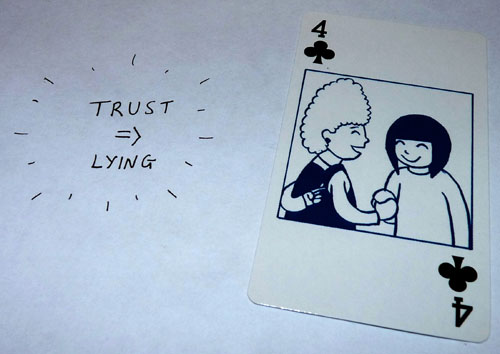
Playing a trading/smuggling game at the recent Sandpit event at the National Maritime Museum, I did something more evil than I knew I was capable of. That got me thinking about the ethics of lying, what games taught me about that, and exactly how rules-based games can enable people to learn about breaking rules. The post is illustrated with playing cards, since I had some to hand.

Link
Two advantages of eBooks are that book size hardly matters, and you can easily link from one page to any other page. Now think about what this means for the choose-your-own-adventure genre. Jon Ingold found you could take a totally different approach, and produced a playable murder mystery that would be as tall as a house were it printed physically.

Quote
A nice way to remember confirmation bias:

Tolstoy: “The most difficult subjects can be explained to the most slow-witted man if he has not formed any idea of them already; but the simplest thing cannot be made clear to the most intelligent man if he is firmly persuaded that he knows already, without a shadow of doubt, what is laid before him.”

Picture
Bullet time

Categories
Old

Things 66: ChatRoulette piano, Tube Door Challenge, Free Will

(Originally sent March 2010, maybe)

Video
ChatRoulette is a fascinating site whose mission is simply to connect you to a random person to video chat with. This is just as good and bad an idea as it sounds. I don’t recommend visiting (particularly if you have a webcam active as it will attempt to throw you into a random encounter immediately) but I do recommend reading about it.

It turns out to be a great environment for improv performance as shown in this video (sound essential, 5’28” long but the first 40” gives you the idea):

I’m fascinated by the extent to which people respond silently – and contrast this with how we usually provide feedback to a musical performance. There’s some very interesting human-machine-human interface stuff going on here.

Link
Sometimes an aesthetic is a byproduct of technology – high contrast in over-reproduced 6”x10” glossy star photos, inconsistent speed in old black and white film, the depth and colour range in Polaroid photos, or the way 80s TV series look rubbish. Digital processing grants a whole new level of control over colour and the ability to choose from a vast range of possible palettes, but the result seems to be that everyone is doing the same thing. This is quite likely how films made in the last ten years will reveal their age when we look back on them ten years from now.

Quote
(via Tim Connor)

Marin Alsop: “Tradition is simply the last bad idea”

Picture
Free Will
.

This weeks’ puzzle
Many years ago Nick challenged me to work out how to tell where the doors of a London Underground tube carriage would stop on the platform so that you could optimise where to stand to improve your odds of boarding first and so getting a seat. I came up with an answer that didn’t work terribly well but assumed that was what he had in mind (without ever confirming it). Only now after 5 months of catching 4 tube trains every workday have I realised a much better solution.

What do you think my first and second solutions were?

Last week’s puzzle
Why are calculator and phone keyboards laid out oppositely? There doesn’t seem to be a definitive answer, but there are a few very likely suspects.

The original decisions that led to 123 being at the bottom for calculators are unclear. Thomas suggests it’s a matter of “where your attention is coming from” – combined with Benford’s law I suspect this could be a key factor driving the layout of the first common mechanical number-entering devices, cash registers, and how devices evolved from there.

When it came to phone pads, it seems (remarkably for this kind of thing) that AT&T actually did some user testing and found the 3×3 grid with 123-at-the-top was the easiest for people to master. As letters were also a consideration in those days, putting ABC with 1 (and so on) made most intuitive sense, and would have looked pretty bizarre had 123 been at the bottom.

My preferred write-up of possible answers comes from The Straight Dope.

Various other attempts to answer this question are curated here.

Richard also points out the following (my summary of his words [my comments in square brackets]):

Handedness is a consideration for other aspects of the layout; in particular computer keyboard number keypads, which sit on the right-hand side, are supposed to be operated with the left hand [a revelation to me after years of feeling slightly odd using my little finger to press the return key], and an interesting challenge emerges when one keyboard is used for both data-entry/calculation and telephone operation, as with Skype today, or the over-prescient One-Per-Desk in 1984.