Categories
New

Things 2025 Q4: Podcasts, long titles, recursive knowledge

Podcasts

I’ve circled around podcasts without diving in for a long time, unsure of how to navigate the medium. With movies or video games, I’m already looking at places that tell me about new and interesting releases, and I know how to find out if something I’m considering might be good; with movies especially I’m aware of directors, writers or actors I like that will form part of the draw. With podcasts, I have none of that!

Despite that, I’ve found a few podcasts over the years that I liked, so it seemed a good time to round them up.

Blank Cheque
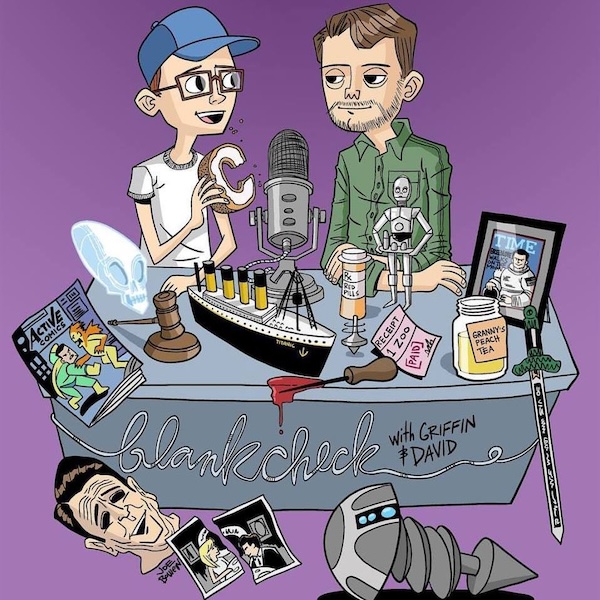
Blank Cheque is a podcast about films (apparently a very popular one but I’d never heard of it, I guess because of my distance from podcasts) specifically about the careers of directors who got ‘blank cheques’, i.e. enough power that they were able to make exactly the films they wanted. It takes the (apparently classic) form of two friends chatting about the subject matter, usually with a guest, but if there was ever a conversation I wanted to overhear about film, this is it. The friends are David Sims, a film critic who is often very funny, and Griffin Newman, an actor/comedian who is also incredibly insightful about films.

They came to my attention through their ‘stunt’ podcast that kicked the whole thing off: “The Phantom Podcast”, a long podcast series diving into Star Wars: Episode I – The Phantom Menace in forensic detail, under the conceit that this was the only Star Wars movie ever made and they are trying to make sense of it. They then ‘discover’ later Star Wars episodes one at a time and continue to analyse them as if nothing else existed. It’s quite incredibly niche and nerdy and there’s only one Things reader I would recommend it to, and I already have, so maybe don’t start with that. (I will say the full ~36 hours (!!) of material covering the prequel trilogy does go out on a pretty audacious high with a George Lucas impersonator defending the films against all criticism in front of a live audience).

I recommend picking a well-known director or film you like and searching the wiki to see if they have covered it (they have covered quite a lot of the big ones by now), then give that episode a listen. My favourite part is that they are often fantastic at drawing out ways in which the film’s meta-text resonates with the text. My least favourite part is that they will often talk over and interrupt their guests, especially women. That’s a pretty sharp down-side, so hopefully the fact I recommend them despite that shows how much I appreciate the good parts.

Link to Blank Cheque podcast

Designer Notes

Ok, I got into this one a while ago but didn’t mention it until now. A little like ‘Blank Cheque’, Designer Notes sees Soren Johnson interview game leads that have produced especially interesting games over their career. As an interviewer, he’s fantastic at drawing out the most interesting stories, with a knack for spotting when a fascinating nugget got skipped and asking the guest to dig into it.

Like Blank Cheque, if there’s a game series or game-maker you like, search (maybe like this) to see if they have been covered and start there.

Link to Designer Notes podcast

Gamecraft
Much shorter than any others mentioned here; if you have any interest in video games as a medium, a business, and in how it has adapted and grown over the past four decades, this is a fantastic listen. Mitch Lasky covers most of the material and is incredibly insightful since, through a lot of luck and some good judgement, he was somehow very close to the action at almost every major evolution the business has been through since the early 90’s. Blake Robins plays the ‘straight man’ role, standing in for the audience by asking the questions you’d naturally want to ask or pointing out context Mitch is sometimes too modest to state.

Link to Gamecraft podcast

Mindscape with Sean Carroll

Sean Carroll is a theoretical physicist with an interest in many different scientific fields, and in this podcast he interviews scientists of all kinds to get a better understanding of their area. He’s a great communicator, and by studying the published materials of his guests in advance he’s able to coax them into explaining it clearly even when they themselves are not quite as eloquent. (Okay, sometimes it doesn’t quite work and he ends up doing most of the explanatory lifting).

Here I recommend scrolling through his list of guests and topics and diving into whichever one you find interesting.

(Random bonus note: I like the way the little intro song has a melody that kind of matches Carroll’s intonation.)

Finally, as an aside, Sean Carroll appeared in Piers Morgan Uncensored to debate Eric Weinstein on the topic of theoretical physics. I’ve seen this characterised as “Jerry Springer for nerds”, notably including the following exchange (only missing a little context):

            Eric: If Sean had actually read my paper…

            Sean: I actually have read your paper! I have it right here!

            Eric: Well first of all, Sean, how dare you…

Someone like Eric is able to get the attention of ‘alternative media’ by sounding very smart and espousing a theory that ‘the establishment’ doesn’t agree with. You need to be incredibly knowledgeable and calm to reasonably debate with someone like this, and Sean pulls it off. I found it fascinating for that reason alone. I even give Piers a little bit of credit for attempting to end the discussion with some grace, given how little he understands the topic (by his own admission).

Link to Mindscape podcast

Useful memorisations

I’m sure a few of you have already done this, but here’s two simple things worth memorising.

First, the numeric position of each letter of the alphabet (a = 1, b = 2, c = 3 etc). In the summer of 2001 I once needed to walk a couple of miles alone and spontaneously decided to memorise this while I walked; I’m amazed how much this has paid off over the years. Admittedly I do move in circles where this sort of thing comes up more often than perhaps is normal.

Second, the ‘major system’ is a simple correspondence between the digits 0-9 and consonants (0 = s, 1 = t/d, 2 = n etc). Once you have memorised this, you can turn any number into a set of letters (e.g. 20251231 = N S N L T/D N M T/D), you then insert whichever vowels you need to make a word or words, which in turn are usually easier to memorise than the numbers because they are a bit weird. This does take a bit of skill, and I’m not very good at it but get by (e.g. NSNL.TN.MT = No SNaiL-eaTeN MuT). Great for PINs or a surprising number of other things. Admittedly sometimes the effort of translating the thing into words and then back again often means I end up memorising the numbers directly, but that’s still a win.

If you have similarly useful memorisations to recommend, let me know!

AI coding trough of disillusionment

In a fast-moving world, this article by Mike Judge, “Where’s the Shovelware? Why AI Coding Claims Don’t Add Up” is now a bit old (article date 3rd Sep 2025), but it was a pretty thorough look for signs of AI coding being transformative in terms of software / websites / apps / games and not finding any evidence:

  • The METR study found developers thought AI made them 20% faster but it actually made them 19% slower
  • Mike’s own mini-trial found nowhere near the powerful effect he had subjectively thought was happening
  • There is no evidence of increased releases of apps on iOS, Android or Steam
  • No increase in domain name registrations
  • No increase in new public Github repositories

Mike also then directly addresses the most obvious counterpoints that could be raised.

https://substack.com/inbox/post/172538377?=&aid=recKGiRdTrn0tC0OH

Now, to avoid oversimplifying, we should also consider the following:

  • Generating code is just one part of shipping a product, all the other parts can be quite difficult and annoying, so maybe that functions as a barrier
  • This doesn’t mean nobody sees any benefit from AI in any coding situation. People can be coding for personal use, or improving existing workflows
  • Even if there’s no effect on publishing rates, there could be other effects, such as different levels of quality or hiring patterns

There are also, of course, other ways in which generative AI has an impact – there’s dramatically more to this topic than I’m covering here. For example, it’s a great way to make social media spam, presentations everywhere are getting bespoke illustrations that would have otherwise been just text, and some have seen a decline in job roles for junior positions (for example), so there’s still lots to watch out for.

Films where they actually had to Do The Thing

With editing and special effects, movies can weave a lot of magic. However, sometimes the plot will require the film-makers to actually depict something incredibly impressive without any tricks.

I first encountered this as a theoretical example in the book (recommended to me by Will W), “Adventures in the screen trade” by William Goldman, screenwriter of All the President’s Men and The Princess Bride. In one chapter he writes a short story and then has experts in different aspects of film-making give him feedback on how the story might need to change to be realised on film. Of particular note was that the story hinged on a boy getting a transcendently incredible haircut of unknowable beauty; it is firmly pointed out to him that this is essentially impossible to portray on screen.

What I’m getting at here is skills specifically outside of those you expect for film-makers. An example of what I’m not counting: sometimes a character gives an inspiring speech to rouse people to action and it’s literally inspiring – difficult to write, but movies have professional writers. Or sometimes a film requires stunt work, especially a Jackie Chan film in which part of the appeal is he is performing difficult and dangerous stunts himself – but this is still a fairly normal part of film-making, with Jackie Chan being an apex example.

Where it can get harder is music.
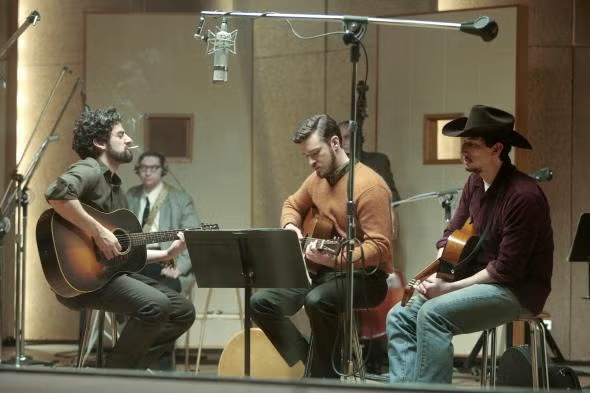
Inside Llewyn Davis (2013) is a film about a folk singer on the edge of musical success and (more often) disaster. They found Oscar Isaac for the lead, who is not only perfect for it but also a legitimately talented musician. At one point he is brought in to record a novelty song, “Please Mr Kennedy” (with Justin Timberlake as the song’s on-screen and off-screen writer; also with Adam Driver doing a silly voice), and Isaac’s character opts to take the session fee rather than any cut of the song’s profits. As an audience you should read this as a mistake, as the song will probably perform well. As a novelty song, and to the point of this section, it is legitimately good enough that you believe that’s a possibility. (It’s partly based on the original Please Mr Kennedy by Mickey Woods, and as @mooviedude141 notes in the comments on the film’s version, a different Kennedy did pretty much go on to send two of the performers into outer space).

There are plenty of other films in which a song needs to do a lot of lifting and they pull it off (“Remember Me” in Coco (2017); the Cloud Atlas Sextet in Cloud Atlas (2012); a central performance in Sinners (2025)), all of which are impressive, but I know of two examples that go the full distance.
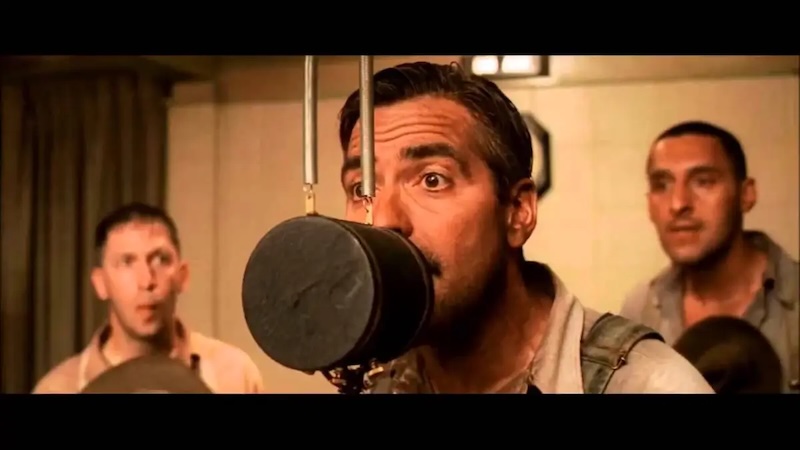
In O Brother, Where Art Thou? (2000), a surprising through-line is that the escaped convict protagonists end up recording “Man of Constant Sorrow”, and while their hijinks continue the song is becoming popular in the background, to pay off beautifully near the end. Meanwhile in real life, that song (and the film’s soundtrack) legitimately became extremely and surprisingly popular.
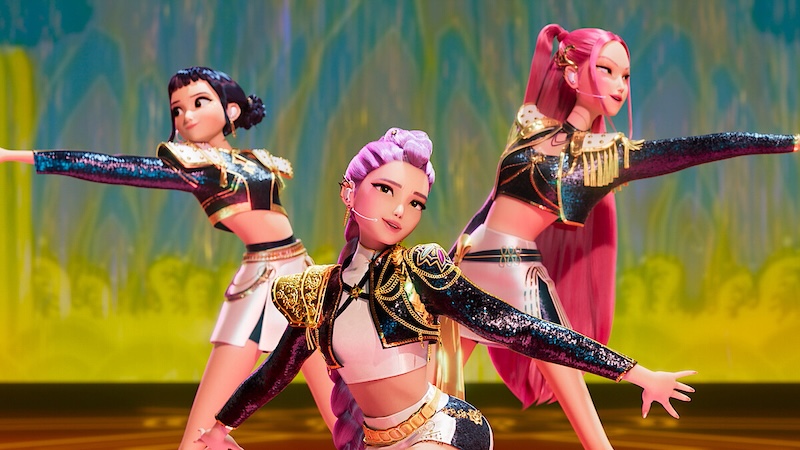
More recently Kpop Demon Hunters (2025) features several songs by the in-movie group HUNTR/X (performed mostly by genuine K-pop group Twice among other expert contributors), who are supposed to be extremely popular – and in real life, to quote from the Wikipedia summary, “it became the first film soundtrack on the Billboard Hot 100 to have four of its songs in the top ten, was certified double Platinum by the Recording Industry Association of America (RIAA) in October 2025, and received five Grammy Award nominations”.

What about non-music?

In The Ring (1998), a particular video will ‘curse’ anyone who watches it. Perhaps making such a video is arguably within the wheelhouse of a horror film director, but the execution of it really stands out. The video is semi-abstract but nonetheless legitimately creates a deeply cursed feeling, which is why I won’t embed it here and also is part of why that film haunted my nightmares for years, only resolving when I dressed as the main spook Sadako one Hallowe’en.

Very long titles of manga and anime that explain the whole premise

This trend has been running for some years in Japanese anime and manga. Some Examples:

  • The World’s Finest Assassin Gets Reincarnated In Another World as an Aristocrat
  • Banished from the Hero’s Party, I Decided to Live a Quiet Life in the Countryside
  • I Got a Cheat Skill in Another World and Became Unrivaled in the Real World, Too
  • The Magical Revolution of the Reincarnated Princess and the Genius Young Lady
  • The Guy She Was Interested in Wasn’t Really a Guy at All

I wonder if this becoming acceptable (or even appealing) makes some stories more marketable than they would have been in a short-title paradigm. Perhaps this is partly why the Isekai genre (protagonist goes to ‘another world’, a genre lately overrepresented in general and also in my above examples) has had such a boom in popularity.

We could consider how this might play for major Hollywood films. There have been a few examples with titles changing mid-marketing-push to get longer/shorter and more/less explicit about the premise:

  • “Birds of Prey (and the Fantabulous Emancipation of One Harley Quinn)” did not seem to work as a title and had a late pivot to “Birds of Prey”. I can’t help but feel just “Harley Quinn” would have worked better, but that’s a topic for another Things.
  • John Carter was previously to be titled John Carter of Mars, but seemingly Disney thought the ‘Mars’ bit would put people off, so hoped to just… sneak it in there?
  • Edge of Tomorrow sounds cool but tells you very little, so had a late pivot to the much clearer (but equally terse) Live. Die. Repeat.

Perhaps there’s something fundamentally different going on in the marketing strategy though – Hollywood films that aspire to be blockbusters will often signify their intended mass appeal with a very short title such as ‘Titanic’, ‘Frozen’, or ‘Sinners’. Meanwhile, a lot of anime and manga are trying to carve out a niche, and they can best do that by setting out the full premise up front so the people looking for that exact sort of thing will find it.

So, if there’s anywhere we might expect this trend to show up in Western media, perhaps it’s books?

Recursive Knowledge

Laurence once pointed out to me that “you have a vested interest in anyone that has a vested interest in someone you have a vested interest in”, and he remains correct.

In the second book of Cixin Liu’s Three Body Problem trilogy, the author dramatises the problem of insufficiently recursive trust. Two groups, who we can label Alice and Bob, have a problem: each of them has the capacity to annihilate the other before there is a chance to retaliate.

  • Alice trusts that Bob will not attack, and Bob trusts that Alice will not attack
  • But, Alice does not know that Bob trusts that will Alice not attack, and vice versa
  • If there’s a chance Bob does not trust Alice will not attack, probably he will attack
  • So to be safe they each should launch a pre-emptive strike

Unfortunately this keeps going even if you can add another level of trust. Consider just Alice’s side in the next level up (using close synonyms for trust/know to try to keep it manageable):

  • Alice trusts that Bob will not attack
  • Alice is also confident that Bob, in turn, trusts that Alice will not attack. Hooray!
  • But… Alice does not know if that meta-confidence is reciprocal. As far as she knows, even though Bob trusts that Alice will not attack, he might not know that she knows that
  • So Alice must consider the possibility that Bob does not know that Alice knows Bob trusts that Alice will not attack.
  • If that’s the case, Bob might be concerned that Alice is unaware that Bob trusts that Alice will not attack. Bob will consider the possibility that Alice does not believe Bob trusts Alice will not attack.
  • If Bob is considering that, it means he worries Alice thinks Bob does not trust that Alice will not attack – and if that was the case Alice, assuming Bob does not trust her, would launch a pre-emptive attack.
  • In this scenario that Alice is imagining, Bob would therefore launch a pre-emptive attack… so Alice had better launch her attack first.

You can see how this keeps going even if you layer on more meta levels of trust. The problem presumably caps out at our ability to compute much further. Unfortunately, if both sides entrust such decisions to AI then this will either become undecideable in the halting problem sense, or they will pre-emptively attack each other while trying to get to the bottom of the recursion just to be on the safe side.

How far can humans really think this sort of thing through? In the previous section I noted there is a manga titled “The Guy She Was Interested in Wasn’t Really a Guy at All”. As you would expect from the title, the drama hinges on the fact that Aya has a crush on Koga who she assumes is a boy, but Koga is in fact a girl in her class who dresses in a very male-presenting way outside of high school.

I don’t think it’s really a spoiler to say that eventually the secret comes out, because it’s very much about the journey rather than the destination (and at the time of writing the series is unfinished). That knowledge recursion is dramatized over a series of stages – Aya finds out about Koga, then Koga learns that Aya has found out but Aya doesn’t know that, and at a certain point Aya overhears that Koga has realised that Aya knows about Koga’s identity – but Koga does not know she knows that! That sounds pretty abstract, but in the moment of reading, the meaning and emotional significance of this highly meta revelation feels incredibly clear. I suppose as social animals, it makes sense that humans can grasp this stuff pretty well when it’s in the context of a story.

While I was thinking about all this I found out that Steven Pinker now has a book out called “When everyone knows that everyone knows”, which deals with ‘common knowledge’; when recursive knowledge operates at a population level.

I should note a slightly distant and dark irony there: we’re going through a kind of ‘common knowledge’ moment right now with the release of the Epstein files. In 2006 Pinker wrote a letter to his friend Alan Dershowitz, who was Epstein’s defence attorney at the time, on the the wording of the “internet luring statute”, and this apparently contributed to federal sex trafficking charges against Epstein being dropped. Pinker says he was unaware this was how it would be used and regrets sending it.

  • Transmission ends somewhat uncomfortably
Categories
New

Things 2024 Q2: Project Lyra, Baseline Scene, Singularity

Correspondence on dancing and music in movies

Last time I spoke about temp tracks, and the use of an end-of-film dance sequence as a nuanced way to wrap up a narrative.

Tarim points out that Edgar Wright’s Baby Driver (2017) is an excellent contrast to a temp track, in that it has many sequences precisely written, choreographed and edited with a very particular song in mind. I had hoped to see this catch on as a trend but have so far been disappointed, so do let me know of anything similar I missed.

Miranda pointed out that in video games, Frog Detective also features the Dance Party Ending trope, which makes me want to play it even more.

Finally Ben notes that Der Hauptmann / The Captain (2017) does something at the end that is not dancing but is nonetheless unexpected and produces an interesting overall effect. I’ve not seen it yet but that does sound pretty intriguing.

Real-world puzzle: Frit

In Things June 2022 I invited you to consider “How do rice cookers work?” as a sort of real-world puzzle one could solve just by thinking about it.

Similarly, frit is the name for the black spotted band you see around the edges of car windscreens or train windows. But why is it there and why does it look like that?

As a clue on how deep to go, from what I have now read there are three parts to the answer, all of which I think you could work out just by thinking about it – if you have enough background knowledge of how the science of this sort of thing works.

Chasing ‘Oumuamua

In 2017, an unusual celestial object (NASA description), uniquely cigar-shaped, was observed rapidly entering the solar system before being slungshot (at 87.3 km/s) by the Sun in a different direction, in what looked like an Oberth maneuver – and even sped up slightly as it left! Tantalisingly, and if you are prepared to get tremendously speculative, this is just the sort of thing you might expect an object created by a Non-Human-Intelligence to look like and do. But it was travelling far too fast for us to stand a chance of sending anything out to take a closer look at it.

Or was it? Project Lyra explores the possibility of finding some kind of trajectory through the solar system that could catch up to it, and impressively actually found a way. Launching a craft in 2030 and pivoting it around Jupiter to launch into its own Oberth maneuver around the sun and catch up with ‘Oumuamua by 2053 – albeit passing it at a relative speed of around 26km/s. It’s not clear if we can build a craft that can actually achieve such a feat, let alone muster the ability to fund it, but it’s a pretty fascinating possibility.

A nice animation of this path can be found with this twitter/X post. If you don’t have an account you can try this YouTube video which edits it to Lynyrd Skynyrd’s Free Bird to greater/lesser effect.

This great astronomy.com article goes into detail about possible explanations for the object (even that acceleration), and multiple methods being investigated to get a closer look at it.

One of my favourite parts was a note on the scale of distances involved. One Astronomical Unit (AU) is the average distance from Earth to the Sun. Travelling at such an incredible speed, in one hundred years ‘Oumuamua will be about 150 AU away from us. In comparison, Proxima Centauri, the closest star to the Sun, is more than 268,000 AU away. While I already understood that interstellar distances are very very large, this helped me put it in better context.

Video round-up

If you’ve not seen her before, Diane Morgan’s fictional character Philomena Cunk is an “ill-informed investigative reporter”, interviewing subject-matter experts and opining on various matters with a playfully unhinged level of naivety, weaving a kind of verbal slapstick with sudden darts of dark satire (sample quote interviewing a professor of imperial history: “Was the British Empire evil like it was in Star Wars?”)

The approach is very silly and sometimes effective, but the stand-out moment for me is her interview on the topic of nuclear weapons, which possibly only lands if you’ve seen her other stuff:

https://www.youtube.com/watch?v=DGrLUNpF7H4

Last time, I wrote about LCD Soundsytem’s “New Body Rhumba”, after which YouTube convinced me to watch some of their other music videos. An excellent highlight of this back-catalogue is the video for Oh Baby, directed by Rian Johnson and telling a short story that I think would be of interest to Things Readers. (Do note that the music and video both take 35 seconds to really kick off):

When I was a kid I said my favourite TV show was the adverts. Perhaps this was a golden age of the form, or perhaps kids just love short-form video wherever they can get it, but in any case one of my favourites was Cog – I literally have it on DVD! So I was very happy to find this behind-the-scenes video about how it was made:

Recommended Media

Spy x Family

As an anime on Netflix, this is notable for being both interesting and comparatively available even to people who don’t usually watch anime. It’s best thought of as a sit-com with a very silly ‘sit’: in an incongruously average Western setting (German style place names, European architecture, English character names, American school buses, vaguely cold war era), a fake family is formed where none of the participants know about the secret lives of the others. Watch the first two episodes to see how this pleasingly mad premise comes about and judge if this kind of silliness is for you!

Delicious in Dungeon

Another anime on Netflix that might appeal to people who don’t usually watch anime! This one is a bit of a wolf-in-sheep’s-clothing. It initially appears to be about a D&D-style dungeon crawl with a surprising fixation on recipes you could make with the monsters killed along the way – like a fantasy-themed cooking show.

After a while though it reveals writer Ryoko Kui’s passion for thoughtfiul world-building with an emphasis on systems-thinking, with the party’s success coming from knowledge and curiosity. It also does get quite dark and violent. You probably need to watch at least 5 episodes to see if you’ll enjoy what it has to offer, but for me the journey was definitely worth it. Also do note that the primary female character becomes much less two-dimensional and sidelined over time, as I found this aspect was quite off-putting in the early episodes.

Riddle of Fire

Just reading the premise on the cinema listing got me interested:

“In the rolling hills of Wyoming, three mischievous children are tasked with collecting a blueberry pie from their local store. However, what begins as a simple errand soon evolves into an odyssey across the American West, as the intrepid trio faces poachers, witches, huntsmen, and fairies, who all seek to challenge them on their quest. Will the bonds of friendship prove strong enough to guide them home?”

This very consciously evokes 70’s live-action Disney, with the film aesthetic, the haircuts and even the casting. I was a bit surprised to realise early on that these kids really can’t act (or possibly are being directed that way), but I took it as part of the Lo-fi approach, and ended up spending most of the film with a big smile on my face.

The trailer does a good job of representing it from the very first seconds, this is pretty much what you get:

Blade Runner 2049: subtext and metatext of the baseline scene (no spoilers)

I found Denis Villeneuve’s Blade Runner sequel cinematically striking, but was quite put off by the script’s underlying preoccupation with the elimination of every commonly recognised contribution of women to society (made no less problematic by the suspicion that this wasn’t even intentional). As such I can’t recommend it, even though I do like what the overarching narrative is going for.

Still, I have to respect the ‘baseline scene’, an update and reframing of the original Blade Runner’s Voight-Kampf test, as something strange and mysteriously compelling. This long essay by andi goes into that in a lot of detail, and is worth reading because it justifiably concludes with this excellent remark:

“At this point the text, subtext, and metatext all converge.”

If you know of anything else in any other media that can be described similarly please let me know!

https://cohost.org/mcc/post/178201-the-baseline-scene

Oral History of Lilo & Stitch

If you don’t want to read a long article about depressing sci-fi, how about one about uplifting animation?

A recent rewatch confirmed that Lilo & Stitch is my favourite movie of all time (closely followed by Kiki’s Delivery Service and Speed Racer). It also has one of the best behind-the-scenes content I’ve ever seen on a DVD in the form of a 2-hour making-of documentary that covers all the aspects of film-making I’m most interested in – especially the iterative writing process and the way in which a singular creative vision is realised with a large team.

This makes it all the more impressive that Vulture’s ‘oral history’ finds even more fascinating information about the making of this film. With some very candid interviews with key players, it puts the film in the proper context of this somewhat wobbly era of Disney animation. It’s also a great case study for giving creative works a certain amount of independence from outside interference, and the benefits of avoiding crunch:

https://www.vulture.com/2022/10/an-oral-history-of-lilo-and-stitch-a-hand-drawn-miracle.html

If you like that, even if you haven’t seen the film you might also appreciate their oral history of the Emperor’s New Groove, which is much more of a roller-coaster when it comes to the evolution of the story.

Quote

“Change? Why do we need change? Aren’t things bad enough as they are?” 

Attributed to Lord Salisbury

Why I love the ‘Singularity’ music video

As part of an attempt to add some positivity to the internet, I previously wrote about why I love the ‘Up All Night’ music video.

While there is less to unpack, allow me to present the Jon Hopkins Singularity music video, directed by Seb Edwards. First watch it here, and note that while pondering a metaphorical reading of the action is quite interesting, I am – unusually – much more drawn to trying to interpret it literally:

As with Up All Night, I’ll use the performers’ names for the unnamed leads: Jarkko and Aliashka (source). By the way, if this doesn’t really interest you then feel free to move on as this is the final Thing of the issue!

Your mileage may vary, but the opening worked perfectly for me: all I could see was something incomprehensible and spooky in a forest, and was only able to interpret the imagery when it then recurs towards the end of the video.

We begin in an ambiguous and dystopian-looking setting (actually Belgrade according to this, looks like Block 61 on Google maps) as Jarkko comes home to discover Aliashka mysteriously floating and spinning down from the sky. Immediately we are challenged to interpret what could be going on.

My read is that they do not know one another, but they are curious about each others’ circumstances, and there’s a spark of attraction. The presence of flashing lights and drifting down from the sky immediately suggests something extra-terrestrial, but the amorous developments and eventual arboreal destination suggest to me Aliashka is some kind of fae spirit entering the human realm for the first time.

The next challenge to a literal interpretation is the movement: actions and reactions are almost normal but have a supernatural grace. Jarkko looks confused about this, not sure if he needs to help or evade, and Aliashka seems mostly interested in how he is reacting. My read here is that in a magical exaggeration of the human instinct to read social cues and mirror behaviour, Aliashka’s fae nature ensnares Jarkko, who can’t help but fall into her patterns of movement a little – and later on, a lot.

Ambiguous behaviour reads as threatening, and for a few shots it seems like Jarkko is cautiously backing away but not entering full flight. Aliashka closes the gap, becoming more interested in him – especially as his movements become more dance-like and fluid. I read this as Jarkko beginning to pass some sort of compatibility test.

A sequence of throws might be Jarkko trying to push Aliashka away, but each one turns into more of a dance, and he becomes more enamoured – now no longer backing away, he chooses to follow her up some stairs with her smiling encouragement.

Moving into an embrace that might usually escalate to a kiss, it seems they have both concluded that they have found a romantic partner. But as the music shifts, so does Aliashka’s demeanour. She starts to look frustrated and even sad. This is because despite confirming a baseline compatibility and attraction, she must now submit Jarkko to a more severe process to progress their courtship.

To Jarkko’s bafflement, her movements now shift decisively from ambiguous to physical attacks and throws. He can’t match her supernatural strength, although he can perhaps endure it.

When thrown through the floor, he tries to stand but can’t – not because he is weakened, but because his body is now fully caught up in the rhythm and spin.

In an almost miss-able moment, standing apart, Aliashka hunches and moves her arms – and Jarkko mirrors the movement, or tries to.

He’s not actually being attacked: this is part of the process by which he is brought into sync with the fae. Her attacks change to patterns for him to copy, or encouragement for him to keep going. Her movements become wilder and more desperate as she puts energy into the process, willing him to survive and complete the process of assimilation.

They finally rise and hold one another, locking eye contact, touching heads. Jarkko understands that this was never an attack, but something more like a bonding ritual and a lesson. They bounce in sync and he finally reaches her level – the ability to spin and float! It’s ridiculous and beautiful and represents a sublime level of compatibility.

They drift out of the urban environment and into the woods – her realm, I think. There they finally stop and share a moment, both relieved and cautiously optimistic about where this might go next.

Or, you know, perhaps it’s just a metaphor for a relationship that breaks down and then heals again. But that’s not as interesting.

  • Transmission ends
Categories
Uncategorized

Things 2024 Q1: Dancing, Temp tracks, Creativity

LEGO is doing okay

This nice visualisation of LEGO group annual revenue shows that after a lull in the late 2010’s, there has been incredible growth since 2020 – presumably somewhat assisted by pandemic lockdowns?

Not shown – revenue growth flattened in 2023

As someone who enjoys LEGO but is running out of storage space, I’ve been trying out BrickBorrow for the last year, where for a subscription (and some postage each time) you can borrow LEGO sets.

A well-designed feature restricts big sets to those who have been subscribed for 3 months – this shows reliability, and also helps with availability of those sets. Now that BrickBorrow have shifted to a Royal Mail sticker postage method, and added a filter on the sets to only show those that are available, I recommend it!

£915 of LEGO I got to build for £235… but had to send back. Worth it!

I Am Not Left-Handed

This is the name of a trope where a character reveals they were previously fighting with a self-imposed handicap, which they then shed to fight at their true power. This is a classic technique for shallow power-fantasy stories, but despite that I find it incredibly compelling every time.

My favourite concentrated example of it is this (now very old!) Anime Music Video which edits together a particular fight from Naruto, which I also appreciate for how it establishes a rooting interest in one of the combatants without any dialogue:

Temp Tracks in film

In this episode of Every Frame a Painting, Tony Zhou and Taylor Ramos break down the way in which ‘safe’ creative choices around music in the Marvel films has led to a weaker overall effect:

Towards the end they highlight the problem of the ‘Temp Track’: a piece of film is edited to a suitable existing piece of music, but the film-makers work with that version for so long they become wedded to the way it sounds, so when they eventually commission original music, they request something almost identical. In a spin-off video, EFAP show a lot of examples.

The opposite of this is Tom Tykwer’s method (director of Run Lola Run (1998) ), in which the soundtrack is composed first. You can hear a bit about it in this segment of the making of The Matrix Resurrections, and it does seem very effective.

While we’re on the topic, I personally greatly enjoyed The Matrix Resurrections (2021) for it’s metatextual resonance rather than literal content, apparently in marked contrast to most people. But that is a story for another time.

Dancing at the end of films

A Bollywood staple, after the film reaches its narrative conclusion, even if it’s not a musical and there has been no dancing before, the film ends with the whole cast performing an elaborate dance number (TV Trope: Dance Party Ending). This can have a fascinating effect on how you feel about the film as a whole, sometimes redeeming antagonists, bringing back characters who died, or just providing an emotional catharsis after an otherwise tense time.

Unfortunately I suspect that citing my favourite Western films that do this is also a strange kind of spoiler. So instead I will recommend to you several films that I have seen recently, at least one of which uses this to good effect, but all of which I think are worth watching for one reason or another. Some will even be improved by you thinking there might be a dance at the end, even if there isn’t!

  • Knight and Day (2010), Disney+, a strange clash of genres that works great… some of the time
  • Labyrinth (1986)
  • Medusa Deluxe (2022), a ‘single-take’ hairdressing competition murder mystery
  • Saltburn (2023), directed by Emerald Fennell, whose previous film Promising Young Woman (2022) I also recommend… for adults that like ambiguous protagonists
  • The Marvels (2023), Disney+, MCU take some creative risks! Some of which work!
  • Teenage Mutant Ninja Turtles: Mutant Mayhem (2023)
  • White Noise (2022), Netflix, weirder and less ‘fun’ than the trailer implies (but I still recommend it)
  • The Zone of Interest (2023)

Dancing in a fursuit

Probably best to jump in with no context and watch this one-minute clip, which annoyingly I can’t embed so you will have to actually click on it:

https://www.youtube.com/shorts/L03td6_rOvk

Wow! What the heck was that? This ad-laden article lays out the whole story. Gintan is some kind of K-pop star in his own right, but is now known for performing at ‘Random Dance’ events in this very distinctive fursuit. In these events, clips from K-Pop songs with popular choreography are played, and anyone who knows the routine jumps into the centre to perform it. There’s a delightfully over-academic essay about these events here.

What’s really impressive is that not only has Gintan memorised so many of these routines, and not only can he perform them with incredible precision and panache on demand, he does all of this while wearing a heavy fursuit – which is like a really fun version of the ‘I Am Not Left-Handed’ trope described above!

On top of that, the slightly serious expression on the suit is a great contrast with the frivolousness of the whole thing, and it always brings a smile to my face.

Find lots more Gintan footage like this with this Youtube search.

The Meta-Problem of Consciousness

Let’s get a bit more serious for a moment.

The Hard Problem of Consciousness is a philosophical one: to use Wikipedia’s summary, it asks why and how do we experience qualia, phenomenal consciousness, and subjective experiences? Related questions: where does consciousness reside? Is it a quantum effect? Is it separate from our physical forms in some way?

I never found this problem convincing at all. Why would we expect consciousness to feel any different to the way it actually does? Literally our only reference case is how we experience it, on what grounds can we say this is surprising?

I first read about this some decades ago, so I was delighted to find that in 2018 philosopher David Chalmers proposed a more precise and slightly sassy formulation of my line of thinking: the “Meta-problem of Consciousness”. This is “the problem of explaining why we think that there is a [hard] problem of consciousness.”

Yes! That does indeed seem to be the more pressing problem.

The Temp Track that went well

I know of one example of a film that used a temp track to edit a key scene, and (in my opinion) this actually produced an excellent final result. Even as someone quite averse to spoilers, in this particular case I don’t think reading about it – or even watching the scene on its own – actually spoils the film!

However, if you worry even more about spoilers than me, you might not want to know about it. So, just know that it is from one of the films listed above, I’ll be talking about it after the extended Thing about creativity-over-time below, and it is the last Thing of this episode so you can easily skip it if you want. Be ready!

Creativity over time: productivity and scope

I’m very interested in the creative process. The brain is a machine that can come up with ideas or whole creative works, but the methods by which you can best achieve that are not obvious.

When it comes to long-form works this is particularly tricky. Here’s a segmentation I came up with for thinking about this:

Planning style: Plan in advance vs. Freestyle
Routine style: Fixed schedule vs. When it’s ready

The pro/con on these is pretty clear, at least for narrative works.

Plan in advance
Pro: A solid overall story that wraps up satisfyingly (even if you have to alter it a bit as you go)
Con: Characters may not act consistently as you’re forcing them to hit story beats

Freestyle
Pro: Characters and situations evolve naturally
Con: Plot may spiral out of control and not go anywhere

Fixed schedule
Pro: Progress is made consistently, can retain and build an audience
Con: Quality may suffer

When it’s ready
Pro: Maximise quality
Con: Easy to put off and polish indefinitely

If you know me, you know what’s coming next… a consideration of the four combinations!

The four approaches to ongoing narrative

As with any classification of creative works, some of this is subjective or debatable for many reasons. Regardless, here’s some examples:

Plan in advance, fixed schedule
Star Wars original trilogy (sort-of), Babylon 5, Breaking Bad.

Plan in advance, when it’s ready
The Gentleman Bastards book series

Freestyle, fixed schedule
Questionable Content, Star Wars sequel trilogy, Lost

Freestyle, when it’s ready
Game of Thrones, Dresden Codak, Confinement animation

Now, just from writing down the first examples I could think of, some very natural patterns emerge.

A plot planned in advance and delivered to a fixed schedule has produced some of the most beloved completed works there are.

In opposition to that, Freestyle and When it’s Ready has produced works that I think have an even more intense fandom (as it maximises quality), but frequently slow down and stall for one reason or another.

Freestyle with a fixed schedule generally seems like a bad idea, but over long time periods works in a sort of ‘soap opera’ format.

Plan in advance, release when ready seems to be very rare, and seems intuitively the most likely to become a victim of procrastination / anxiety / writer’s block stalling progress.

Some case studies in slowed progress

Game of Thrones (or properly titled, the ‘A Song of Ice and Fire’ series) is perhaps the apex example of ‘Freestyle, when it’s ready’ slowing to a crawl (or possible halt). Here’s a chart showing the release date and length of each book, running up to the present day when ‘The Winds of Winter’ has not yet come out.

To be clear, I don’t consider this a failing. I think the books are as well-loved as they are precisely because this method of production maximises quality and character. However, expectations for a timely finish should be held quite low.

A recent example was shared with me by Laurence: Confinement, a series of animations based on the SCP Foundation (referenced in Things November 2022). These had an even more dramatic stall: episode 7 was extremely popular and drove many to support the creator’s Patreon. However, about 3.5 years later the creator admitted they didn’t have it in them to make episode 8 any more and formally closed all their social channels. (There’s a lot more drama to that, which you can read about here).

Here’s how those releases looked, running the x-axis to the point when the project was officially cancelled:

In what is (I think) an example of the rare “Planned in advance, release when ready”, the Bee and Puppycat animation managed to reach a pretty satisfying conclusion (so far) about 9 years after it began – with an astonishing 83% of the run-time dropping all at once at the very end:

The slowness of early releases was due to a very small team working on the animation. Then a series of complicated licensing delays and disasters conspired to delay later releases. But in the end, a soft reboot / series 2 eventually dropped all at once on Netflix in September 2022.

I’ll tell you why Bee and Puppycat is so good another time, but for now just know that when I audited all 50+ in-jokes I share with Clare, this series accounted for more of them than anything else.

While less narrative in nature, the web comic Hyperbole and a Half had a very prolonged hiatus. In the dangerous “Freestyle, release when it’s ready” category, but without the burden of an overarching narrative, artist Allie Brosh had published a series of excellent and very personal hybrid comic/narratives, from 2009-2010. Output slowed in 2011 due to mental health issues, a medical condition, and a focus on turning the content into a book. Things seemed to end with the book coming out in October 2013 and at the same time the truly excellent “Menace” strip being published (shortly after the Bee and Puppycat pilot aired).

Then, nothing, for a very long time. This was also quite concerning given the prior comic was a very personal one about coming to terms (perhaps?) with depression. On the other hand, author Allie Brosh had said “In the world of writing internet content, there’s all this talk of “maintaining an audience” and “staying on the radar,” but I’d rather just work really hard for a really long time on one thing that I feel really good about publishing.”

So it was that a sequel book “Solutions and Other Problems”, announced in 2015, eventually came out in September 2022, 9 years after the last published work (and also around the time the Netflix Bee and Puppycat series finally dropped, as it happens). The content of that book follows the previous form, and also details some of the things that happened to Brosh in the intervening years, and the reason for the gap in public output becomes devastatingly clear. I highly recommend both books.

Finally, in that rare “Plan in advance, release when ready” category, Scott Lynch published The Lies of Locke Lamora in 2006. Nick recommended it to me, and I enjoyed it quite a lot, but it seemed like the author liked world-building a little too much. As the first in a planned series of 7 books called the ‘Gentleman Bastard’ series, I decided to wait until the series finished before reading on.

A second book appeared in 2007, a third in 2013… and at the time of writing, nothing else.

Scott Lynch wrote very candidly in 2022 about what has been going on. He has in fact been writing very productively, but a kind of anxiety is holding him back from publishing any of it, including updates about how it is going. (As a Things reader you probably enjoy ‘meta’ things, so you should read that post).

Here’s the point where we get meta about it right here: I recognise that problem because that is exactly what happened to me since 2020 (when a pandemic happened, funnily enough). I have 4 rather long and pretty much complete blog posts about various topics, none of which I felt confident enough about to post. This hasn’t happened to me before!

As a Things reader you might also recognise that even aside from that, the rate of Things posts gets slower and slower (with the surprise exception of this one… at the time I’m writing this sentence, anyway). That is something I find a bit harder to explain.

Having written all the above, it does make me wonder: should I commit to a schedule for Things? Wouldn’t once a quarter be a completely reasonable one to try?

Let’s say this is the 2024 Quarter 1 things and see how things go from there!

The Temp Track that Went Well: not a spoiler, but might be if you’re very worried in which case don’t read this

Are you ready?

So this is about a scene that happens at the very end of one of the films in my list above.

Specifically a scene where everyone starts dancing

That’s enough line spacing, so here we go. Perhaps you are familiar with the LCD Soundsystem’s 2005 song “Daft Punk is Playing in my House”. It seems to be their 3rd most popular song on Spotify, and 2nd most popular song on Youtube. It is rather repetitive but has a very compelling hook:

(The music video references the Things-favourite Michel Gondry-directed music video to Daft Punk’s “Around the World”, another repetitive but compelling song).

So at the end of White Noise (2022), there is a scene where the characters visit the excellently set-dressed 80’s supermarket and everyone there starts dancing as the credits roll. Incidentally, this tipped the movie over from something I thought was interesting-but-a-bit-weird into excellent.

LCD Soundsystem’s ‘Daft Punk is Playing in my House’ was used as the temp track for this scene – and indeed was the track the dancing was choreographed and performed to, which ordinarily I would say is going a bit too far for a temp track. However, here’s the twist: they commissioned LCD Soundsystem themselves to write a new track to play over the scene instead.

I had previously written about how fans of a band often cling to the past and are less keen (at least initially) on new musical directions, with the example of the audience response to a DJ Shadow gig (“Artistic Stasis or Death!”). So it seems like an outrageously bold thing to ask a band to make a new song so specifically similar to a well-loved old one.

And the beauty of it is, LCD Soundsystem did it. They made a new track – “new body rhumba” – that for me is even better than DPIPIMH from 17 years earlier, and is completely perfect for this scene in the movie. You can listen to it here or just watch that scene itself (accepting that this is perhaps more of a spoiler, although not really given how loose the rules of continuity are when it comes to Dance Party Endings).

Side-note, this may just seem weird and boring without the context of the film leading up to it, or even with it since everything is subjective. But anyway, enjoy!

  • Transmission ends
Categories
Old

Things 18: Layton Squares, Lesson Learned, IWIWAL

(Originally sent June 2008)

This week’s films – one line reviews
The Happening was a huge disappointment, anticlimactic in every way.
(My review: http://uk.youtube.com/watch?v=_Mpa9ViwoMg)

The Incredible Hulk was impressive yet strangely forgettable.
(My review: http://uk.youtube.com/watch?v=ltWgo9TXvKk)

Next Week’s film
Wanted
. It looks like the standard Hero’s journey (ordinary guy discovers he is in fact the son of the world’s best assassin and must take up his mantle to protect Fate itself!!) with a great cast. This is my personal most anticipated movie of the year, since it is directed by Timur Bekmambetov, who directed my favourite movie of last year, Day Watch. He has an amazing talent for making the incredible look plausible, yet still awesome. I am seeing this at the first possible opportunity.

Fantastic teaser trailer featuring a single illustrative fragment of the film:
http://uk.youtube.com/watch?v=oTRh66yvYpc [Video removed – this short teaser kind of does the job though – Tim 23/8/2010]

If that’s not enough for you, here’s the full trailer which probably has most of the awesome stuff in it.
IMDb rating
: 7.8/10
Rotten Tomatoes rating: n/a (It’s not being shown to critics?!) [Currently 71% – Tim 23/8/2010]

A Puzzle
In answer to last week’s “what comes next”: heaven.

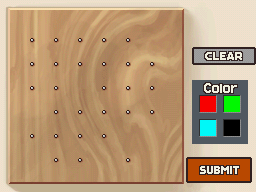
This week: Professor Layton and the curious village is a puzzle game for the Nintendo DS, and my favourite puzzle in it is number 100. The challenge is to work out how to loop seven elastic bands around the pins in the board so that each one is held in the shape of a square, and no pin is used as a corner twice:

A Quote
Another baffling moment from my friend Nick:

Nick: Have you heard of the psychologist, Wasslavich?
Tim: No…
Nick: Neither have I.

A Link
A lesson is learned but the damage is irreversible is the name of the webcomic, and each strip generally follows that theme and stands alone. It’s also mindblowingly insane and creative and I can’t just link to a single strip. So, depending on which opening line you like the most, take your pick:

“Dale, I owe the legendary ghosts of mafia bosses $80,000!”
http://www.alessonislearned.com/index.php?comic=20

“Caroline’s doppelganger is crying again.”
http://www.alessonislearned.com/index.php?comic=37

“The universe was so ashamed that you slept late, it is shrivelling into a raisin.”
http://www.alessonislearned.com/index.php?comic=31

A video
I can’t understand why I haven’t linked to this video before. It’s an excellent example of the “Anime Music Video” (AMV) format, in which scenes from anime are ingeniously edited to create a video for a song, in this case the brilliant “I wish I was a lesbian”:

A picture
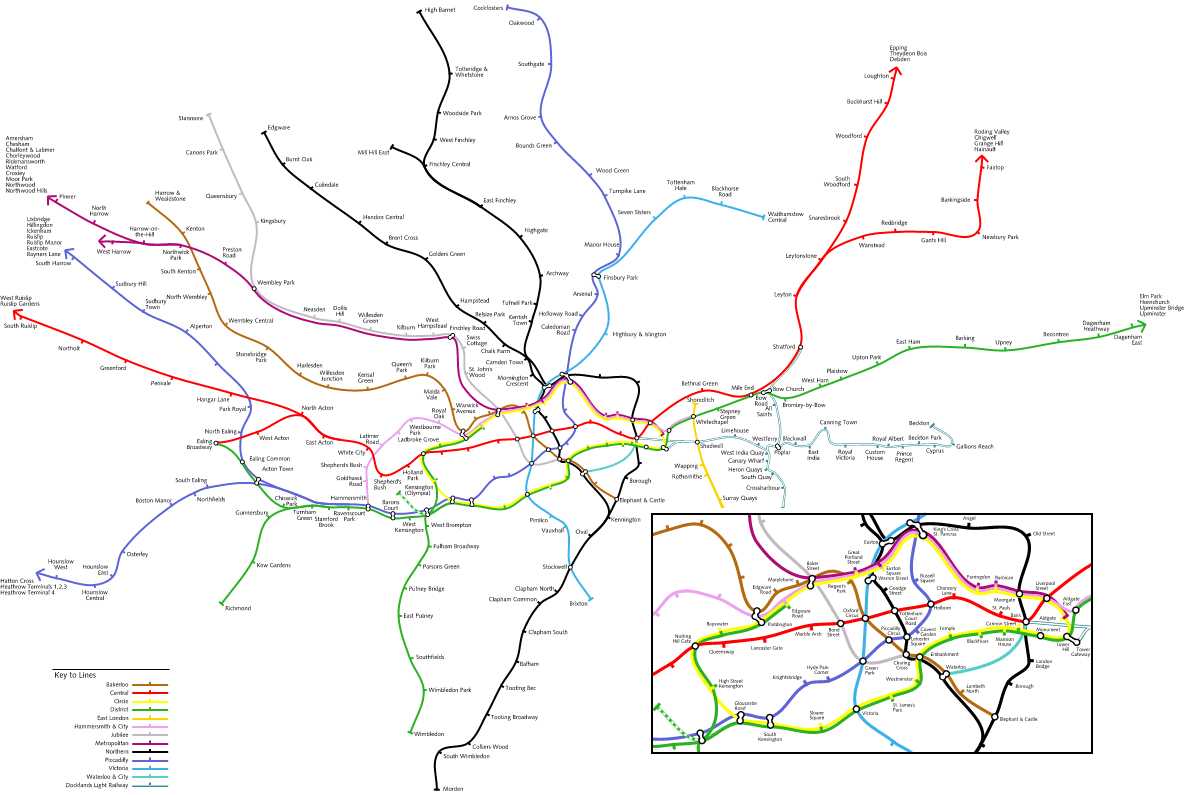
The surprisingly rarely seen true scale version of the London underground. The stylised version we are familiar with is actually an incredible triumph of marketing that turned around the fortunes of the tube.