Categories
New

Things 2025 Q4: Podcasts, long titles, recursive knowledge

Podcasts

I’ve circled around podcasts without diving in for a long time, unsure of how to navigate the medium. With movies or video games, I’m already looking at places that tell me about new and interesting releases, and I know how to find out if something I’m considering might be good; with movies especially I’m aware of directors, writers or actors I like that will form part of the draw. With podcasts, I have none of that!

Despite that, I’ve found a few podcasts over the years that I liked, so it seemed a good time to round them up.

Blank Cheque
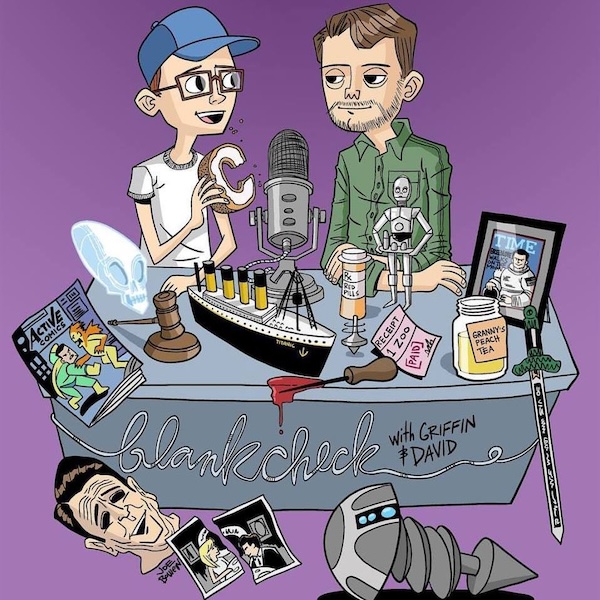
Blank Cheque is a podcast about films (apparently a very popular one but I’d never heard of it, I guess because of my distance from podcasts) specifically about the careers of directors who got ‘blank cheques’, i.e. enough power that they were able to make exactly the films they wanted. It takes the (apparently classic) form of two friends chatting about the subject matter, usually with a guest, but if there was ever a conversation I wanted to overhear about film, this is it. The friends are David Sims, a film critic who is often very funny, and Griffin Newman, an actor/comedian who is also incredibly insightful about films.

They came to my attention through their ‘stunt’ podcast that kicked the whole thing off: “The Phantom Podcast”, a long podcast series diving into Star Wars: Episode I – The Phantom Menace in forensic detail, under the conceit that this was the only Star Wars movie ever made and they are trying to make sense of it. They then ‘discover’ later Star Wars episodes one at a time and continue to analyse them as if nothing else existed. It’s quite incredibly niche and nerdy and there’s only one Things reader I would recommend it to, and I already have, so maybe don’t start with that. (I will say the full ~36 hours (!!) of material covering the prequel trilogy does go out on a pretty audacious high with a George Lucas impersonator defending the films against all criticism in front of a live audience).

I recommend picking a well-known director or film you like and searching the wiki to see if they have covered it (they have covered quite a lot of the big ones by now), then give that episode a listen. My favourite part is that they are often fantastic at drawing out ways in which the film’s meta-text resonates with the text. My least favourite part is that they will often talk over and interrupt their guests, especially women. That’s a pretty sharp down-side, so hopefully the fact I recommend them despite that shows how much I appreciate the good parts.

Link to Blank Cheque podcast

Designer Notes

Ok, I got into this one a while ago but didn’t mention it until now. A little like ‘Blank Cheque’, Designer Notes sees Soren Johnson interview game leads that have produced especially interesting games over their career. As an interviewer, he’s fantastic at drawing out the most interesting stories, with a knack for spotting when a fascinating nugget got skipped and asking the guest to dig into it.

Like Blank Cheque, if there’s a game series or game-maker you like, search (maybe like this) to see if they have been covered and start there.

Link to Designer Notes podcast

Gamecraft
Much shorter than any others mentioned here; if you have any interest in video games as a medium, a business, and in how it has adapted and grown over the past four decades, this is a fantastic listen. Mitch Lasky covers most of the material and is incredibly insightful since, through a lot of luck and some good judgement, he was somehow very close to the action at almost every major evolution the business has been through since the early 90’s. Blake Robins plays the ‘straight man’ role, standing in for the audience by asking the questions you’d naturally want to ask or pointing out context Mitch is sometimes too modest to state.

Link to Gamecraft podcast

Mindscape with Sean Carroll

Sean Carroll is a theoretical physicist with an interest in many different scientific fields, and in this podcast he interviews scientists of all kinds to get a better understanding of their area. He’s a great communicator, and by studying the published materials of his guests in advance he’s able to coax them into explaining it clearly even when they themselves are not quite as eloquent. (Okay, sometimes it doesn’t quite work and he ends up doing most of the explanatory lifting).

Here I recommend scrolling through his list of guests and topics and diving into whichever one you find interesting.

(Random bonus note: I like the way the little intro song has a melody that kind of matches Carroll’s intonation.)

Finally, as an aside, Sean Carroll appeared in Piers Morgan Uncensored to debate Eric Weinstein on the topic of theoretical physics. I’ve seen this characterised as “Jerry Springer for nerds”, notably including the following exchange (only missing a little context):

            Eric: If Sean had actually read my paper…

            Sean: I actually have read your paper! I have it right here!

            Eric: Well first of all, Sean, how dare you…

Someone like Eric is able to get the attention of ‘alternative media’ by sounding very smart and espousing a theory that ‘the establishment’ doesn’t agree with. You need to be incredibly knowledgeable and calm to reasonably debate with someone like this, and Sean pulls it off. I found it fascinating for that reason alone. I even give Piers a little bit of credit for attempting to end the discussion with some grace, given how little he understands the topic (by his own admission).

Link to Mindscape podcast

Useful memorisations

I’m sure a few of you have already done this, but here’s two simple things worth memorising.

First, the numeric position of each letter of the alphabet (a = 1, b = 2, c = 3 etc). In the summer of 2001 I once needed to walk a couple of miles alone and spontaneously decided to memorise this while I walked; I’m amazed how much this has paid off over the years. Admittedly I do move in circles where this sort of thing comes up more often than perhaps is normal.

Second, the ‘major system’ is a simple correspondence between the digits 0-9 and consonants (0 = s, 1 = t/d, 2 = n etc). Once you have memorised this, you can turn any number into a set of letters (e.g. 20251231 = N S N L T/D N M T/D), you then insert whichever vowels you need to make a word or words, which in turn are usually easier to memorise than the numbers because they are a bit weird. This does take a bit of skill, and I’m not very good at it but get by (e.g. NSNL.TN.MT = No SNaiL-eaTeN MuT). Great for PINs or a surprising number of other things. Admittedly sometimes the effort of translating the thing into words and then back again often means I end up memorising the numbers directly, but that’s still a win.

If you have similarly useful memorisations to recommend, let me know!

AI coding trough of disillusionment

In a fast-moving world, this article by Mike Judge, “Where’s the Shovelware? Why AI Coding Claims Don’t Add Up” is now a bit old (article date 3rd Sep 2025), but it was a pretty thorough look for signs of AI coding being transformative in terms of software / websites / apps / games and not finding any evidence:

  • The METR study found developers thought AI made them 20% faster but it actually made them 19% slower
  • Mike’s own mini-trial found nowhere near the powerful effect he had subjectively thought was happening
  • There is no evidence of increased releases of apps on iOS, Android or Steam
  • No increase in domain name registrations
  • No increase in new public Github repositories

Mike also then directly addresses the most obvious counterpoints that could be raised.

https://substack.com/inbox/post/172538377?=&aid=recKGiRdTrn0tC0OH

Now, to avoid oversimplifying, we should also consider the following:

  • Generating code is just one part of shipping a product, all the other parts can be quite difficult and annoying, so maybe that functions as a barrier
  • This doesn’t mean nobody sees any benefit from AI in any coding situation. People can be coding for personal use, or improving existing workflows
  • Even if there’s no effect on publishing rates, there could be other effects, such as different levels of quality or hiring patterns

There are also, of course, other ways in which generative AI has an impact – there’s dramatically more to this topic than I’m covering here. For example, it’s a great way to make social media spam, presentations everywhere are getting bespoke illustrations that would have otherwise been just text, and some have seen a decline in job roles for junior positions (for example), so there’s still lots to watch out for.

Films where they actually had to Do The Thing

With editing and special effects, movies can weave a lot of magic. However, sometimes the plot will require the film-makers to actually depict something incredibly impressive without any tricks.

I first encountered this as a theoretical example in the book (recommended to me by Will W), “Adventures in the screen trade” by William Goldman, screenwriter of All the President’s Men and The Princess Bride. In one chapter he writes a short story and then has experts in different aspects of film-making give him feedback on how the story might need to change to be realised on film. Of particular note was that the story hinged on a boy getting a transcendently incredible haircut of unknowable beauty; it is firmly pointed out to him that this is essentially impossible to portray on screen.

What I’m getting at here is skills specifically outside of those you expect for film-makers. An example of what I’m not counting: sometimes a character gives an inspiring speech to rouse people to action and it’s literally inspiring – difficult to write, but movies have professional writers. Or sometimes a film requires stunt work, especially a Jackie Chan film in which part of the appeal is he is performing difficult and dangerous stunts himself – but this is still a fairly normal part of film-making, with Jackie Chan being an apex example.

Where it can get harder is music.
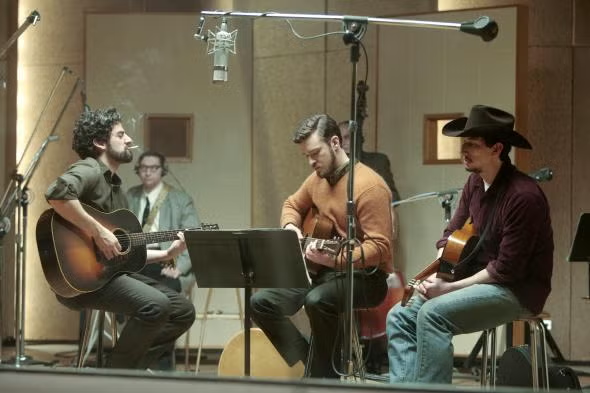
Inside Llewyn Davis (2013) is a film about a folk singer on the edge of musical success and (more often) disaster. They found Oscar Isaac for the lead, who is not only perfect for it but also a legitimately talented musician. At one point he is brought in to record a novelty song, “Please Mr Kennedy” (with Justin Timberlake as the song’s on-screen and off-screen writer; also with Adam Driver doing a silly voice), and Isaac’s character opts to take the session fee rather than any cut of the song’s profits. As an audience you should read this as a mistake, as the song will probably perform well. As a novelty song, and to the point of this section, it is legitimately good enough that you believe that’s a possibility. (It’s partly based on the original Please Mr Kennedy by Mickey Woods, and as @mooviedude141 notes in the comments on the film’s version, a different Kennedy did pretty much go on to send two of the performers into outer space).

There are plenty of other films in which a song needs to do a lot of lifting and they pull it off (“Remember Me” in Coco (2017); the Cloud Atlas Sextet in Cloud Atlas (2012); a central performance in Sinners (2025)), all of which are impressive, but I know of two examples that go the full distance.
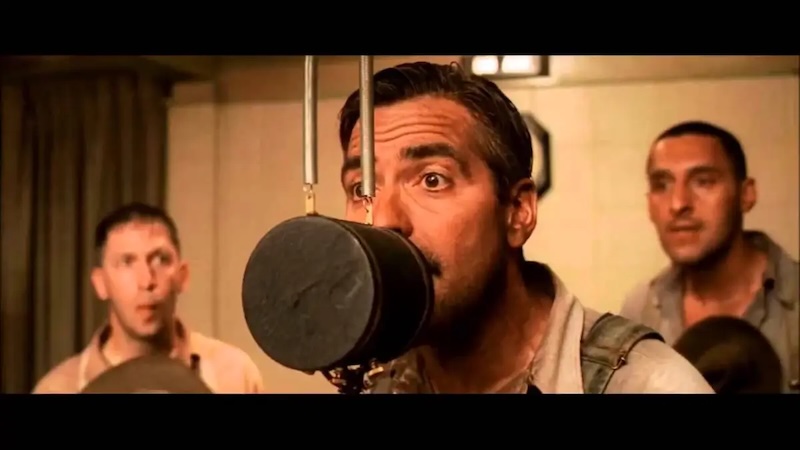
In O Brother, Where Art Thou? (2000), a surprising through-line is that the escaped convict protagonists end up recording “Man of Constant Sorrow”, and while their hijinks continue the song is becoming popular in the background, to pay off beautifully near the end. Meanwhile in real life, that song (and the film’s soundtrack) legitimately became extremely and surprisingly popular.

More recently Kpop Demon Hunters (2025) features several songs by the in-movie group HUNTR/X (performed mostly by genuine K-pop group Twice among other expert contributors), who are supposed to be extremely popular – and in real life, to quote from the Wikipedia summary, “it became the first film soundtrack on the Billboard Hot 100 to have four of its songs in the top ten, was certified double Platinum by the Recording Industry Association of America (RIAA) in October 2025, and received five Grammy Award nominations”.

What about non-music?

In The Ring (1998), a particular video will ‘curse’ anyone who watches it. Perhaps making such a video is arguably within the wheelhouse of a horror film director, but the execution of it really stands out. The video is semi-abstract but nonetheless legitimately creates a deeply cursed feeling, which is why I won’t embed it here and also is part of why that film haunted my nightmares for years, only resolving when I dressed as the main spook Sadako one Hallowe’en.

Very long titles of manga and anime that explain the whole premise

This trend has been running for some years in Japanese anime and manga. Some Examples:

  • The World’s Finest Assassin Gets Reincarnated In Another World as an Aristocrat
  • Banished from the Hero’s Party, I Decided to Live a Quiet Life in the Countryside
  • I Got a Cheat Skill in Another World and Became Unrivaled in the Real World, Too
  • The Magical Revolution of the Reincarnated Princess and the Genius Young Lady
  • The Guy She Was Interested in Wasn’t Really a Guy at All

I wonder if this becoming acceptable (or even appealing) makes some stories more marketable than they would have been in a short-title paradigm. Perhaps this is partly why the Isekai genre (protagonist goes to ‘another world’, a genre lately overrepresented in general and also in my above examples) has had such a boom in popularity.

We could consider how this might play for major Hollywood films. There have been a few examples with titles changing mid-marketing-push to get longer/shorter and more/less explicit about the premise:

  • “Birds of Prey (and the Fantabulous Emancipation of One Harley Quinn)” did not seem to work as a title and had a late pivot to “Birds of Prey”. I can’t help but feel just “Harley Quinn” would have worked better, but that’s a topic for another Things.
  • John Carter was previously to be titled John Carter of Mars, but seemingly Disney thought the ‘Mars’ bit would put people off, so hoped to just… sneak it in there?
  • Edge of Tomorrow sounds cool but tells you very little, so had a late pivot to the much clearer (but equally terse) Live. Die. Repeat.

Perhaps there’s something fundamentally different going on in the marketing strategy though – Hollywood films that aspire to be blockbusters will often signify their intended mass appeal with a very short title such as ‘Titanic’, ‘Frozen’, or ‘Sinners’. Meanwhile, a lot of anime and manga are trying to carve out a niche, and they can best do that by setting out the full premise up front so the people looking for that exact sort of thing will find it.

So, if there’s anywhere we might expect this trend to show up in Western media, perhaps it’s books?

Recursive Knowledge

Laurence once pointed out to me that “you have a vested interest in anyone that has a vested interest in someone you have a vested interest in”, and he remains correct.

In the second book of Cixin Liu’s Three Body Problem trilogy, the author dramatises the problem of insufficiently recursive trust. Two groups, who we can label Alice and Bob, have a problem: each of them has the capacity to annihilate the other before there is a chance to retaliate.

  • Alice trusts that Bob will not attack, and Bob trusts that Alice will not attack
  • But, Alice does not know that Bob trusts that will Alice not attack, and vice versa
  • If there’s a chance Bob does not trust Alice will not attack, probably he will attack
  • So to be safe they each should launch a pre-emptive strike

Unfortunately this keeps going even if you can add another level of trust. Consider just Alice’s side in the next level up (using close synonyms for trust/know to try to keep it manageable):

  • Alice trusts that Bob will not attack
  • Alice is also confident that Bob, in turn, trusts that Alice will not attack. Hooray!
  • But… Alice does not know if that meta-confidence is reciprocal. As far as she knows, even though Bob trusts that Alice will not attack, he might not know that she knows that
  • So Alice must consider the possibility that Bob does not know that Alice knows Bob trusts that Alice will not attack.
  • If that’s the case, Bob might be concerned that Alice is unaware that Bob trusts that Alice will not attack. Bob will consider the possibility that Alice does not believe Bob trusts Alice will not attack.
  • If Bob is considering that, it means he worries Alice thinks Bob does not trust that Alice will not attack – and if that was the case Alice, assuming Bob does not trust her, would launch a pre-emptive attack.
  • In this scenario that Alice is imagining, Bob would therefore launch a pre-emptive attack… so Alice had better launch her attack first.

You can see how this keeps going even if you layer on more meta levels of trust. The problem presumably caps out at our ability to compute much further. Unfortunately, if both sides entrust such decisions to AI then this will either become undecideable in the halting problem sense, or they will pre-emptively attack each other while trying to get to the bottom of the recursion just to be on the safe side.

How far can humans really think this sort of thing through? In the previous section I noted there is a manga titled “The Guy She Was Interested in Wasn’t Really a Guy at All”. As you would expect from the title, the drama hinges on the fact that Aya has a crush on Koga who she assumes is a boy, but Koga is in fact a girl in her class who dresses in a very male-presenting way outside of high school.

I don’t think it’s really a spoiler to say that eventually the secret comes out, because it’s very much about the journey rather than the destination (and at the time of writing the series is unfinished). That knowledge recursion is dramatized over a series of stages – Aya finds out about Koga, then Koga learns that Aya has found out but Aya doesn’t know that, and at a certain point Aya overhears that Koga has realised that Aya knows about Koga’s identity – but Koga does not know she knows that! That sounds pretty abstract, but in the moment of reading, the meaning and emotional significance of this highly meta revelation feels incredibly clear. I suppose as social animals, it makes sense that humans can grasp this stuff pretty well when it’s in the context of a story.

While I was thinking about all this I found out that Steven Pinker now has a book out called “When everyone knows that everyone knows”, which deals with ‘common knowledge’; when recursive knowledge operates at a population level.

I should note a slightly distant and dark irony there: we’re going through a kind of ‘common knowledge’ moment right now with the release of the Epstein files. In 2006 Pinker wrote a letter to his friend Alan Dershowitz, who was Epstein’s defence attorney at the time, on the the wording of the “internet luring statute”, and this apparently contributed to federal sex trafficking charges against Epstein being dropped. Pinker says he was unaware this was how it would be used and regrets sending it.

  • Transmission ends somewhat uncomfortably
Categories
Special

Things August 2017: Archive Adventures – part 2

Last time I shared the first half of the exciting archive of historic unused Things. In this second half, I’ll cover music, games, writing, and some data visualisation. Enjoy!

Video/Audio

I was collecting examples of music where I felt the production process was the main contributor to the quality of the song (rather than the songwriting or performance), examples being Britney Spears – Toxic, Mark Ronson – God Put a Smile on Your Face, and the Space Channel 5 theme tune. Then I wondered if actually I just like crisp brass and distorted orchestral sounds, and have no ear for production at all, so wasn’t sure whether I could meaningfully comment. But listen to those songs as a set and see what you think!

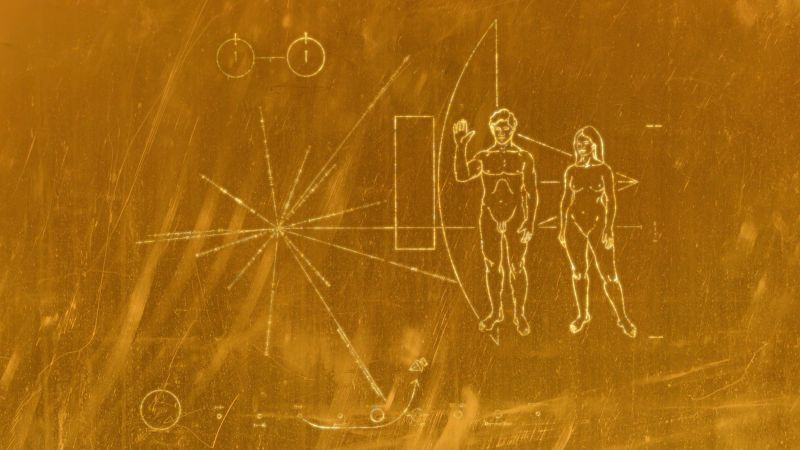
Putting a record of important sounds from earth in a spacecraft and shooting it out of the solar system is pretty speculative (although I’d argue we don’t know enough about the parameters in the Drake equation or the full potential of technology in this universe to know just how speculative) – but is also a profoundly optimistic and beautiful act, so I’m really glad we did it.

Some trivia that hilariously undermines the beauty of the gesture: EMI refused permission for The Beatles’ “Here Comes the Sun” to be included; and the engravings showing what humans look like (naked) were actually censored and therefore inaccurate.

Copyright issues have always made it challenging to listen to the full Voyager track listing on earth, but the copyright-subverting hydra that is YouTube solves this problem, and I highly recommend making time to appreciate the playlist.

https://www.youtube.com/watch?v=Bhuq9rNO_FQ&list=PLA5Z0m2JKyVJUgkMG08WP8KsAvLrjfkjP

[Haha, no – that’s dead. Try this youtube search – T.M. 7/4/21]

And this just in, with a title that sets expectations perfectly, another candidate for music-to-share-with-the-galaxy: Duel of the Fates on Trombones

Games

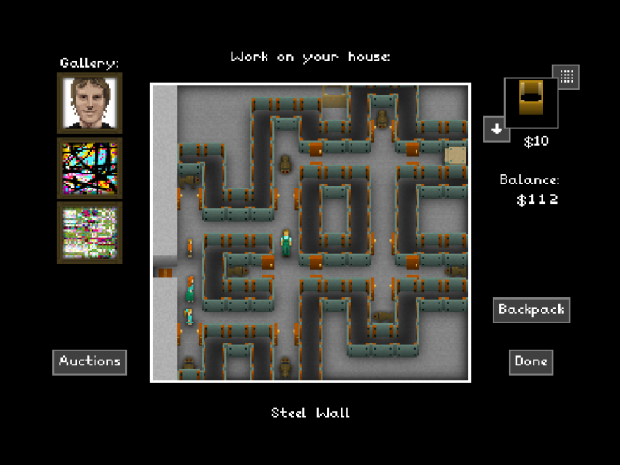
I previously wrote about game-maker Jason Rohrer in Things 121 (specifically on Chain World, a game intended to become a religion). In 2014 he released The Castle Doctrine, a game about gun-ownership through the medium of PvP house-security design and burglary. Players design a secure ‘house’, with the restriction that it must be possible to break into without tools; they then try to break into other player’s houses to steal loot, and then store that loot in their own house and hope their design keeps other thieves out. Total loot owned is public, so a nice feedback loop emerges where a more successful player will attract more burglary attempts.

The challenge for such a game design is you need to come up with creative opportunities and restrictions that will emergently lead to players creating a huge range of fascinating house-designs. I particularly enjoyed the systems-design reasoning at work in Rohrer’s post on some of the design changes he had to make in response to players converging on clever (but boring) solutions.

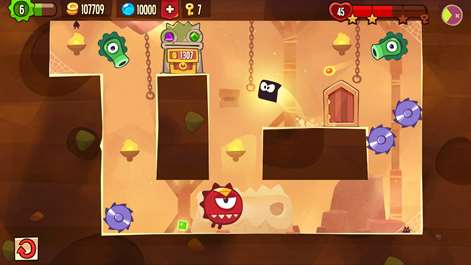
In mobile games, the mind-bogglingly successful Clash of Clans (and its many clones) operates on a similar basis with (very) light real-time-strategy gameplay, but the strategic variety seems ultimately quite weak. I’m more impressed by King of Thieves, also operating on the same idea but with single-screen platformer gameplay. It’s free, so if that sounds at all interesting you should check it out (on iOS and Android). Unfortunately the late-game becomes about pixel-perfect jump timing which is a bit less fun.

Self-improvement

I can’t remember what I was thinking when I added this link, but perhaps that in itself is telling: Kottke’s extract from an Adam Phillips interview, “The need not to know yourself“.

I suspect that procrastination is a challenge for a large number of people, and found that Quora has a collection of highly upvoted answers. I personally found the best approach is a mixed strategy: trying lots of things in sequence. So this is a good place to go to find lots of ideas.

Writing, Data Visualisation, Everything Else

A good long read is, these days, the closest I get to the escapism of a good novel: a chance to inhabit and explore another world-view. If you’re the same, you’ll probably enjoy this long article on novels, tragedy, comedy, and religion on two levels. Sample quotes:

“the invention of the novel privatised myth, because the novel, invented after Aristotle, did not have a holy book. The novelist was on his own. Sometimes he’s even a she. There were no rules.”

“As they became professional, writers began to write about writers. As they became academicised, writers began to write about writing.”

“You may think that to praise The Simpsons at the expense of Henry James makes me a barbarian. Well, it does, but I’m a very cultured barbarian. The literary novel has gone late Roman. It needs the barbarians.”

There was an article about a trend online to use “?” where formal writing used a hyphen, for example:

“The greatest pleasure of all – the categorisation of minutiae.”
“The greatest pleasure of all? The categorisation of minutiae.”

I felt that captured something I’d seen and been annoyed by, and figured I would collect some examples. I guess shortly after that I just started to accept it and didn’t collect anything, and then couldn’t find the original link, leaving this a bit of a non-thing. Although I think the fact I abandoned it is at least somewhat interesting.

Unremembered by present me, and unexplained by past me, the Things archive includes a link to the Tableau product support page.

Here are some fascinating maps on the distribution of blood types.

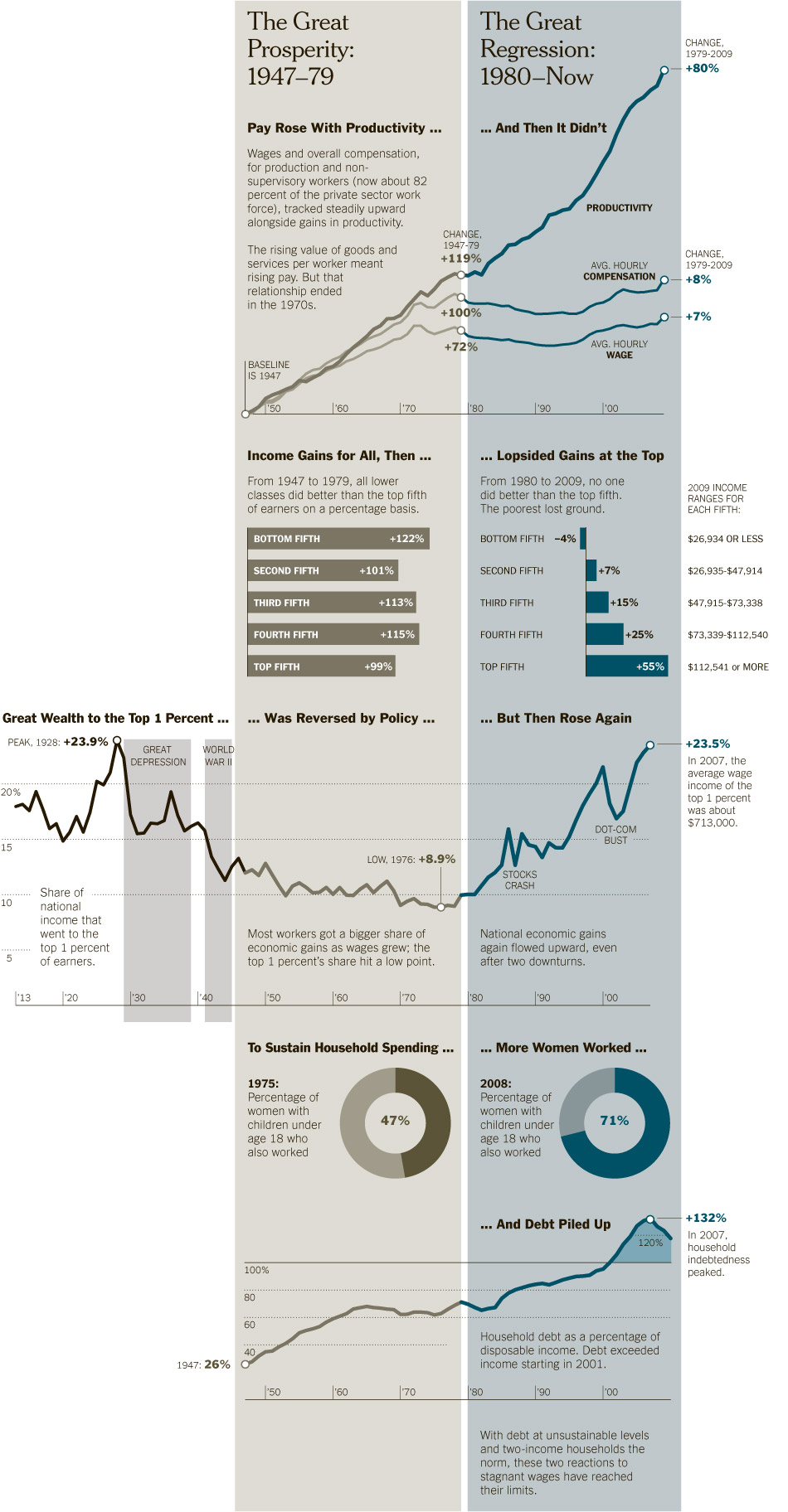
And finally, a superb example of giving insight into long-term trends using well-designed data visualisation: The Great Prosperity (1947-79) and The Great Regression (1980-2009)


(Click for full version)

– Transmission finally ends

Categories
Special

Things July 2017: Archive Adventures – part 1

In November, Things will be 10 years old. Since the beginning, I’ve collected an archive of interesting things, and at various intervals then created Things out of that archive. I tend to collect slightly more things than I publish, so the archive has grown. Rather than cull it, I’m going to just put them all out in two big catch-up editions. In this edition: Stories, Technology, Imagery, and all the Puzzles. This is going to be intense!

This Just In

Before I get to the archive, a couple of recent things.

Damien Henry’s video for Steve Reich’s “Music for 18 Musicians” makes excellent use of machine learning for art. Using video shot from a moving train, an algorithm learns how to predict what the next frame will look like. Every 20s into the video the amount of learning used increases. The result is fascinating, and perfectly complements the music. You can skip through the video to get an idea of the effect, but it’s best played in full!

There is an awkward vein of humour in which comedians interview (often) unsuspecting subject-matter experts in a non-serious manner (Philomena Cunk interviewing Brian Cox is one I don’t mind so much). Superficially, Werner Herzog sometimes takes a similar approach in his documentaries (noted in Things 118 in 2012, “Please describe an encounter with a squirrel”), but there is a hidden earnestness behind his questions. If you’ve never seen any of his documentaries, this excellent short clip on penguins shows you what you’re missing.

Stories

I think via Richard L, here’s an interesting piece on Plots not involving conflict.

In some stories/fables/myths the inciting incident or key point of drama is a character attempting to do something different to normal. In old stories, the character often fails and is punished, the moral being “know your place” (for example, the crow that tries to sing and in so doing drops a piece of cheese). In more modern stories, the character often succeeds and is rewarded. Is that generalisation true though? And what does it mean? I was going to collect examples of each and try to see a pattern, but never ended up doing that, so I’ll just leave it here as an unfinished thought.

The Cosmology of Serialised Television is an essay by David Auerbach which categorises long-running TV fiction by cosmological universe types: Steady State, Expansionary, Big Crunch. I didn’t find it particularly useful in terms of identifying solutions to the intrinsic storytelling problems of the medium, or even uncovering hidden gems (just the expected “Everything is terrible except for The Wire and Babylon 5“).

Still, it’s a lot of fun to read and nod along to, with some great terse summaries along the way, for example:

“So comics evolved by directing creative effort away from any moments of quality and toward large-scale creative bankruptcy”

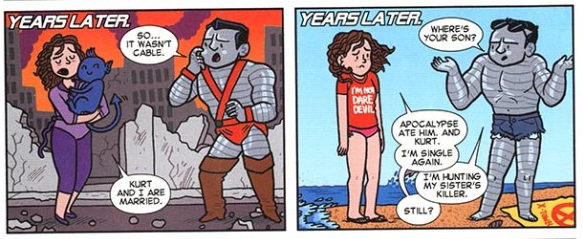
See Maris Wicks’ 16-panel summary of Kitty Pride’s relationship with Colossus (penultimate comic in this post [dead link, try here – T.M. 7/4/21]) for a great example of this.

Choose Your Own Adventure

One of my favourite kind of stories is any subversion of the “Choose your own adventure” format. Previously on Things I’ve linked to Luke Surl’s perfectly terse ‘Free Will‘ page. As an implied CYOA, this previously-linked Beaver and Steve comic also remains a classic.

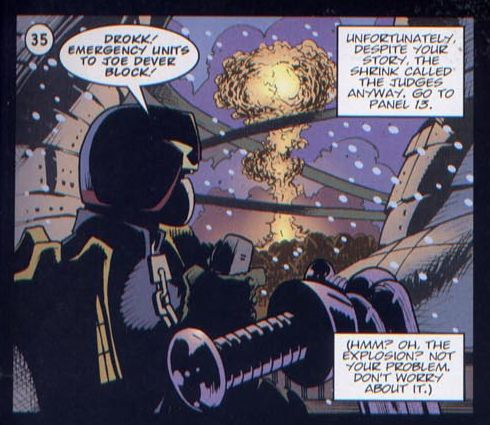
The “Prog 2012” issue of 2000AD featured a story called “Choose your own Xmas”, and subverts the format while also shattering the 4th wall. It’s completely brilliant but isn’t online so you’ll just have to trust me and buy or borrow it.

Viviane Schwarz also subverted the format beautifully to convey what it’s like to suffer from anxiety.

Working within the extraordinarily tight constraints of having a fixed panel and art layout, Ryan North still found a way to make a CYOA version of Dinosaur Comics.

Save The Date (recommended to me by Tarim and Richard L, available for free on Windows, Mac or Linux) leverages the Ren’Py ‘visual novel’ engine in a rather clever way, and if you’re interested in games and storytelling, have 30-60 minutes to spare, and can tolerate an apparently high rate of failure, you should give it a go. It could perhaps have delivered its message more elegantly at the “end”.

Also via Richard L, Trapped In Time (pdf) is a nice twist on the traditional choose-your-own-adventure format that leverages the format in a few interesting ways I’ve not seen before, and actually works very well as a pdf!

And I should mention this just in – browser-based interactive time travel fiction, One Night in Skegness, by Matheson Marcault (Holly Gramazio and Sophie Sampson). More time travel, but in a more relaxed way.

Technology

Perhaps surprisingly, a link about technology that sat in my backlog for 5 years has become more interesting with age. John B recommended the article, in which Alexis Madrigal laments that (in 2012), internet startups are just retreading the same ground and no longer promise to revolutionise our lives. John also pointed out the comment below the article by Urgelt (comment link doesn’t seem to work, wait for comments to load, which they often don’t, then find ‘Urgelt’ in the page). Urgelt more precisely categorises startups into those that grow the economy vs those that just take market share from existing businesses, and the issue is that most startups are falling into the latter category.

Both make a very interesting read 5 years further on, leading one to ask: has anything changed since then? Two trends jump to mind.

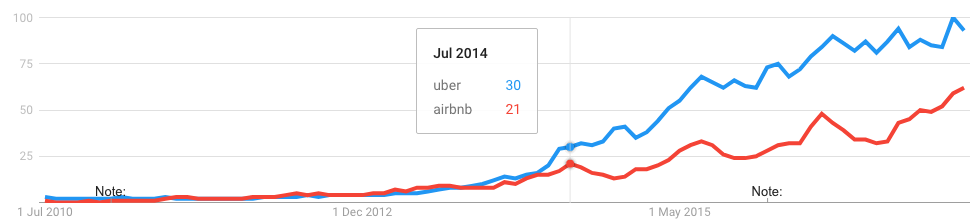
The Gig-economy-style startups (Uber, Deliveroo, AirBnB) suggest major changes, but might not actually scale. Uber charges around half of the true cost, subsidising the rest in a bid to achieve market dominance when driverless cars arrive; Deliveroo similarly rides an unsustainable cost/charge balance for much the same reason; only AirBnB arguably doesn’t fit into this category as the market sets the price.

Crowdfunding seems to be a more impressive development. In 2012, Kickstarter was just turning the corner, and Patreon is now in the ascendancy. From artists/game-makers that I follow, these services genuinely seem to be creating viable revenue-streams that were not previously available, to the benefit of culture in general. For example, Captain Disillusion (referenced in Things March 2015 and Things 17) was never mass-market enough for ad-revenue to be viable, but now raises sufficient money from Patreon to work on his videos pretty much full time.

In more “modern life is terrible” news, here’s an article from Cracked in late 2013 that is really just an enjoyably angry and sarcastic rant about clickbait content-farming. I remember at the time thinking that, if nothing else, the clickbait headline style would have to change as humans will fall for anything once, or maybe a hundred times, but eventually will develop a sort of semiotic herd-immunity to these well-dressed empty promises. Four years on… have things changed? Well, if nothing else, Facebook is at least attempting to deprioritise these sorts of headlines; more specifically, headlines that withhold key information, and headlines that senselessly exaggerate the content.

Imagery and Comics

Wondermark on the thought-experiment of money having a continuity rather than just being an abstract quantity of value. Wet owlsInopportunely placed stickers [Dead :\ – T.M. 4/7/21]. Bikes recreated (digitally) from drawings. The Door to Hell [Gone, try here – T.M. 4/7/21]  “They set the hole on fire, expecting it to burn itself out of fuel in a few days. Now, some 42 years later, it is still burning”.

Puzzles/Questions

Collecting all unused puzzles here is probably too intense, but I quite like that about it, so I’m doing it anyway.

1) 2D News

Sci/tech news is often quite one-dimensional, revealing a single scientific discovery or technological advancement at a time. As a thought-experiment, try combining two or more such stories from the past year into something amazing. For example, advances in drone technology + advances in ‘invisibility cloaks’ = army of invisible drones. Finding loads of other planets + anything = awesome.

2) Put Put boat

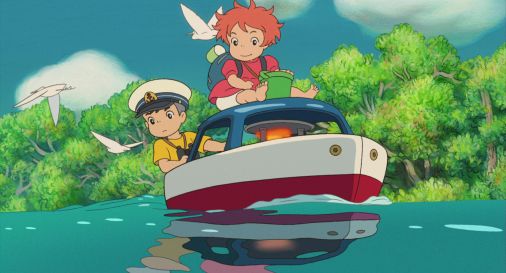
A toy Put Put boat has an amazingly simple heat engine, which you may recognise from the film Ponyo. A candle heats a small boiler; some water in the boiler vaporises but cannot escape, generating pressure that pushes the remaining water out a pipe. The momentum of the water keeps it pushing out, leaving the inside of the boiler with low air pressure. As a result, water then rushes back in, and the process repeats. Water thus repeatedly enters and exits a pipe pointed out the back of the boat, which then travels forward in a halting manner. The puzzle is this: why does the boat actually move forward, instead of just moving back and forth, given water is just going in and out?

3) Bernoulli vs the Train Window

In a similar vein to the Put Put boat, we have the Bernoulli train window problem. Bernoulli’s principle roughly states that faster moving air acts as if it has lower pressure. The classic demonstration is to hold a piece of A4 paper by one end in front of your chin so it droops downwards away from you; by blowing over the top, the pressure is reduced, and the piece of paper rises up due to the higher pressure underneath it.

A similar effect could be seen in an old-fashioned push-to-close narrow train window. If such a window was open and the train entered a tunnel, the window would slam shut. Or, would a shut one blow open? Depending on whether you take the perspective of the tunnel or the train, the faster moving air is on one side of the window or it is on the other. So which way does the window go?

4) Catbird seat

The Catbird seat is one of those puzzles I like because you can solve it with drawings and trigonometry, and then you can solve it better with simpler drawings and simpler trigonometry, and then you wonder if you can solve it in some kind of purely intuitive manner.

5) Shape of a Harp

When plucked, a longer taut string makes a deeper note. A harp has progressively longer strings to cover a range of notes. However, even though the interval between each note is the same, the length of the strings does not change linearly, or even following a simple curve, but rather an S-curve. Why is that? I thought this question might have a nice intuitive solution that could be reached by reason rather than by physics, but the answer is a bit more disatisfying, so this question remained in my backlog unasked. If you don’t want to figure it out (and my personal opinion is it’s not that interesting to do so), you can read about it here, although you’ll need the internet archive page for the harp citation.


Not a harp, but the principle is the same

– Transmission finally ends

Categories
New

Things September 2015: The Sea, Song Covers, Weather Reporting, Alphabear

Comic – The Deep Ones

A few thematically related thoughts have been freaking me out quietly but insistently for many years: the idea that, when in the sea, you are in the same body of water as sharks and giant squid; the imagined sensation of floating somewhere in the sea and sensing something vast swimming just beneath your feet; the idea that the sea has not been thoroughly explored and that monsters may truly lurk in deep trenches. This short comic, “The Deep Ones” by Julia Gfrörer explores these ideas quite poetically and insightfully.

Sample:


Music – Covers that that Trump Originals

Logistics note: reading through old editions of Things, about 50% of all YouTube videos I link to disappear after a couple of years. So I’m now including a link to a generic YouTube search that should work even if the one I chose has gone away.

While fully recognising that everything is subjective, especially music,  I hold that these covers are particularly notable.

Jose Gonzalez does “Hand On Your Heart”, sounds like he means it:
(In case of removed video, try this search)


In case you need reminding, here’s Kylie with the original:
(In case of removed video, try this search)


Similarly, Iron & Wine sings ‘Love Vigilantes’, a lovely and quite moving ballad about returning to family from war:
(In case of removed video, try this search)


That was New Order’s idea originally, but I’m just not as convinced by their version:
(In case of removed video, try this search)


Just in case it looks like I’m only into gentle acoustic covers, here’s something going the other way!

In Scott Pilgrim vs The World (a movie I will tell anyone that will listen is underrated right after I’ve tried to convince them to appreciate Speed Racer), Scott (Michael Cera) tries to impress Ramona (Mary Elizabeth Winstead) with a 30 second song he wrote about her:
(In case of removed video, try this search)

She tells him she can’t wait to hear it when it’s finished. That’s the joke.

The things is, this song is actually by Beck, which explains why it’s a surprisingly assured and satisfying chord progression – Beck contributed most of the original songs for the film. I like to imagine Beck saw this bit and thought “You know what, I will finish it” and came out with this:
(In case of removed video, try this search)


Weather-related newspaper headlines

(via Iain) I had wondered if there was a corollary to Betteridge’s law of headlines relating to the weather. I hadn’t noticed that the Daily Express was particularly fond of weather-related headlines, but quite brilliantly Scott Bryan compared a year of headlines against what actually transpired back in 2012. The post is no longer up but you can find it on the internet archive.


Libraries caught up with the future when I wasn’t looking

Back when people were getting excited about the advent of ebooks and digital audio books, I remember a lot of intense discussion about what this might mean for libraries.

Turns out that all the pieces came together, and you can now digitally borrow these things from your local library directly from your device, for free. (Perhaps more accurately, you’ve already paid for it with your taxes). I’ve been using the Overdrive app to do it and it’s really quite brilliant.

Two caveats. First, you very reasonably do have to join your local library in the first place to get an ID and PIN. Second, don’t be tempted to create an Overdrive account using Facebook, because if you later want to borrow an eBook and put it on a device that doesn’t run Overdrive, you’ll need to go through some icky business with ‘Adobe Digital Editions’ (because DRM), and that doesn’t work if you used Facebook.

On the topic of DRM, I’m still convinced it’s a terrible idea for digital purchases, but I think it’s pretty much essential to make this whole borrowing idea work, so I’m happy to accept it there.


Mobile games to try

Free-to-play mobile games are trying all sorts of strategies these days to find a business model that works (because straight paid on mobile sadly doesn’t). One model is to create a game that never really ends, is completely enjoyable without spending anything, and in which spending gains you a small advantage of some sort. These games don’t make a huge amount of money for the people that make them, and the flip side of that is that they can give you a lot of fun for very little money.

Alphabear is one such game. It’s a really lovely word-puzzle game with some nice strategy. There’s an ‘energy’ mechanic (you can only play a certain amount and need to wait for your ‘energy’ to come back), but you can buy ‘infinite honey’ which removes the energy thing entirely. So if you enjoy the game, you should definitely do that.

Breakneck is another, and takes the form of a twitchy high-speed sci-fi sort of endless runner, reminiscent of Wipeout. If your device is up to it, it’s a very polished experience at a ridiculously low price. (iOS only – sorry)

– Transmission ends